Introduction
Many people are surprised when they first try swimming by the intense exertion of water-based exercise—even just slowly swimming a few laps can quickly drive your heart rate up to levels comparable to fast running. Behind this lies profound physical and physiological reasons: water is about 800 times denser than air, and its viscosity is as much as 55 times higher than air. This means that when the body moves forward through water, the resistance it must overcome far exceeds that of land-based exercise. Understanding the science of drag in water not only explains swimming’s high oxygen consumption but also helps athletes and coaches identify the keys to improving efficiency.
The Three Main Sources of Drag in Water
Form Drag
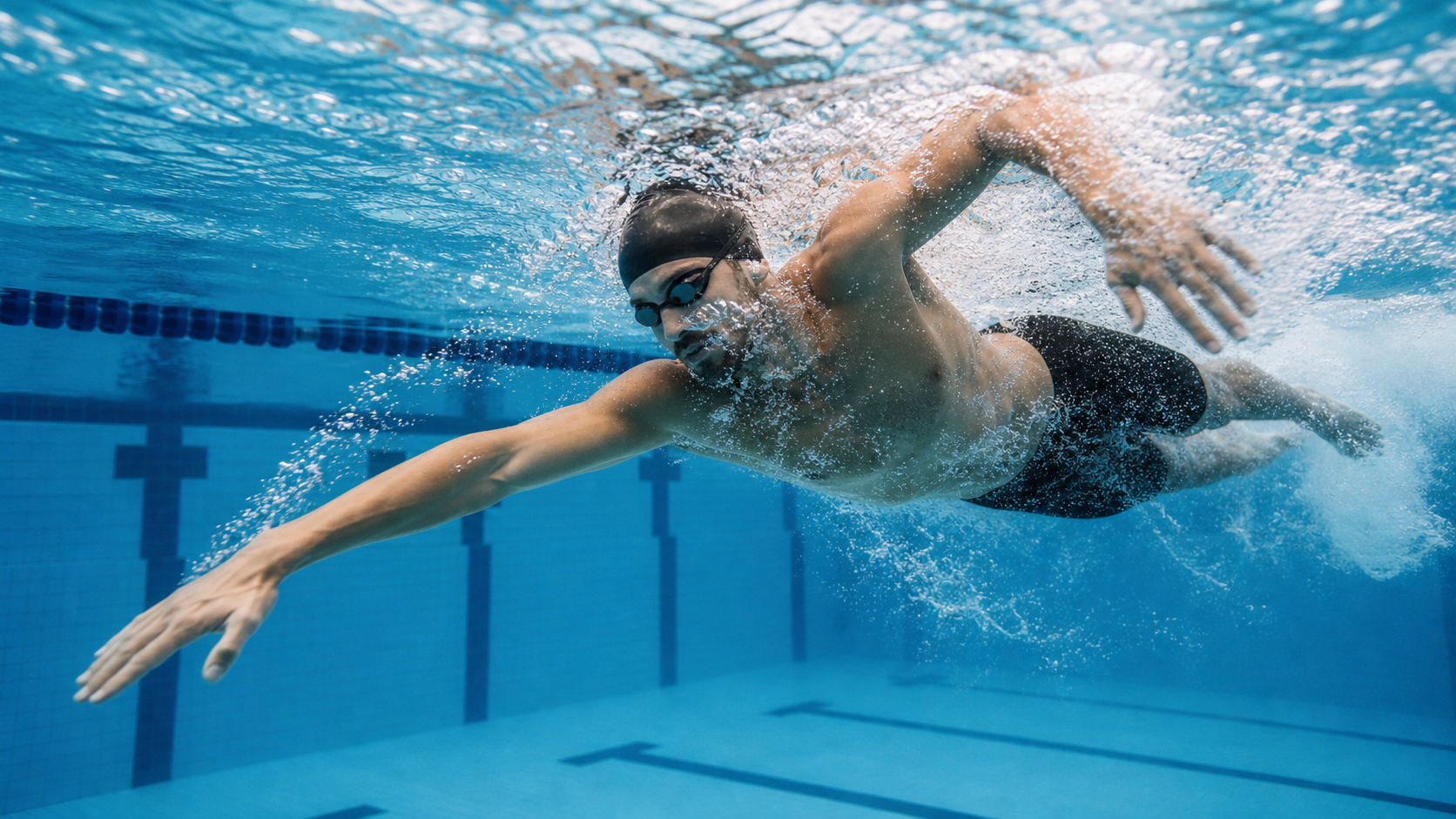
Form drag is the primary source of resistance, arising from the obstruction of water flow by the body’s cross-sectional area. When a swimmer has poor posture—such as sinking hips or holding the head too high—the frontal cross-sectional area increases, forcing water to flow around a larger “obstacle,” creating turbulence and wasting propulsive force. Research shows that elite swimmers have 20–30% lower form drag than amateur swimmers, with the main difference lying in the degree of horizontal alignment (streamlining) of the body position in the water.
Form drag is proportional to the square of velocity (F ∝ v²), meaning that when speed doubles, resistance increases to four times the original. This is precisely why sprinting over short distances consumes far more energy than long-distance easy swimming over the same duration.
Wave Drag
When the body swims near the water’s surface, it generates waves that consume significant energy. This is also why resistance is actually lower when swimming in deep water, and why competitive swimmers use underwater dolphin kicks after the start in butterfly to maintain speed—at that point, wave drag is nearly zero. Wave drag rises sharply at speeds exceeding 1.5 m/s, which is also one of the physical limits on human swimming speed.
Friction Drag
The larger the body’s surface area, the higher the friction with water. Competitive swimmers shave body hair and wear high-tech swimsuits (such as sharkskin materials) precisely to reduce surface roughness and lower frictional drag. Laboratory tests show that wearing a full-body racing swimsuit can reduce frictional drag by 5–10%.
| Drag Type | Main Contributing Factors | Reduction Methods |
|---|---|---|
| Form Drag | Body position, cross-sectional area | Core stability training, horizontal posture |
| Wave Drag | Speed, position at the surface | Underwater propulsion, reducing stroke rate |
| Friction Drag | Body surface area, roughness | Racing swimsuits, shaving body hair |
Swimming vs. Running: Oxygen Consumption Comparison
At the same speed, swimming’s oxygen uptake (VO₂) is approximately 4–6 times that of running. Even accounting for buoyancy reducing joint load, swimmers’ heart rates and overall metabolic rates remain significantly higher. The main reasons include:
- Involvement of full-body muscle groups: Swimming simultaneously engages the upper body, core, and lower body muscles, whereas running primarily uses the lower body—resulting in a greater total muscle mass being recruited
- Continuous resistance against drag: Every stroke must overcome a high-density medium, making muscular work efficiency far lower than land-based exercise in air
- Energy expenditure for thermoregulation: In cold water, the body must expend additional energy to maintain core temperature (discussed in a separate article)
- Breathing limitations: Inability to breathe freely at any time adds extra load on the respiratory muscles
Research data shows that the average oxygen consumption during a 1500-meter swimming race is approximately 55–65 mL/kg/min, approaching the VO₂max levels of elite marathon runners, yet the completion time is only 15–20 minutes—demonstrating the extreme metabolic intensity.
Practical Recommendations
For Taiwanese swimmers looking to improve swimming efficiency and reduce unnecessary energy expenditure:
- Prioritize improving body position in the water: A 5-centimeter drop in the hips can increase form drag by approximately 20%. After each training session, use short videos or coach observation to confirm body alignment
- Perform resistance training: Wear resistance pants or tow a drag chute to let muscles adapt to higher resistance, so that during main sets the reduced resistance becomes more noticeable
- Utilize underwater dolphin kicks: Maintain 5–7 meters of underwater dolphin kicking after every turn, using the zone where wave drag is lowest to preserve speed
- Reduce wave disturbance: Practice “quiet entry”—entering the water fingertips-first with minimal splash—indicating a smaller cross-sectional area and lower form drag
- Consider water temperature: In Taiwan, summer pool water temperatures often reach 29–31°C. Although warmer water reduces the extra energy needed for thermoregulation, excessive heat accelerates fatigue; it is recommended to maintain training water temperatures at 26–28°C
Conclusion
The reason swimming consumes more oxygen than running is fundamentally a physiological challenge created by the physical environment. Form drag, wave drag, and friction drag in water collectively determine propulsive efficiency, and optimizing stroke technique often reduces energy expenditure more effectively than simply increasing strength. In Taiwan’s swimming training culture, the mindset of “swim more, swim faster” should gradually give way to “swim right, swim fast”—understanding the science of drag is an essential subject for every advanced swimmer.
Related Reading
- The Science of Water Resistance in Swimming: Streamlining Technique and Energy Expenditure
- The Science of Water Resistance in Swimming: The Ratio of Form Drag vs. Friction Drag and Drag Reduction Strategies
- The Science of Water Resistance in Swimming: How Streamlined Posture Reduces Drag
- Swimming Drag Analysis: Wave Drag, Friction Drag, and Form Drag
#公路車 #Vo2Max #最大攝氧量 測驗 體驗 | 心肺測試
6 年前
一日北高前的西濱集訓 | 跟著11小時軍團 | 300W踩不動的大逆風 | 輪車破風差幾瓦?
6 年前
靠單車減肥35公斤 心得分享與整理
7 年前
戰略) Zwift Race 如何咬在第一集團 如何評估自己要開多少推力 (請開1.5倍速看)
7 年前
一日北高前的高裝檢 | 北高 360 | 挑戰11小時的裝備 | 一日雙塔 | 補給
6 年前
一日北高/長距離團騎 常見問題補充篇 / 組團或跟團的眉角 / 壯車友容易被瘦車友慢性拉爆 / 原來屁股痛可能是這個原因...? / 風場配速法 / 公路車 / CT Yeh
2 年前
水金九不厭五分 10度寒流冷到不願停!feat. 卡卡 / 公路車 / CT Yeh
6 個月前
3D 列印車褲墊 / 舒適改善? / 無痕 x 分區壓縮 / ATK & Decider系列 / JE22黑科技 / #公路車 #CTYEH
11 個月前