Introduction
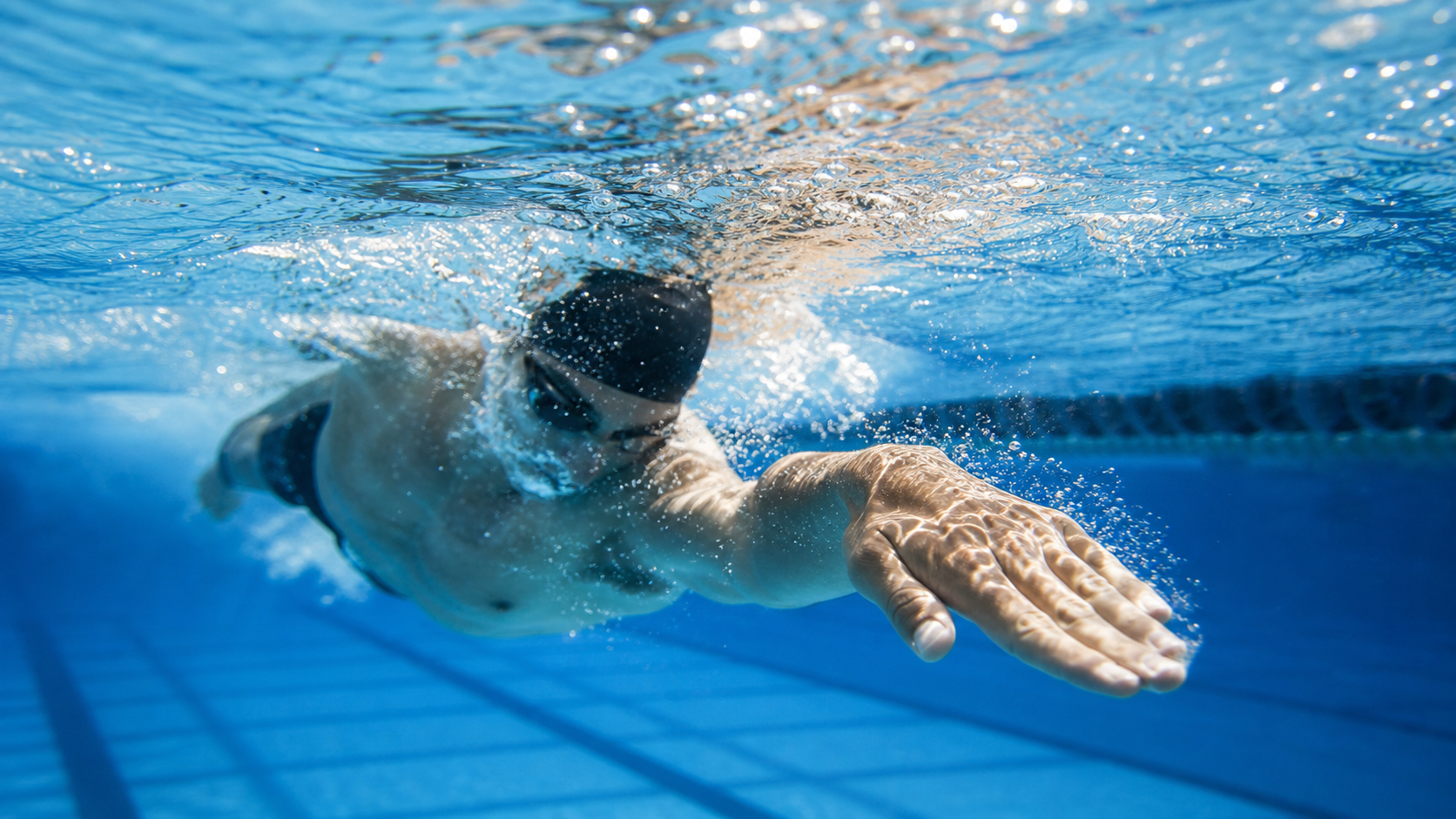
“He has great feel” — this is one of the highest praises in the swimming world for gifted athletes. The so-called “feel for the water” refers to a swimmer’s ability to keenly perceive the pressure distribution between the palm, forearm, and water, and to adjust the stroke motion accordingly in real time. For a long time, water feel was considered innate, but modern neuroscience research has clearly shown that water feel is a high-level integration of proprioception and tactile senses that can be strengthened through conscious training.
The Neurophysiological Basis of Water Feel
The Role of Skin Receptors
Multiple receptors are distributed throughout human skin, and the most important ones for swimming water feel are:
Merkel Cells: Sense sustained static pressure, allowing the palm to perceive the stable pressure distribution of water flow against the skin, corresponding to the “grip” sensation during the pull.
Meissner’s Corpuscles: Sense light touch and low-frequency vibration, densely distributed especially in the fingertips, and highly sensitive to subtle water flow changes at the moment of hand entry.
Ruffini Endings: Sense skin stretch, reflecting changes in tension distribution when the palm angle changes, allowing swimmers to perceive whether the angle of attack during the pull is optimal.
The density of tactile receptors in the palm (especially in the fingertip area) reaches 100–200 per square centimeter, making it one of the most sensitive tactile areas of the human body — which is why the palm is the core organ for swimming water feel.
The Proprioceptive System
In addition to skin receptors, receptors in the joint capsules (Ruffini endings, Pacinian corpuscles) and the muscle spindles and Golgi tendon organs in the muscles collectively provide the brain with real-time feedback on arm position, velocity, and force, allowing swimmers to precisely perceive the mechanical state of each stroke without relying on vision.
One of the biggest differences between elite and amateur swimmers is that the former have more refined sensorimotor integration circuits: they can detect subtle changes in water pressure within 50–100 milliseconds and automatically adjust wrist and elbow angles without any conscious intervention.
The Brain’s Sensory Map
The famous “Sensory Homunculus” in neuroscience shows that the cortical area allocated to sensory processing for the hands is larger than that for the entire torso. Swimming training is essentially a form of neuroplasticity training — repeated stroke practice strengthens the neural connections in the hand’s sensory cortex, making perception increasingly precise.
| Receptor Type | Perceived Content | Swimming Application |
|---|---|---|
| Merkel Cells | Sustained pressure | “Grip” sensation, confirming pull propulsion |
| Meissner’s Corpuscles | Light touch, low-frequency vibration | Water flow perception at hand entry |
| Ruffini Endings | Skin stretch | Angle of attack feedback during the pull |
| Muscle Spindles | Changes in muscle length | Stroke speed perception |
| Golgi Tendon Organs | Tendon tension | Monitoring propulsive force |
Scientific Methods for Water Feel Training
Sensory Deprivation Drills
Swimming with eyes closed is one of the simplest and most effective methods for enhancing water feel. Removing visual information forces the brain to rely more on tactile and proprioceptive input, improving sensitivity to palm pressure perception. Research shows that swimming 50–100 meters with eyes closed 2–3 times per week for 6 consecutive weeks significantly improves athletes’ accuracy in perceiving the angle of attack during the pull.
Glove Contrast Training
First swim a distance wearing insulating gloves (reducing tactile sensitivity), then swim the same distance with bare hands. The strong perceptual contrast quickly awakens the brain’s attention to palm pressure and reinforces the neural circuits.
Ultra-Slow Stroke Drills
Perform stroke drills at an extremely slow pace (1/3 of normal stroke speed), giving the brain enough time to process the sensory input from each phase of the movement. This is the swimming application of “deliberate practice”: trading speed for perceptual quality rather than relying on high-speed automated movements to get by.
Practical Recommendations
- Spend the first 10 minutes of each session warming up water feel: In 25-meter increments, alternate between deliberate attention swimming focused on “feeling palm pressure” to establish the day’s sensory baseline
- Fingertip Drag Drill: During the recovery phase, deliberately drag the fingertips along the water surface to strengthen arm position awareness and tactile preparation before hand entry
- Contrast testing with different hand shapes: Swim the same distance with a fist (zero water feel), open palm, and cupped hand respectively, using strong contrast to reinforce the brain’s sensory memory of the “correct hand shape”
- Water feel training after fatigue is especially valuable: During the technique set after the main workout, the nervous system’s fatigue reduces automation, forcing conscious perception and adjustment — this is when technical blind spots are most easily revealed
- Sensory recovery exercises after cold water immersion: After prolonged swimming in cold water, skin sensation becomes numb; upon exiting the water, perform fine finger sensory exercises (such as picking up small objects) to accelerate sensory nerve recovery
Conclusion
The essence of water feel is a highly specialized neural perceptual ability, built on the combined action of skin tactile receptors, joint proprioceptors, and the brain’s sensorimotor integration circuits. For Taiwanese swimmers, systematizing and consciously incorporating water feel training — rather than merely logging large volumes of swimming and hoping the feel develops by chance — is the key breakthrough for accelerating improvement. Neuroplasticity tells us: with the right training methods, everyone can cultivate a keener water feel.
Related Reading
- Aquatic Perception in Swimming: The Role of Proprioception in Learning Swimming Technique
- Swimming Feel for Water: What Is the Correct Perception of “Grip”
- Is Feel for the Water Pseudoscience? Making It Scientific with Sculling Drills
- Neuromuscular Coordination in Swimming: Learning and Automating Aquatic Movement Patterns
[教學] Premiere 影片 手震 修正 教學 防抖 單眼 影像 GoPro 穩定 Video Stabilization
8 年前
#公路車 #Vo2Max #最大攝氧量 測驗 體驗 | 心肺測試
6 年前
一起升級!海鷗盃LSD團練...JJSC Zone2招待 騎到手抖 / 公路車 / CT Yeh
1 天前
西進武嶺 自製新版AI配速表產生器 x 賽前攻略 抱佛腳! 沒有功率計也可以產生配速表嗎?有什麼其他眉角賽前要注意的呢? | 西進武嶺 / 東進武嶺 KOM 攻略 | 公路車 | CT Yeh
4 年前
3D 列印車褲墊 / 舒適改善? / 無痕 x 分區壓縮 / ATK & Decider系列 / JE22黑科技 / #公路車 #CTYEH
11 個月前
#PUSHBIKE 原來這麼好玩! 小朋友 滑步車 初體驗 超可愛
6 年前
西進武嶺 免費訓練分析服務 Intervals | 練不夠還是練過頭?你哪一種類型選手?AI模型告訴你! | 備戰神器 | 公路車 訓練 | CT Yeh
4 年前
Insta 360 One 超級防手震技術實測
7 年前