Complete Guide to Knee Pain While Cycling: Distinguishing Patellar Tendinitis from IT Band Syndrome
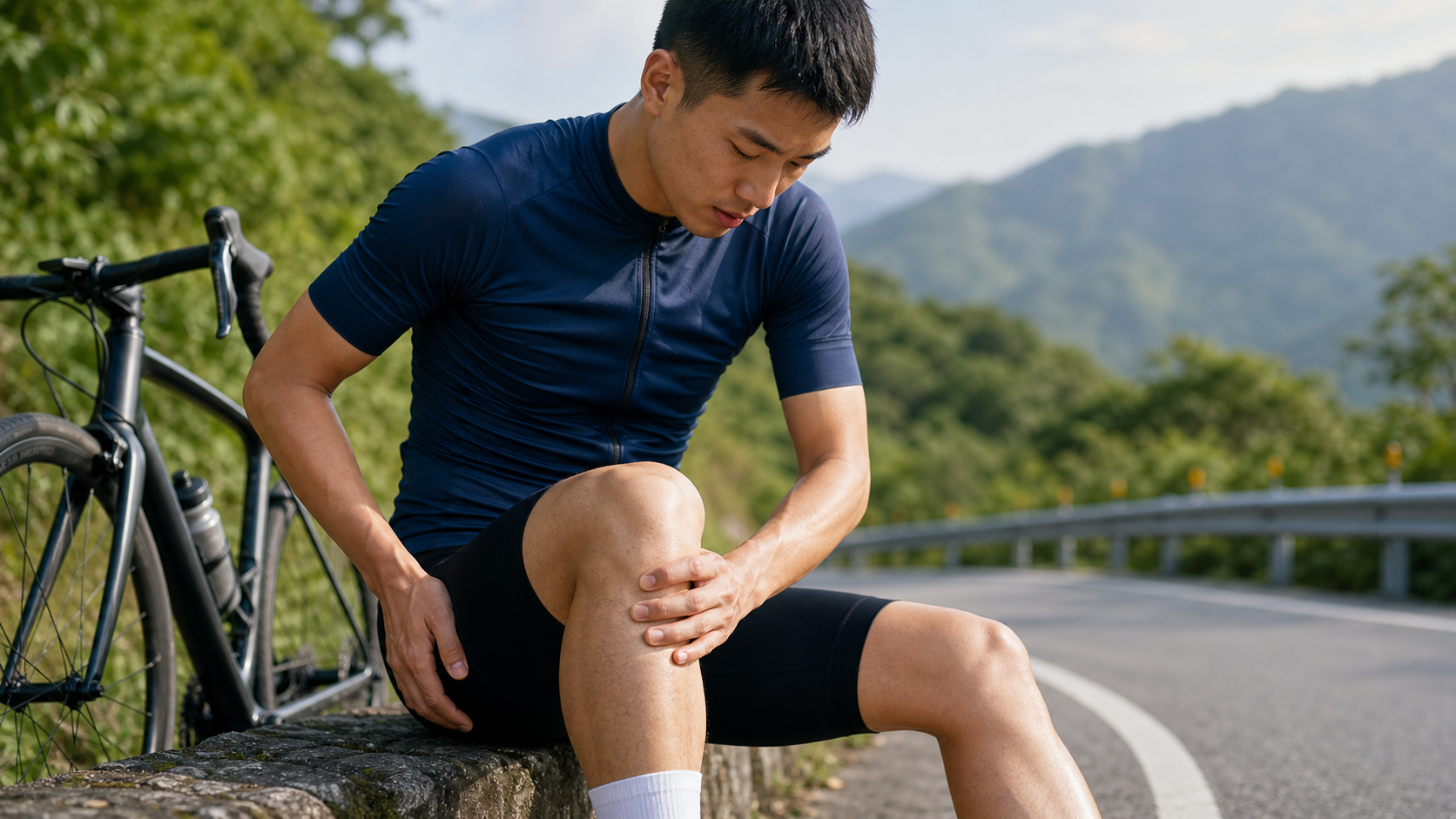
Introduction
Knee pain is a nightmare that almost every serious cyclist has faced. According to sports medicine statistics, approximately 40% of cyclists have experienced knee discomfort, with Patellar Tendinitis and Iliotibial Band Syndrome (ITBS) being the most common. Although these injuries occur in similar locations, they have fundamentally different causes and treatments; confusing them often delays recovery.
Key Anatomical Differences
To distinguish between these two injuries, you must first understand their anatomical locations:
| Injury Type | Pain Location | Affected Group | Primary Cause |
|---|---|---|---|
| Patellar Tendinitis | Directly below the kneecap (inferior pole of the patella) | Climbers with high cadence | Low cadence, heavy gear ratios, saddle too low |
| Iliotibial Band Syndrome | Lateral side of the knee (near the lateral femoral condyle) | Long-distance endurance riders | Saddle too high, wide Q-factor, weak hip abductors |
Patellar Tendinitis pain is concentrated at the tendon attachment point directly below the kneecap, worsening significantly when going up or down stairs or squatting. During cycling, the patellar tendon experiences maximum tension at a knee flexion angle of approximately 70–90° during the pedal stroke. If cadence is low (below 75 rpm), gear ratios are too heavy, or the saddle position is set too low, the burden on this tendon increases significantly.
Iliotibial Band Syndrome pain appears on the lateral side of the knee, most notably when the pedal stroke causes knee flexion of approximately 30°—the angle where friction between the IT band and the lateral femoral condyle is most intense. Repeated thousands of pedal cycles during riding allow this friction to accumulate into chronic inflammation.
Diagnostic Methods and Self-Assessment
Here are the key clinical points for distinguishing between the two injuries:
Identifying Patellar Tendinitis
- Tenderness Point: Pressing on the lower edge of the patella causes distinct localized sharp pain
- Functional Test: Pain in the front of the knee worsens during a single-leg squat
- Morning Symptoms: Stiffness upon first walking after waking up, slightly relieved after movement
- Cycling Pattern: Pain worsens after climbing long hills and is relatively reduced at high cadence on flat ground
Identifying Iliotibial Band Syndrome
- Tenderness Point: Severe pain when pressing 2 cm above the lateral bony prominence (lateral femoral condyle) of the knee
- Ober Test: Lying on the side to perform IT Band stretch test; if the thigh cannot drop below horizontal, it indicates a tight IT band
- Cycling Pattern: Worsens after long rides on flat roads, especially when riding into a sustained crosswind or with a road bike pedal stance that is too everted (outwardly rotated)
- Accompanying Symptoms: The lateral buttock (gluteus medius area) often feels tight
Vehicle Setup Adjustment Strategies
The root cause of many knee injuries stems from incorrect Bike Fit settings. Below are adjustment recommendations for each injury:
Treating Patellar Tendinitis:
- Raise saddle height by 3–5 mm (adjust incrementally and observe response)
- Move saddle position slightly backward to reduce anterior knee displacement at the top of the pedal stroke
- Increase cadence to 85–95 rpm to reduce tendon tension per pedal stroke
- When using SPD pedals, check the fore/aft position of the cleat (Ball of foot aligned with pedal axle center)
Treating Iliotibial Band Syndrome:
- Lower saddle height by 3–5 mm to avoid excessive pelvic rocking at the bottom of the pedal stroke
- Check pedal Q-factor; a wide axle distance increases IT Band stretch tension
- Adjust cleat angle to allow 3–5° of float (movement), allowing the knee to align naturally
Practical Advice
Training Volume Management:
- Follow the “10% Rule”: Increase weekly riding volume by no more than 10% to avoid excessive load
- Immediately reduce volume by 50% upon experiencing knee pain; do not push through
- Perform dynamic warm-ups before riding (leg swings, hip circles) and static stretching after riding (quadriceps, IT Band, glutes)
Strength Training:
- Patellar Tendinitis: Focus on strengthening quadriceps; recommend “Wall Sit Isometric,” 45 seconds per set, 3 sets daily
- IT Band Syndrome: Focus on strengthening gluteus medius; recommend “Clamshell” and “Side Walking with Resistance Band” training, 2–3 sets daily
When to See a Doctor
If the following situations occur, it is recommended to seek medical attention from a sports medicine department or orthopedic specialist promptly:
- Pain persists for more than 2 weeks without improvement
- Significant swelling appears in the knee
- Pain persists even at rest
- Night pain affects sleep
Conclusion
Knee pain is not a fate for cyclists; in most cases, there is a clear biomechanical cause that can be traced. While Patellar Tendinitis and Iliotibial Band Syndrome appear similar, they require entirely different adjustment strategies. The most common mistake among Taiwanese riders is adjusting the saddle “by feel,” ignoring the overall balance of the kinetic chain. It is recommended that every serious cyclist undergo professional Bike Fit regularly and seek evaluation from a sports medicine specialist when discomfort arises, so that cycling becomes a long-term healthy partner rather than a source of injury.
Related Topics
- Cyclist Knee Pain: Distinguishing and Treating Anterior Knee, Posterior Knee, and Iliotibial Band
- Iliotibial Band Syndrome in Cyclists: Prevention and Treatment of Lateral Knee Pain
- Tendinitis Prevention and Recovery for Cyclists: Complete Guide for Knee, Achilles, and IT Band
- Complete Prevention and Rehabilitation Guide for Iliotibial Band Syndrome (IT Band)
一日北高常見問題大集合 | 攻略 | 路線 | 訓練 | 補給 | 自行車 單車 | 一日雙城 | 雙塔 | TWB北高360 | 屁股痛
6 年前
2022台北國際自行車展 訓練台 試騎心得大全 差點腿軟走出! 元宇宙武嶺!| Garmin Tacx Oreka Xpedo Wahoo | 公路車 | CT Yeh
4 年前
一日北高/長距離團騎 常見問題補充篇 / 組團或跟團的眉角 / 壯車友容易被瘦車友慢性拉爆 / 原來屁股痛可能是這個原因...? / 風場配速法 / 公路車 / CT Yeh
2 年前
高雄綠園道鐵路自行車道 / 外地人能輕鬆駕馭 還是整路崩潰? / 2025 全線開通 春節實地探索一次!(附GPS連結)/ 公路車 / CT Yeh
1 年前
多到選擇障礙... 換個單車把帶想一個小時 / BTP / 編織&軟木特有材質超吸睛! / 公路車 / CT Yeh
1 年前
#公路車 #Fitting 靠人工智慧APP 幫你調整單車
6 年前
單車AI教練!全新 ChatGPT4o 幫你分析訓練成果!排武嶺課表,分析騎車姿勢! 太神了! / 公路車 / CT Yeh / feat. 緯緯
2 年前
超開放的自行車錶!可以玩遊戲裝APP!?/ SRAM合併的 Hammerhead Karoo深入開箱!/ 即時爬坡偵測 / 全球導航地圖 / Garmin Bryton / CT Yeh
1 年前