Introduction
Saddle discomfort is one of the most awkward yet widespread problems in cycling. Studies suggest roughly 40-50% of male cyclists have experienced perineal numbness, and over 30% of female riders report vulvar discomfort. These symptoms are by no means something to simply “ride through” — prolonged perineal compression can cause nerve damage and circulatory impairment, and in men, has even been linked to sexual function issues.
The Anatomical Mechanism of Perineal Compression
While cycling, most of the body’s weight concentrates on the two bony protrusions of the ischial tuberosities (the “sit bones”), which ideally should be the primary weight-bearing points. However, when riding posture is overly forward-leaning, saddle height is improper, or the saddle shape doesn’t match individual anatomy, weight shifts to the perineal triangle in front of the sit bones, directly compressing the following important structures:
| Structure Compressed | Consequences | Gender Differences |
|---|---|---|
| Pudendal Nerve | Numbness, tingling, reduced sensation | Present in both sexes, with slightly different pathways in women |
| Pudendal Artery and Vein | Localized ischemia, erectile dysfunction (men) | More significant impact in men |
| Perineal Body | Tissue damage, inflammation | Women’s vestibular bulbs are more vulnerable |
| Prostate (men) | Prostate irritation, urination issues | Men only |
Research shows that under a standard riding posture, a conventional saddle can subject the perineal area to pressure as high as 25-30% of total body weight — if riding exceeds 3 hours, local tissue may develop ischemic damage similar to early-stage pressure sores.
The Scientific Approach to Saddle Selection
Measuring Sit Bone Width
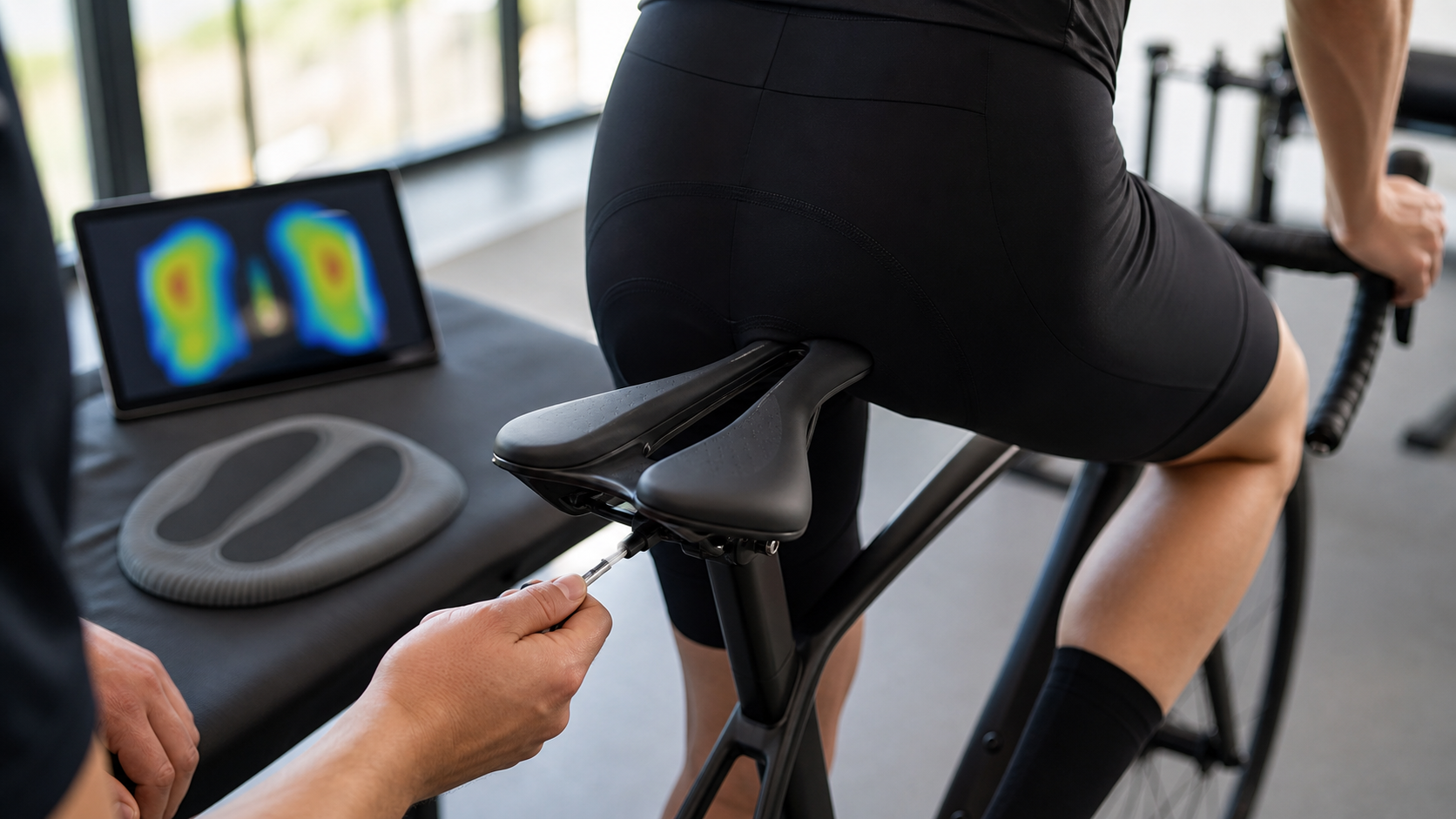
The most important biomechanical parameter in saddle selection is sit bone spacing. Ischial tuberosity width varies by individual, typically ranging from 90-140mm. Professional bike shops offer gel pad measurement services where the rider sits on an impression pad to leave a pressure indentation, allowing precise measurement of sit bone spacing.
Saddle width selection principles:
- Effective saddle support width = sit bone spacing + 20-30mm
- Aggressive riding position (larger forward lean angle) → can choose 10-15mm narrower
- Comfort-oriented position (more upright) → can choose 0-5mm narrower
The Benefits of Center-Channel Saddles
Saddles with a central channel design have been confirmed by multiple studies to effectively reduce perineal pressure. A 2006 study published in the Journal of Sexual Medicine showed that using a center-channel saddle reduced perineal compression by approximately 82%, significantly improving perineal blood oxygen supply.
However, not all channel designs are equivalent:
- Narrow, long channel: suitable for a moderate forward-lean position, effectively reduces urethral pressure
- Wide opening: suitable for female riders, effectively protects the vulvar area
- Fully noseless saddle: offers the best prostate protection but poorer handling control, suitable for leisure riding
Differences Between Men and Women
Key points for men’s saddle selection:
- The nose of the saddle should be thin enough to reduce groin friction while riding
- The center channel should extend to over the front 1/3 of the saddle
- Avoid a saddle design with an upturned tail, which can cause posterior pelvic tilt
Key points for women’s saddle selection:
- Sit bone spacing is generally wider than men’s, typically requiring a wider saddle
- The distance from the front of the sit bones to the pubic symphysis is shorter, so a design with a deeper rear support is preferable
- Some women are suited to noseless or short-nose designs, which effectively protect the vestibular area
Riding Posture Adjustment and Saddle Setup
Saddle tilt angle:
- The saddle should remain level or with the nose tilted slightly down 1-3°
- A saddle nose that’s too high is the most common setup error causing perineal compression
- Use a digital level or professional bike fit software to confirm the angle
Saddle height:
- The optimal knee extension angle is 25-35° of knee flexion at the bottom of the pedal stroke
- Saddle too low → anterior pelvic tilt → pubic bone presses against the saddle nose → sharply increased perineal pressure
Fore-aft saddle position:
- Using “Knee Over Pedal Spindle” (KOPS) as a reference, a vertical line from the center of the kneecap should align with the center of the pedal spindle
- Saddle positioned too far forward → pelvic instability, continued forward sliding → sustained perineal compression
Practical Recommendations
Daily care:
- Wear quality cycling shorts (bib shorts), choosing a style with minimal seams positioned away from the sit bones
- Use chamois cream to reduce friction, especially before long-distance rides
- Avoid wearing cotton underwear under cycling shorts
- Change clothes as soon as possible after riding, keeping the perineal area ventilated and clean
Riding habits:
- On long rides, stand and pedal for 30 seconds every 30-45 minutes to restore blood circulation to the tissue
- If numbness occurs, immediately switch to standing pedaling — if numbness persists beyond 10 minutes without resolving, shorten the ride
When to seek medical attention:
If the following occur after riding, it’s recommended to see a urologist or gynecologist:
- Numbness persisting for more than 24 hours
- Difficulty achieving erection in men
- Persistent vulvar pain or swelling in women
- Difficulty urinating or urinary urgency
Conclusion
Saddle selection is one of the most underestimated aspects of cycling health. There’s no such thing as “the best saddle” — only “the saddle best suited to your own anatomy.” Riders in Taiwan are encouraged to measure their sit bone width before purchasing a saddle, and to test-ride different models at a professional bike shop. Investing in the right saddle not only makes riding more comfortable — it’s an important decision for protecting long-term nerve and vascular health.
單車胎壓觀察到的有趣現象,SRAM Quarq TyreWiz 2.0 無內胎胎壓計 / 裝了有哪些幫助? / Tubeless / 公路車 / CT Yeh
1 年前
靠單車減肥35公斤 心得分享與整理
7 年前
再一組! 全碳幅條 碟煞/無內胎輪組 開箱! 到底好騎嗎? UNAAS X40 | 公路車 | CT Yeh
4 年前
一日北高/長距離團騎 常見問題補充篇 / 組團或跟團的眉角 / 壯車友容易被瘦車友慢性拉爆 / 原來屁股痛可能是這個原因...? / 風場配速法 / 公路車 / CT Yeh
2 年前
#公路車 #Fitting 靠人工智慧APP 幫你調整單車
6 年前
鉅齒紋輪組!? ControlTech MEG-T50 EVO 碳纖維幅條輪組/ 功率對比實驗 / 公路車 / CT Yeh
2 年前
Nepest NOVA 碳條輪組:輕量、空力、舒適一次滿足!/ 公路車 / CT Yeh
7 個月前
3D 列印車褲墊 / 舒適改善? / 無痕 x 分區壓縮 / ATK & Decider系列 / JE22黑科技 / #公路車 #CTYEH
11 個月前