Introduction
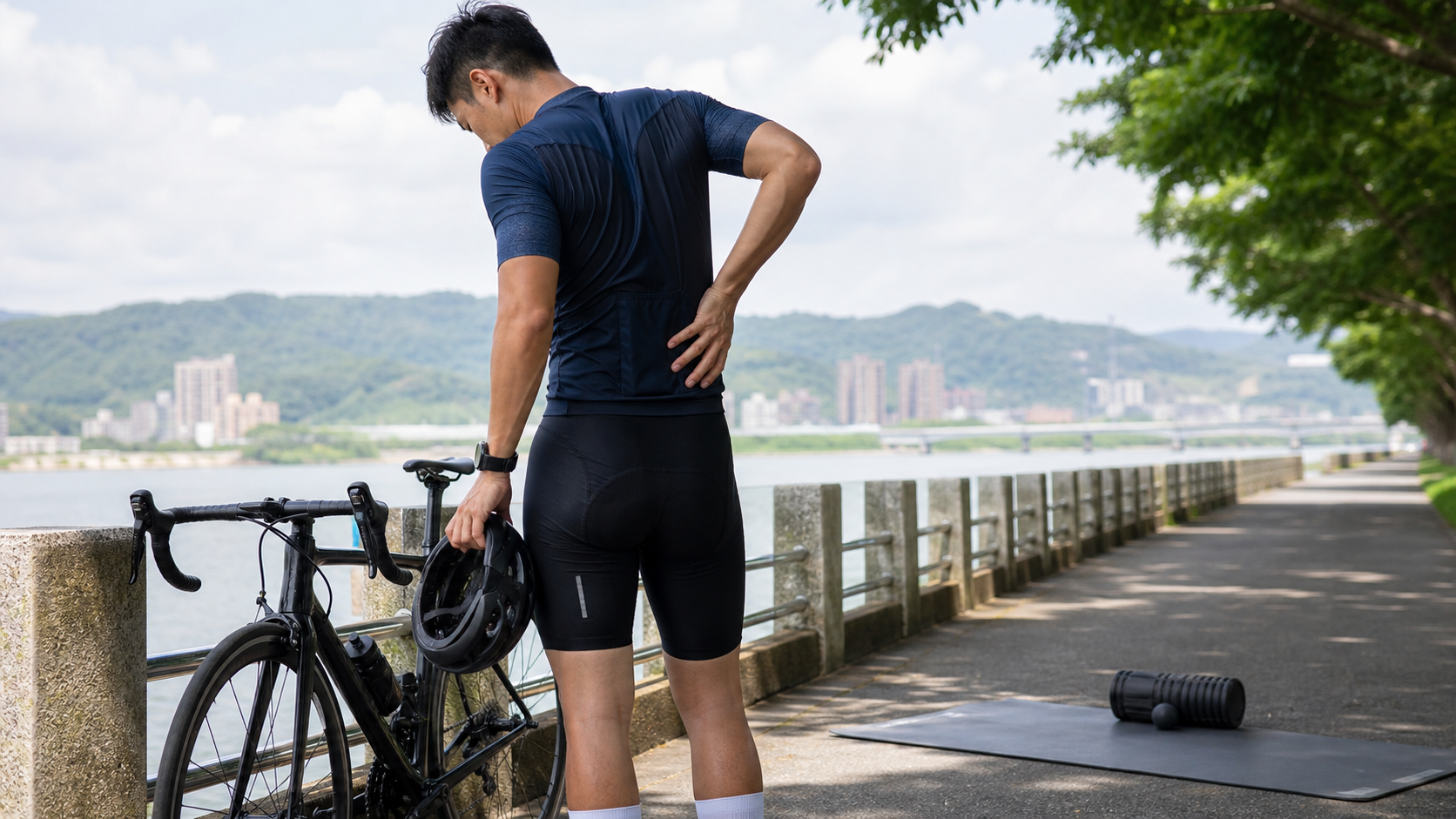
“Sore lower back after a ride” is a common complaint among the cycling community in Taiwan. Low back pain is the second most common injury in cycling, after knee problems, with a prevalence as high as 58% among long-distance cyclists (over 200 km per week). Regrettably, many cyclists consider lower back pain a “normal cost” of riding, only seeking help when it evolves into a chronic lumbar injury.
Main Causes of Lower Back Pain
Cycling-induced lower back pain typically involves multiple factors, which can be analyzed using the following framework:
| Cause Category | Specific Issue | Commonly Affected Group |
|---|---|---|
| Insufficient Core Muscles | Transversus abdominis and multifidus unable to maintain lumbar stability | Beginners, cyclists with sedentary office jobs |
| Tight Hip Flexors | Overly tight iliopsoas leading to anterior pelvic tilt | Cyclists who sit at a desk for long hours |
| Compensatory Posterior Pelvic Tilt | Caused by a saddle that is too high or insufficient ischial flexibility | Male cyclists with poor flexibility |
| Lumbar Facet Joint Compression | Sustained forward-leaning posture compresses posterior lumbar structures | Cyclists using an aggressive road bike position |
| Leg Length Discrepancy | Cyclic pelvic rotation during pedaling | Those who haven’t had a bike fit |
The Chain Reaction of Insufficient Core Muscles
During cycling, the lumbar spine needs to maintain a moderate lordosis to distribute spinal pressure. When the core muscles—particularly the transversus abdominis and multifidus—are weak, the body recruits the superficial erector spinae to compensate, leading to increased compressive load on the lumbar spine and excessive fatigue in the erector spinae.
The longer the ride, the greater the core muscle fatigue, the more severe the compensation, and the more pronounced the posterior pelvic tilt (“cat back” posture) becomes. The pressure on the posterior part of the lumbar intervertebral discs continuously increases—this is the fundamental reason why “the further you ride, the more your back hurts.”
The Impact of Tight Hip Flexors
Many cyclists in Taiwan spend long hours sitting at a desk for work, keeping the iliopsoas muscle in a chronically shortened state. A shortened iliopsoas increases the anterior pelvic tilt angle. When cycling, maintaining a forward-leaning posture is also required. The superimposition of these two anterior tilt forces creates lumbar hyperlordosis, placing abnormal stress on the lumbar facet joints.
Assessing Your Own Core Condition
Here are a few simple self-assessments you can do at home:
Plank Test:
- Perform a prone plank and observe if you can maintain the position for 90 seconds without sagging your lower back or lifting your hips.
- If you cannot reach 60 seconds, your core needs strengthening.
Thomas Test:
- Sit on the edge of a bed, hug one knee to your chest, and let the other leg hang down naturally.
- If the thigh of the hanging leg cannot drop below the horizontal line, it indicates tight hip flexors.
Functional Movement Assessment:
- Perform a squat and observe if your pelvis tilts posteriorly (“butt wink” during a squat).
- If your pelvis tilts posteriorly when your thighs are parallel to the ground, it indicates insufficient hip joint mobility.
Core Training and Flexibility Improvement
Deep Core Activation (Do Daily):
- Diaphragmatic Breathing Activation: Lie on your back with knees bent. Inhale slowly, allowing your abdomen to expand. As you exhale, gently draw in your lower abdomen (like tightening a belt). Maintain this contraction while breathing normally for 5 minutes each session.
- Bird-Dog: Start on all fours. Extend opposite arm and leg (right arm, left leg) diagonally while keeping your lumbar spine in a neutral position. Hold for 5 seconds, then switch sides. Perform 10 repetitions per set, 3 sets daily.
- Glute Bridge: Lie on your back with knees bent. Slowly lift your pelvis until your thighs and torso form a straight line, emphasizing the contraction of the gluteus maximus. Hold for 5 seconds, then slowly lower. Perform 10 repetitions per set.
Hip Flexor Stretches:
- Lunge Stretch: Assume a deep lunge position with the back knee on the ground. Push your pelvis forward, feeling a stretch in the front of the thigh and groin area. Hold for 30 seconds per side, 3 sets daily.
- Couch Stretch: Elevate your back foot onto a chair seat. Keep your body upright to intensely stretch the iliopsoas. Hold for 60 seconds per side.
Bike Setup Adjustments:
- A saddle that is too high causes the pelvis to shift alternately to both sides at the bottom of the pedal stroke, triggering cyclic lumbar torsion. Consider lowering it by 3–5 mm.
- If the saddle’s fore-aft position is too far back, the body’s center of gravity shifts rearward, increasing pressure on the posterior lumbar spine. Consider adjusting it slightly forward.
- Switch to a shorter stem to reduce the forward lean angle, making it easier for the core muscles to maintain stability.
Practical Advice
Strategies During the Ride:
- Consciously “reset” your riding posture every 30 minutes: take a deep breath to expand your ribcage, exhale while drawing in your abdomen, and feel a slight core activation.
- Briefly adopt a more upright posture when climbing to give your lumbar spine a rest.
- Replenish electrolytes appropriately during long rides; hyponatremia and hypomagnesemia can accelerate muscle fatigue and spasms.
Pre-Ride Preparation:
- Perform a 5–10 minute dynamic warm-up before riding, specifically including hip rotation and thoracic spine rotation movements.
- Avoid going on a long ride directly after sitting at a desk for over 8 hours. It is recommended to move around for 20 minutes first.
Conclusion
Lower back pain is one of the most preventable injuries for cyclists. Core strengthening exercises don’t require complex equipment. With 15–20 minutes of targeted training daily, significant improvement can be felt within 3–4 weeks. Incorporating core training into your daily routine is not just a solution for lower back pain, but an investment in enhancing cycling efficiency—a strong core allows pedaling power to be transmitted more effectively, enabling you to ride faster, farther, and more comfortably.
Related Topic Reading
- Lower Back Pain from Cycling: Management Strategies for Core Strengthening and Riding Posture Adjustment
- Lower Back Pain and Cycling: Cause Analysis, Posture Correction, and Long-Term Solutions
- Post-Cycling Lower Back Pain: A Comprehensive Analysis of Core Weakness, Frame Geometry, and Handlebar Height
- Common Back Pain Caused by Cycling: Cause Analysis and a Complete Rehabilitation Plan
一日北高/長距離團騎 常見問題補充篇 / 組團或跟團的眉角 / 壯車友容易被瘦車友慢性拉爆 / 原來屁股痛可能是這個原因...? / 風場配速法 / 公路車 / CT Yeh
2 年前
一日北高常見問題大集合 | 攻略 | 路線 | 訓練 | 補給 | 自行車 單車 | 一日雙城 | 雙塔 | TWB北高360 | 屁股痛
6 年前
CT 喇低賽) 單車 比賽總是沒照片? 攝影師的觀點大公開 姿勢就是力量! 請加速1.25倍收看
7 年前
摔車後補裝備: 好市多新款單車安全帽& Specialized Romin 北高整路屁股都不痛的坐墊 | 一千元居然有MIPS | CT Yeh | 公路車
4 年前
靠單車減肥35公斤 心得分享與整理
7 年前
碟煞公路車 銑面器 !? 原來銑完差這麼多! 降低蹭碟機率! | TIME 公路車 保養小記錄 | CT Yeh
3 年前
#公路車 #Fitting 靠人工智慧APP 幫你調整單車
6 年前
單車 一日北高 ( 雙城 ) 肥宅雙人瘋狂行 紀錄片 REACTO
10 年前