Introduction
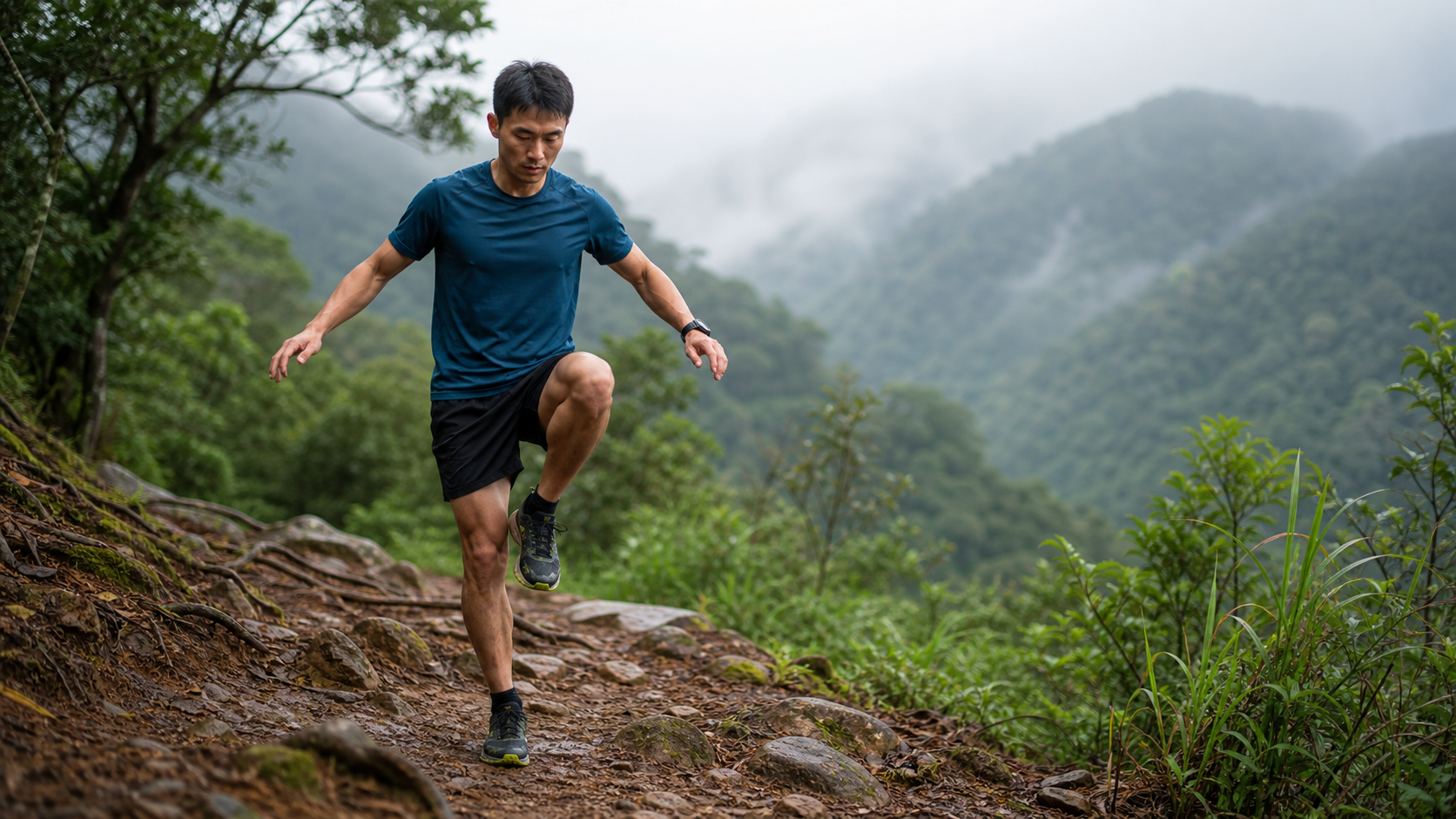
In Taiwan, trail running and mountain road running are becoming increasingly popular among runners. Compared to flat surfaces, the gravel, dirt, roots, and elevation changes on mountain trails place much higher demands on a runner’s balance. Even in regular marathon events, late-race fatigue often causes runners to experience unstable gait and ankle rolling.
Balance is the ability to perceive the body’s position (proprioception) and adjust posture accordingly. This ability can be significantly improved through training, yet the vast majority of runners’ weekly training plans completely lack this component.
The Connection Between Balance and Running Performance
Specific benefits of balance training for running:
- Reduced ankle sprains: Enhanced ankle proprioception and faster reaction times allow for quicker self-correction when landing unevenly
- Improved running form: The core and gluteus medius maintain pelvic stability more efficiently during single-leg support
- Control on mountain and trail terrain: Maintaining center of gravity stability on uneven ground to avoid falls from stepping on rocks
- Stability in late-stage fatigue: After balance training, the neuromuscular system can maintain stability even in a more fatigued state during the later stages of high-intensity exercise
| Balance Ability Level | Typical Movement | Primary Training Goal |
|---|---|---|
| Static Foundation | Single-leg stance | Establish proprioceptive foundation |
| Static Advanced | Single-leg stance with eyes closed | Reduce visual dependence |
| Dynamic Foundation | Single-leg mini squat | Functional stability control |
| Dynamic Advanced | Single-leg landing control | Running impact absorption |
| Functional Integration | Dynamic reaction while running | Real-world running application |
Progressive Static Balance Training
Level 1: Single-leg stance with eyes open
- Basic movement: Lift one leg with the thigh parallel to the ground while standing on the other leg
- Goal: Maintain for 30 seconds without swaying, without any support
- If unable to maintain for 10 seconds: First practice standing while holding a wall for support
Level 2: Single-leg stance with eyes closed
- Closing the eyes removes visual assistance, significantly increasing the proprioceptive challenge
- Goal: Maintain for 15–20 seconds
- Note: Keep a support object nearby to grab, safety first
Level 3: Single-leg stance on unstable surface
- Stand on a BOSU ball, balance board, or folded yoga mat
- Start with eyes open, then challenge with eyes closed once stable
Dynamic Balance Training
Single Leg Mini Squat:
- Stand on one leg, slowly bend the supporting knee to 30 degrees while keeping the pelvis level
- Observe whether the knee caves inward; if so, it indicates insufficient gluteus medius strength or control
- 12 reps per side × 3 sets
Star Excursion Balance Test:
- Stand on one leg and reach as far as possible with the toes of the other leg to the front, diagonal front, and directly to the side, then slowly return
- This movement serves as both an assessment tool and a training exercise
- 5 reaches per direction × 2 sets per side
Single Leg Landing:
- Jump from approximately 20cm in height and land on one leg
- Hold a stable position for 2–3 seconds after landing, observing whether the knee aligns with the toes
- If the knee caves inward significantly, strengthen the gluteus medius before continuing this training
Special Trail Running Preparation Movements
Specialized training for Taiwan’s mountain road runners:
- Walking on rocks: Walk slowly on cobblestone or uneven surfaces, barefoot or in minimalist shoes, to train plantar sensation
- Lateral obstacle crossing: Set up low obstacles (books, water bottles) and step over them laterally or with a crossover step to train lateral dynamic balance
- Slow walking with eyes closed: Walk slowly 10–15 steps with eyes closed in a safe, open area to feel the proprioceptive feedback of each footfall
Practical Recommendations
Incorporating balance training into daily life:
- Single-leg stance while brushing teeth: 2 minutes each morning and evening, easily accumulating balance training volume
- Single-leg stance while waiting for the MRT: You can train during your commute in Taiwan, making it very easy to build the habit
- Pre-run balance activation: Do 3 minutes of single-leg mini squats and star excursions before every run to awaken ankle proprioception
- One dedicated balance day per week: 20–30 minutes of advanced dynamic balance training, which can be combined with core training
Conclusion
Balance is the invisible guardian of running safety. It doesn’t show up directly in performance metrics like mileage or pace, yet it silently protects you every time you step on unstable ground, during late-race fatigue, and on mountain trail turns. Starting from the simplest single-leg stance while brushing your teeth and progressing to dynamic landing control, balance training will help you run more safely and confidently on any terrain and in any state of fatigue.
Related Reading
- Runner’s Balance Training: The Stability Benefits of Single-Leg Stance and BOSU Ball Training for Running
- The Power of Single-Leg Training: Improving Bilateral Imbalances and Enhancing Athletic Performance
- Balance and Fall Prevention for Athletes: A Practical Guide from Single-Leg Stance Assessment to Fall Prevention in Older Adults
- Single-Leg and Asymmetric Load Training: Correcting Left-Right Imbalances and Functional Transfer in Endurance Athletes
[教學] Premiere 影片 手震 修正 教學 防抖 單眼 影像 GoPro 穩定 Video Stabilization
8 年前
西進武嶺 免費訓練分析服務 Intervals | 練不夠還是練過頭?你哪一種類型選手?AI模型告訴你! | 備戰神器 | 公路車 訓練 | CT Yeh
4 年前
#公路車 #Fitting 靠人工智慧APP 幫你調整單車
6 年前
Fitting訓練兩用功率車 ! Thinkrider ST900 完整實測!/ 坡度升降 / 鄰居測試/ smart bike/公路車/ CT Yeh
2 年前
元宇宙單車運動!智騎 X7 Pro 智能訓練台 ThinkRider 居家線上練功
5 年前
白沙屯媽祖進香在家走!UREVO 坡度自調走步機 / 可連接訓練遊戲APP MyWhoosh / 邊看直播邊走起來 / CT Yeh
11 個月前
邁金 T500 訓練台開箱!有下坡輔助、路感模擬、不用插電、直驅電機 !兩萬級距頂規享受新選擇!/ 公路車 / 室內訓練 / CT Yeh
1 年前
Never Stop 西進武嶺 前後雙機 完整全程錄影 訓練台 實境
8 年前