Health Benefits of Electric-Assist Bicycles (E-bikes): Applications for Older Adults and Rehabilitation
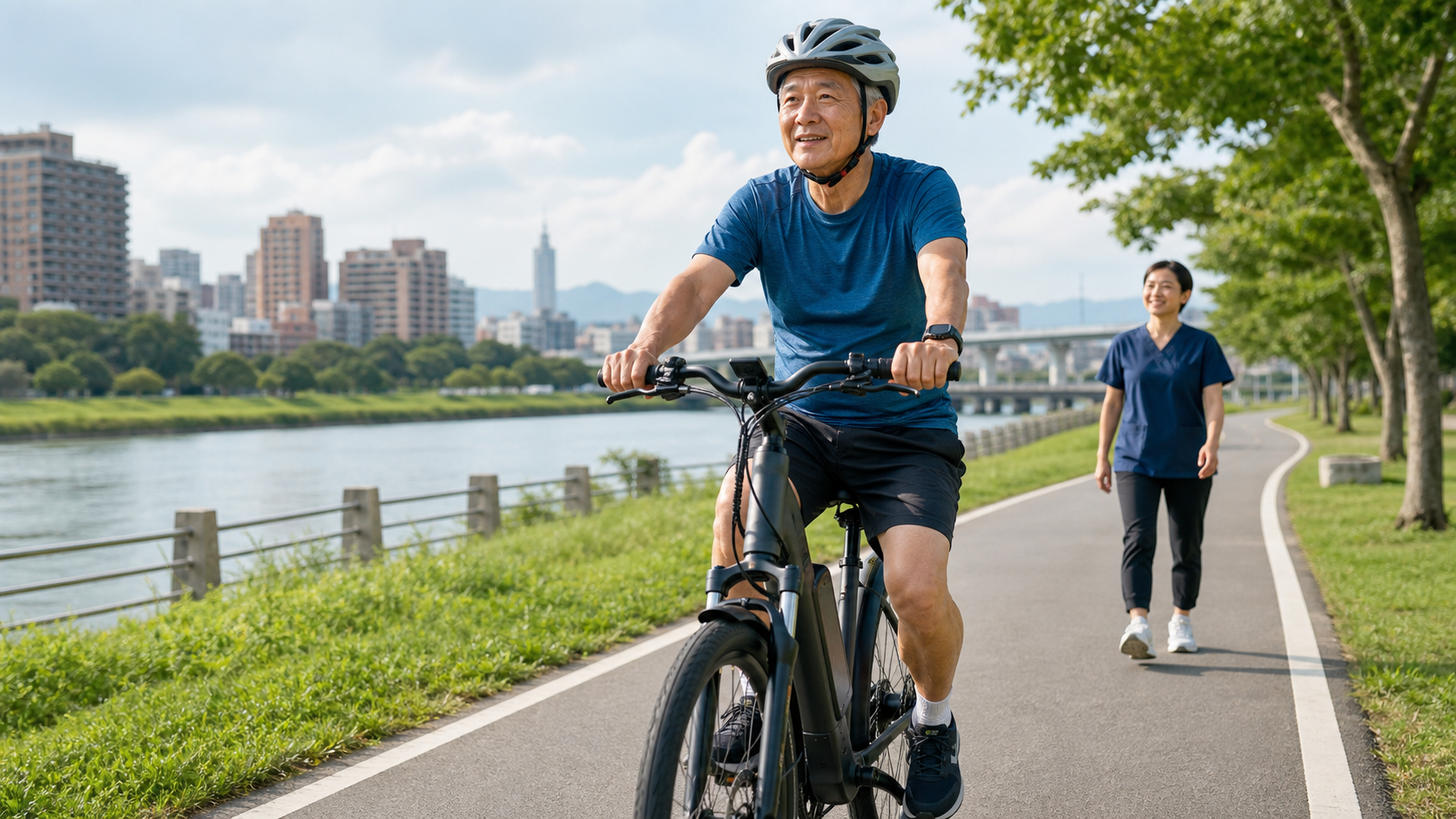
Introduction
The rise of electric assist bicycles (E-bikes) is one of the most significant transformations in the cycling industry over the past decade. As a major bicycle manufacturing nation, Taiwan has seen E-bike production and market share continue to climb, with domestic users rapidly expanding from middle-aged and older commuters to seniors, post-surgical rehabilitation patients, and those with chronic conditions. However, a common misconception about E-bikes persists: “Riding an e-bike doesn’t count as exercise.” Recent scientific research is gradually overturning this stereotype.
The Health Benefits of E-bikes: What Does Science Say?
Key Research Evidence
A systematic review published in the Journal of Medical Internet Research in 2019 analyzed 21 E-bike studies and reached the following conclusions:
| Health Indicator | E-bike Effect | Comparison with Conventional Bicycles |
|---|---|---|
| Physical activity level | Significantly higher than walking or driving to work | Slightly lower, but the gap is narrowing |
| Cardiorespiratory fitness | Significant improvement in VO2max | Approximately 70–80% of conventional bicycles |
| Metabolic equivalents (METs) | 5.1–8.3 METs (moderate to vigorous intensity) | Conventional bicycles 6–12 METs |
| Riding time | Significantly longer than conventional bicycle users | Compensation effect: longer duration ≈ similar total calorie expenditure |
| Riding frequency | Higher (because assistance lowers the fatigue threshold) | Conventional riders ride less frequently but at higher intensity |
Key finding: E-bike users often ride more frequently and over longer distances than conventional bicycle users, ultimately accumulating comparable or even higher levels of physical activity.
Cardiometabolic Benefits
A 2020 study from the University of Bristol in the UK followed 100 previously inactive commuters who switched to E-bike commuting. After 12 weeks, the results showed:
- Maximal oxygen uptake (VO2max) increased by an average of 10.5%
- Fasting blood glucose decreased by 0.5 mmol/L
- Body fat percentage decreased by 1.7%
- Systolic blood pressure decreased by 3.1 mmHg
While these improvements are lower than those from high-intensity training, they are highly significant for populations that were previously completely inactive.
E-bike Applications for Seniors
An Ideal Tool for Active Aging
Taiwan is about to enter a super-aged society (population over 65 exceeding 20%), and maintaining physical activity levels among older adults is a critical public health issue. The advantages of E-bikes for seniors:
- Lower entry barrier: The assist function allows older adults with insufficient knee joint or cardiopulmonary function to complete meaningful rides
- Safety considerations: Compared to running, the low-impact nature of E-bikes significantly reduces the risk of joint injury
- Preserved social function: Riders can keep up with faster cycling companions, maintaining participation in social rides
- Extended reach: The assist function allows seniors to explore a wider geographic range, promoting mental health
Recommended E-bike setups for older Taiwanese riders:
- Choose a step-through frame: Eliminates the need to swing the leg high over the frame, reducing the risk of falls
- Choose a mid-drive motor: Lower center of gravity, with better handling stability than hub motors
- Start with moderate assist levels (Eco or Tour mode) to ensure the rider still exerts a reasonable amount of pedaling force
- Speed limit: Taiwanese regulations cap E-bike electric assist at 25 km/h, which aligns with the safety needs of seniors
Fall Risk Assessment
Special attention is needed: E-bikes are heavier than conventional bicycles (typically 20–28 kg). If a rider falls or is unstable when stopping, the risk of being injured by the bike falling over is higher, particularly for seniors with osteoporosis. Recommendations:
- Practice stationary starts and stops on flat ground first (the most common moments for falls)
- Only ride on the road after confirming stability with feet on the ground
- Consider installing a high-quality kickstand to ensure stable parking
E-bike Applications in Post-Surgical Rehabilitation
Post-Surgical Scenarios Suitable for E-bike Rehabilitation
E-bikes are particularly well-suited to the following early post-surgical activity scenarios:
After knee replacement surgery:
- Conventional bicycle rehabilitation has strong evidence, but for patients whose muscle strength has not yet recovered, pedaling resistance may be excessive
- E-bike assistance allows patients to begin light riding 4–6 weeks after surgery, accelerating the recovery of knee joint range of motion
- Assist levels can be gradually reduced as rehabilitation progresses
After cardiac surgery (cardiac rehabilitation):
- Following coronary artery bypass surgery or cardiac stent placement, E-bikes can serve as an alternative tool in cardiac rehabilitation programs
- The assist function ensures heart rate remains within a safe rehabilitation intensity range (50–60% of maximum heart rate)
- Suitable for patients unaccustomed to indoor trainers; the outdoor environment supports psychological recovery
Chronic Obstructive Pulmonary Disease (COPD):
- COPD patients often avoid activity due to shortness of breath, leading to a vicious cycle of muscle atrophy and continued functional decline
- E-bikes allow COPD patients to maintain activity without triggering severe wheezing
- It is recommended to use a pulse oximeter to monitor blood oxygen, maintaining SpO2 > 90%
Practical Recommendations
Key considerations when purchasing an E-bike:
- Assist system brand: Bosch, Shimano STEPS, and Brose are currently the most highly regarded mid-drive motor systems
- Battery capacity: Choose 400–500 Wh or above to ensure sufficient assisted range (80–150 km depending on assist level)
- Display features: Should show the current assist level and remaining battery charge for easy management
- Importance of test riding: The riding feel of an E-bike differs from a conventional bicycle; be sure to test ride before deciding
Riding strategies to maximize health benefits:
- Don’t always use the highest assist mode; try low assist on flat roads and only increase it when you feel exertion
- Set a target heart rate zone for at least 30 minutes per ride to ensure genuine aerobic stimulation
- Gradually increase riding distance and reduce reliance on assistance, allowing the body to adapt to higher exercise loads
Conclusion
The E-bike is a bridge—it connects the worlds of “unable to ride” and “able to enjoy riding,” giving seniors, post-surgical rehabilitation patients, and those with chronic conditions renewed freedom of movement. Scientific evidence has clearly shown that E-bikes deliver real and meaningful health benefits; they are not “cheating” but a smart tool choice. Taiwan’s aging society needs more low-barrier, high-benefit physical activity options like this, and E-bikes are rewriting the definition of what it truly means to “actually exercise.”
Related Reading
- Electric Bicycles and Exercise Rehabilitation: The Gentle Power of Stepping Back on the Pedals
- Cycling and the Environment: The Contribution of Electric Assist Bicycles (E-bikes) to Urban Carbon Reduction
- Taiwan Market Trends for Electric Assist Bicycles (E-Bikes)
- The Science of Human-Machine Collaboration in Electric Assist Bicycles: Quantitative Research on Ebike Riding Efficiency
靠單車減肥35公斤 心得分享與整理
7 年前
2025 自行車錶排行榜 兩萬車友大數據 / Garmin Bryton 排名會大洗牌嗎? / 全新的碼表前身分析 /公路車 / CT Yeh
1 年前
大家都在開箱的...單車用藍芽對講耳機真的有幫助嗎? SENA BiKom 20 長距離旅遊 & 海鷗繞圈賽 實際體驗心得 / 公路車 / CT Yeh
9 個月前
高雄綠園道鐵路自行車道 / 外地人能輕鬆駕馭 還是整路崩潰? / 2025 全線開通 春節實地探索一次!(附GPS連結)/ 公路車 / CT Yeh
1 年前
#公路車 #Fitting 靠人工智慧APP 幫你調整單車
6 年前
3D 列印車褲墊 / 舒適改善? / 無痕 x 分區壓縮 / ATK & Decider系列 / JE22黑科技 / #公路車 #CTYEH
11 個月前
2023 自行車錶排名 大數據 23,000位車友用什麼錶? Garmin Edge 對決 Bryton Rider 誰市佔高? 你用的上榜了嗎? | 公路車 | CT Yeh
3 年前
2023自行車展!與環台賽選手一同表演賽 / 全自動AI Fitting?/ TIME新車發表/神秘充電桌等 精華分享 VLOG | CT Yeh | 公路車
3 年前