Introduction
The heartbeat is not a metronome. Even at rest, the time interval between two heartbeats varies slightly; this variation is called Heart Rate Variability (HRV). The magnitude of HRV reflects the balance state of the autonomic nervous system—specifically between the parasympathetic nervous system (rest and recovery) and the sympathetic nervous system (fight or flight)—and is currently one of the most scientifically recognized tools for monitoring training recovery.
Physiological Mechanism of HRV
The autonomic nervous system regulates the heart through two branches:
- Parasympathetic Nervous System (Vagus Nerve): When activated, heart rate decreases, heart beat intervals vary more, and HRV values are higher.
- Sympathetic Nervous System: When activated, heart rate increases, heart beat intervals become more regular, and HRV values are lower.
When an athlete is in a good state of recovery, parasympathetic tone is higher, resulting in relatively higher HRV values; when subjected to excessive training stress, insufficient sleep, or illness, the sympathetic nervous system activates, causing HRV values to drop.
Common HRV Metrics:
| Metric | Full Name | Meaning |
|---|---|---|
| RMSSD | Root Mean Square of Successive Differences | Reflects parasympathetic activity; most commonly used for training monitoring |
| SDNN | Standard Deviation of NN Intervals | Overall HRV, including both sympathetic and parasympathetic components |
| pNN50 | Percentage of successive RR differences >50ms | Percentage metric for parasympathetic activity |
| LF/HF ratio | Low Frequency/High Frequency Power Ratio | Sympathetic/Parasympathetic balance (requires frequency domain analysis) |
How to Measure HRV
Measurement Methods
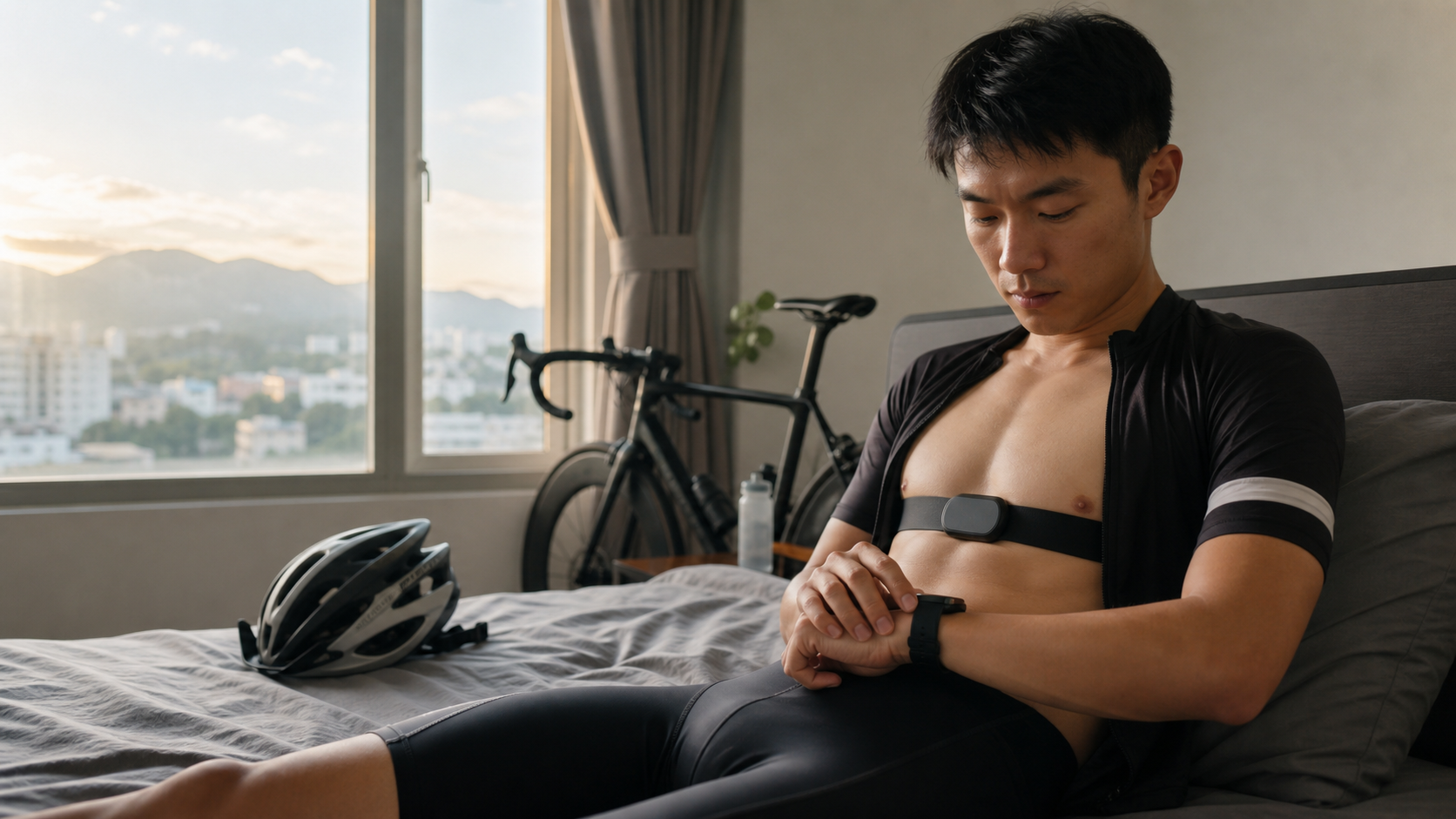
- Heart Rate Monitor (HRM) Strap: Such as Polar H10, offers the highest accuracy and records beat-to-beat RR intervals.
- Optical Heart Rate Sensor (PPG): Integrated in most smartwatches (Apple Watch, Garmin, Whoop); high convenience but slightly higher error margin.
- Mobile Applications: HRV4Training (camera-based optical), Elite HRV (requires HRM strap).
Key Timing for Measurement
Lying supine and resting for 3–5 minutes immediately after waking up is the standard time to measure HRV. At this time, parasympathetic activity is highest, and values best reflect actual recovery status. Any activity, food intake, or noise will interfere with the values.
Measurement Steps:
- After the alarm rings, do not get up; maintain a supine position.
- Turn on the measurement device or App.
- Breathe calmly (without deliberately controlling the rhythm) for 3–5 minutes.
- Record the value and enter it into the training log.
Framework for Interpreting HRV Data
Personalized Baseline
HRV values vary from person to person (ranging from 20 to 200ms or more), and there is no “standard normal value.” What matters is establishing a personal baseline (7–14 day rolling average) and observing relative changes rather than absolute values.
Interpretation Principles:
- Higher than personal average by >5–10%: Good recovery; suitable for high-intensity training.
- Within 5% range above or below average: Normal status; proceed with planned training.
- Lower than personal average by >5–10%: Insufficient recovery; reduce training intensity or schedule rest.
- Persistently low for more than 3 consecutive days: Warning of overtraining; requires active intervention.
Importance of HRV Trends
Fluctuations in single values do not necessarily indicate a problem; long-term trends are the key. In a typical training cycle (e.g., a 4-week block):
- Weeks 1–3: HRV may slightly decrease due to training stress.
- Week 4 (reduction week): HRV rebounds, indicating that supercompensation is occurring.
Practical Recommendations
- Establish a daily HRV recording habit; at least 4 weeks are needed to obtain a meaningful personal baseline.
- Record HRV values alongside subjective feelings (fatigue, sleep quality, muscle soreness); cross-verification makes the data more reliable.
- High temperatures and humidity in summer in Taiwan increase autonomic nervous system stress; slightly lower HRV during summer training is normal.
- Devices like Whoop, Garmin Body Battery, and Oura Ring provide HRV trend analysis and can serve as auxiliary tools.
- Do not let HRV numbers hijack training decisions; if subjective feeling is good but HRV is low, consider a “probe” training session for the first 10 minutes before deciding on intensity.
- Alcohol, insufficient sleep, and jet lag significantly affect HRV; recording these “confounding factors” helps in correctly interpreting values.
Conclusion
HRV is currently the biological indicator closest to a “fatigue thermometer,” helping Taiwanese cyclists find the optimal balance point between busy work and training. Daily 3-minute morning measurements, over the long term, will help you better understand your body’s rhythms, sprint at the right time, and truly relax when rest is needed. Data serves training, rather than controlling you.
Related Reading
- Application of Heart Rate Variability (HRV) in Cycling Training: Morning HRV Guides Daily Training Intensity
- Heart Rate Variability (HRV) and Training Recovery: How to Use Data to Avoid Overtraining
- HRV Monitoring: Application of Autonomic Nervous System Balance Index in Training Monitoring
- Cycling Training HRV Monitoring: Mastering Body Recovery Status
西進武嶺 免費訓練分析服務 Intervals | 練不夠還是練過頭?你哪一種類型選手?AI模型告訴你! | 備戰神器 | 公路車 訓練 | CT Yeh
4 年前
2026 車錶排行榜!誰是最多車友正在使用?練家子最愛哪款?🏆 (2萬名車友數據) / 公路車 / CT Yeh
5 個月前
2025 自行車錶排行榜 兩萬車友大數據 / Garmin Bryton 排名會大洗牌嗎? / 全新的碼表前身分析 /公路車 / CT Yeh
1 年前
超開放的自行車錶!可以玩遊戲裝APP!?/ SRAM合併的 Hammerhead Karoo深入開箱!/ 即時爬坡偵測 / 全球導航地圖 / Garmin Bryton / CT Yeh
1 年前
#公路車 #Vo2Max #最大攝氧量 測驗 體驗 | 心肺測試
6 年前
單車AI教練!全新 ChatGPT4o 幫你分析訓練成果!排武嶺課表,分析騎車姿勢! 太神了! / 公路車 / CT Yeh / feat. 緯緯
2 年前
Rouvy 元宇宙運動世界! 用VR 騎遍全台灣單車路線 武嶺 中社路 風櫃嘴
5 年前
如何用 AI 寫車錶 App? Hammerhead Karoo 自行車錶 近期大改版 / 官方App Store來了 / 公路車 / CT Yeh
1 年前