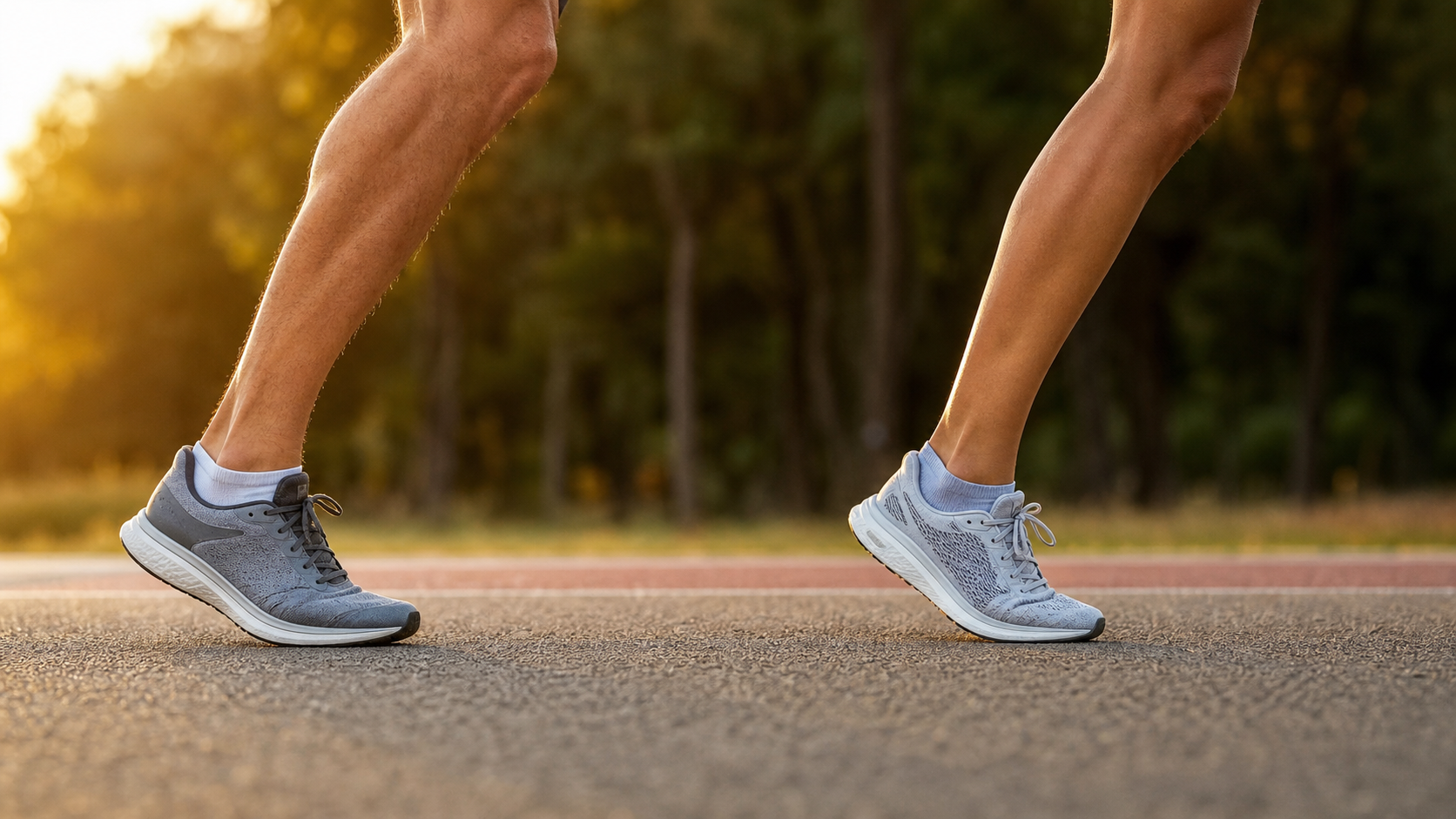
Introduction
“You should switch to a forefoot strike, that way you won’t get injured!” This statement is quite common in Taiwan’s running community, leading many runners to question whether their long-standing running form has been flawed. With the barefoot running craze sweeping the globe in the 2010s, the argument that “forefoot striking is superior to heel striking” became widespread.
However, more than a decade later, scientific research has provided a more complex and nuanced answer: There is no absolute superiority between strike patterns; the key lies in execution quality and individual suitability. This article will take you through the biomechanical differences between the two strike patterns and the results of scientific research.
Classification of Strike Patterns
Running strike patterns are mainly divided into three types:
| Strike Type | English Abbreviation | Contact Area | Estimated Percentage Among Amateur Runners |
|---|---|---|---|
| Heel Strike | RFS (Rearfoot Strike) | Heel | 75–80% |
| Midfoot Strike | MFS (Midfoot Strike) | Heel and forefoot simultaneously | 10–15% |
| Forefoot Strike | FFS (Forefoot Strike) | Forefoot | 5–10% |
Research shows that among amateur marathon runners, heel striking remains the most common pattern. Among world-class elite runners, the proportion of forefoot and midfoot striking is higher, but heel strikers are not uncommon—including several past Olympic marathon gold medalists.
Biomechanical Differences
Impact Force and Loading Rate
Heel striking is most often criticized for its characteristic “impact transient”—the rapid impact force generated the moment the heel contacts the ground, which can reach 1.5–3 times body weight, with an extremely fast loading rate.
Forefoot striking absorbs impact through the eccentric contraction of the plantar flexor muscles (calf muscles), with no significant impact transient at initial contact. However, the subsequent peak ground reaction force (GRF) is not much lower than that of heel striking.
The key differences are:
- Heel strike: Impact is rapidly transmitted to the tibia and knee joint
- Forefoot strike: Pressure is primarily borne by the ankle joint and calf tendons
Joint Stress Comparison
| Area | Heel Strike | Forefoot Strike |
|---|---|---|
| Knee joint stress | Higher (especially patella) | Lower |
| Ankle joint stress | Lower | Higher |
| Achilles tendon load | Lower | Significantly higher |
| Tibial stress | Higher (risk of tibial stress fracture) | Lower |
Injury Risk: Who Is More Prone to Injury?
This is the most critical question. According to existing research:
- Tibial stress fractures: Heel strikers are at higher risk because longitudinal impact forces are transmitted more directly into the tibia
- Achilles tendon issues (Achilles tendinitis/rupture): Forefoot strikers are at higher risk because the eccentric load on the Achilles tendon is greater
- Iliotibial band syndrome (runner’s knee): Not strongly related to strike pattern; it depends more on gluteal strength and knee valgus habits
- Plantar fasciitis: Both patterns are possible; it depends on arch strength and the rate of training volume increase
Multiple subsequent randomized controlled studies (including recent large-scale prospective studies) show that there is no significant difference in overall injury rates between the two strike patterns—rather, “too rapid an increase in running volume” and “changes in running form without adequate training” are the primary causes of injury.
Should You Change Your Strike Pattern?
Situations Where Change May Be Worth Considering
- Chronic anterior knee pain (such as patellofemoral pain syndrome)
- Recurrent tibial stress fractures
- Professional assessment and recommendation from an exercise physiologist or physical therapist
Situations Where a Hasty Change Is Not Recommended
- No current injuries, but simply wanting to “run faster”
- Within 2–3 months before a race (gait changes require a 3–6 month adaptation period)
- Lack of a foundation in calf strength training (forcing a forefoot strike will significantly increase the risk of Achilles tendon and calf injuries)
The Right Approach to Gait Improvement
Rather than obsessing over “forefoot or heel,” the following holistic gait improvements have stronger scientific backing:
- Increase cadence (170–180 steps/min): Reduces overstriding, allowing the foot to land directly beneath the center of mass, naturally reducing impact forces
- Strengthen the glutes: The strength of the gluteus maximus and gluteus medius is central to maintaining stable running posture
- Strengthen the core: Good trunk stability reduces rotational energy loss
- Avoid excessive forward or backward lean: A slight (5–10 degrees) overall forward lean is appropriate, but it should not involve only bending at the waist
Practical Advice
- If you are currently running without injury, do not force a change in gait because of popular trends in the community
- To understand your own strike pattern, ask a friend to record you from the side, or use the gait analysis function on your running watch
- If you intend to transition to a forefoot strike, start with short distances (3–5 km), not exceeding 20% of your total weekly mileage
- Calf strength training (calf raises) is essential preparation for a forefoot strike—progress gradually
- Physical therapists in Taiwan (especially those specializing in sports injuries) can provide personalized gait assessment recommendations
Conclusion
Running gait analysis is not a journey to find the “one correct answer,” but rather a process of understanding your own body. Scientific research tells us that there is no absolute verdict on the superiority of strike patterns; what matters is overall running efficiency, injury history, and the long-term sustainability of training. Finding the running style that suits your own body is the most correct “running science.”
Related Reading
- Running Posture Analysis: Research on Forefoot Strike vs Heel Strike
- Forefoot Strike vs Rearfoot Strike: Which Running Style Suits You?
- Complete Analysis of Running Strike Patterns: Scientific Comparison of Impact Forces in Forefoot, Midfoot, and Heel Strikes
- Running Gait Analysis: The Science of Forefoot vs Midfoot vs Heel Strikes
CT 喇低賽) 武嶺牽車 才是王道 西進牽車四小時內秘訣 攝手位置 如何判斷 防抽筋小秘訣
7 年前
滑雪新手們慘摔學習全紀錄(請開字幕),滑雪好好玩 | Snowboard + Ski | 岩原 スキー場 | 滑雪APP使用 | GoPro Max
6 年前
碟煞公路車 優缺點?換車一年半實際經驗分享 / 公路車 / CT Yeh
2 年前
抖肩舞 台灣x日本交流版 (台灣 vs 前橋) 赤城山登山賽 coincidance
8 年前
戰略) Zwift Race 如何咬在第一集團 如何評估自己要開多少推力 (請開1.5倍速看)
7 年前
下次拍照前要查清楚啦🤣 #cycling
7 個月前
西進武嶺各路段 前8000名 大數據分析 配速攻略/功率/心律/推力比/維持率/踏頻/踏瓦比/牽車率 大公開 | 建大盃 NeverStop 可參考 | 公路車 | CT Yeh
5 年前
#公路車 #Fitting 靠人工智慧APP 幫你調整單車
6 年前