Introduction
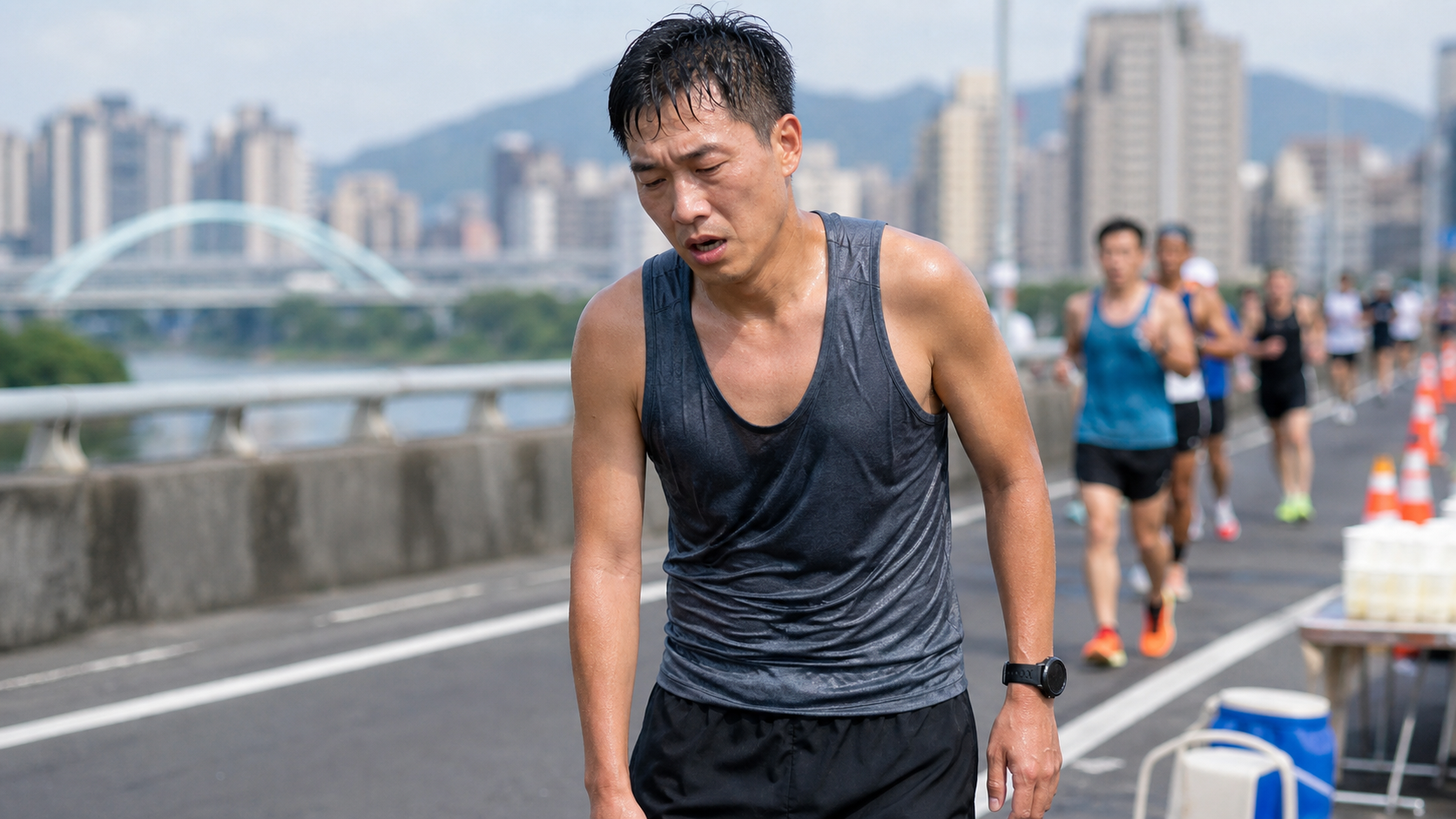
“Hitting the Wall” is a terrifying phenomenon every marathon runner has heard of. Around the 30–35 kilometer mark, many runners suddenly feel their legs turn to lead, their willpower crumbles, their pace plummets, and they may even be unable to keep running. Along the route of the Taipei Marathon, countless runners are seen walking near Ren’ai Road and Minquan Bridge every year, testament to how common this phenomenon is.
“Hitting the wall” is not a matter of willpower, but a real physiological crisis—muscle glycogen is nearly depleted, forcing the body to undergo a drastic shift in metabolic mode. Understanding marathon energy metabolism is the scientific foundation for preventing the wall and breaking your PB.
Energy Sources for the Marathon
The energy expended during running comes from two main sources:
| Fuel Source | Storage Location | Available Amount (Well-Trained Runner) | Primary Conditions of Use |
|---|---|---|---|
| Muscle Glycogen (Carbohydrate) | Skeletal Muscle | Approx. 300–400g (~1,200–1,600 kcal) | Moderate-to-high intensity exercise |
| Liver Glycogen (Carbohydrate) | Liver | Approx. 80–100g (~320–400 kcal) | Maintaining blood glucose stability |
| Body Fat | Adipose Tissue | Nearly unlimited (tens of thousands of kcal) | Low-to-moderate intensity, slower metabolism |
| Protein | Muscle | Small amounts (emergency situations) | When glycogen is severely depleted |
The calories burned in a marathon (42.195 km) are approximately: body weight (kg) × 0.9 × 42.195 (kcal). For a 70 kg runner, this amounts to roughly 2,673 kcal.
The Mechanism of Glycogen Depletion and “Hitting the Wall”
In a marathon, running at a 5:00/km pace corresponds to an intensity of about 75–80% of VO2max. At this intensity, carbohydrates supply 70–80% of total energy, with fat contributing 20–30%.
The problem lies in:
- Limited glycogen stores: Even with pre-race carbohydrate loading, muscle and liver glycogen combined provide only about 1,800–2,200 kcal
- Rapid glycogen depletion: Running at marathon race intensity, glycogen stores approach a critical threshold at around the 28–32 km mark
- Fat metabolism is not fast enough: The maximum rate of fat oxidation cannot fully replace glycogen, so pace must drop significantly
When glycogen is depleted, the body is forced to rely entirely on fat, and the pace corresponding to the maximum fat oxidation rate is roughly at an easy jogging level (far below marathon race pace). This is the physiological essence of “hitting the wall.”
Factors Affecting Glycogen Stores
Training Adaptations
Long-term endurance training can significantly increase the muscle’s glycogen storage capacity:
- Well-trained runners can store 30–50% more muscle glycogen than untrained individuals
- Training also enhances fat oxidation capacity, sparing more glycogen at the same intensity
Pre-Race Carbohydrate Loading
“Carbohydrate Loading” is a strategy of consuming large amounts of carbohydrates 1–3 days before the race to supercompensate glycogen stores:
- Effect: Can increase muscle glycogen stores by 20–40%
- Implementation: For the 3 days before the race, increase daily carbohydrate intake to 10–12g/kg body weight
- Note: Each gram of glycogen is stored with approximately 3 grams of water, so a weight gain of 1–2 kg after carbohydrate loading is normal
Pre-Race Meal
- Eat 200–300g of complex carbohydrates (such as rice or toast) 2–4 hours before the race
- Avoid high-fat and high-fiber foods (they slow digestion and may cause gastrointestinal discomfort)
- Common pre-race meals for Taiwanese runners: rice porridge with egg, white toast with peanut butter, banana with rice
In-Race Fueling Strategies
Timing of Energy Intake
Research recommends carbohydrate intake for runs lasting longer than 75 minutes:
- Frequency: Refuel every 30–45 minutes
- Dose per intake: 30–60g of carbohydrates (trained runners can handle up to 90g/hour, but with multiple transportable carbohydrates)
- Forms: Energy gels, sports drinks, bananas, dates (provided at many races in Taiwan)
The Importance of Hydration
Energy gels require adequate water to be absorbed effectively:
- When taking a gel, drink 150–250mL of plain water
- Taiwan marathons typically have an aid station every 3–5 km—this is the best opportunity to refuel
Summary of Strategies to Prevent “Hitting the Wall”
- Build your aerobic base: Increase Zone 2 training volume to enhance fat oxidation and spare glycogen
- Pre-race carbohydrate loading: Increase carbohydrate intake 2–3 days before the race
- Conservative start strategy: Run the first 10 km 5–10 seconds/km slower than target pace to reduce early glycogen expenditure
- Regular fueling: Take energy gels or sports drinks every 30–45 minutes; don’t wait until you “feel tired to refuel”
- Simulate in long runs: Practice your fueling strategy during long training runs to test gastrointestinal tolerance
Conclusion
“Hitting the wall” is not fate, but a preventable physiological event. Through systematic training to increase glycogen stores and fat oxidation capacity, combined with scientific pre-race fueling strategies and regular in-race refueling, most runners can avoid the embarrassment of walking across Taipei Bridge or down Ren’ai Road. The science of energy metabolism is precisely the key bridge that takes a marathoner from “finishing” to “breaking their PB.”
Related Reading
- Glycogen Depletion in Long-Distance Running: The Biochemical Mechanism of Hitting the Wall in Marathons
- The Glycogen Depletion Mechanism in Road Running: A Physiological Explanation of the Marathon Wall
- Marathon Hitting the Wall: Psychological and Physical Strategies After 30 km
- The Marathon Wall at 30 km: The Dual Mechanism of Glycogen Depletion and Brain Fatigue
CT暗黑廚房) 車友必備 宇宙無敵鮮蚵湯 幫助訓練恢復 天然食補 好市多 超肥鮮蚵 破PR
7 年前
水金九不厭五分 10度寒流冷到不願停!feat. 卡卡 / 公路車 / CT Yeh
6 個月前
單車 一日北高 ( 雙城 ) 肥宅雙人瘋狂行 紀錄片 REACTO
10 年前
半日 小台灣 極限單車路線挑戰實錄
7 年前
爬陡坡被爆胎的車友跑步超車 #cycling #里佳部落
9 個月前
台北闊瀨陡坡 騎旅 / 日本單車雜誌編輯車友臨時加入!/ 髮香才是最強的 / feat. 北迴歸線小隊 / 公路車 CT Yeh
6 個月前
靠單車減肥35公斤 心得分享與整理
7 年前
大武山20%魔王陡坡【JJSC南台灣遊騎Day2】!屁股真的要裂開了...凡士林抹滿也沒用?神秘金教堂還有超便宜夜市
3 個月前