Introduction
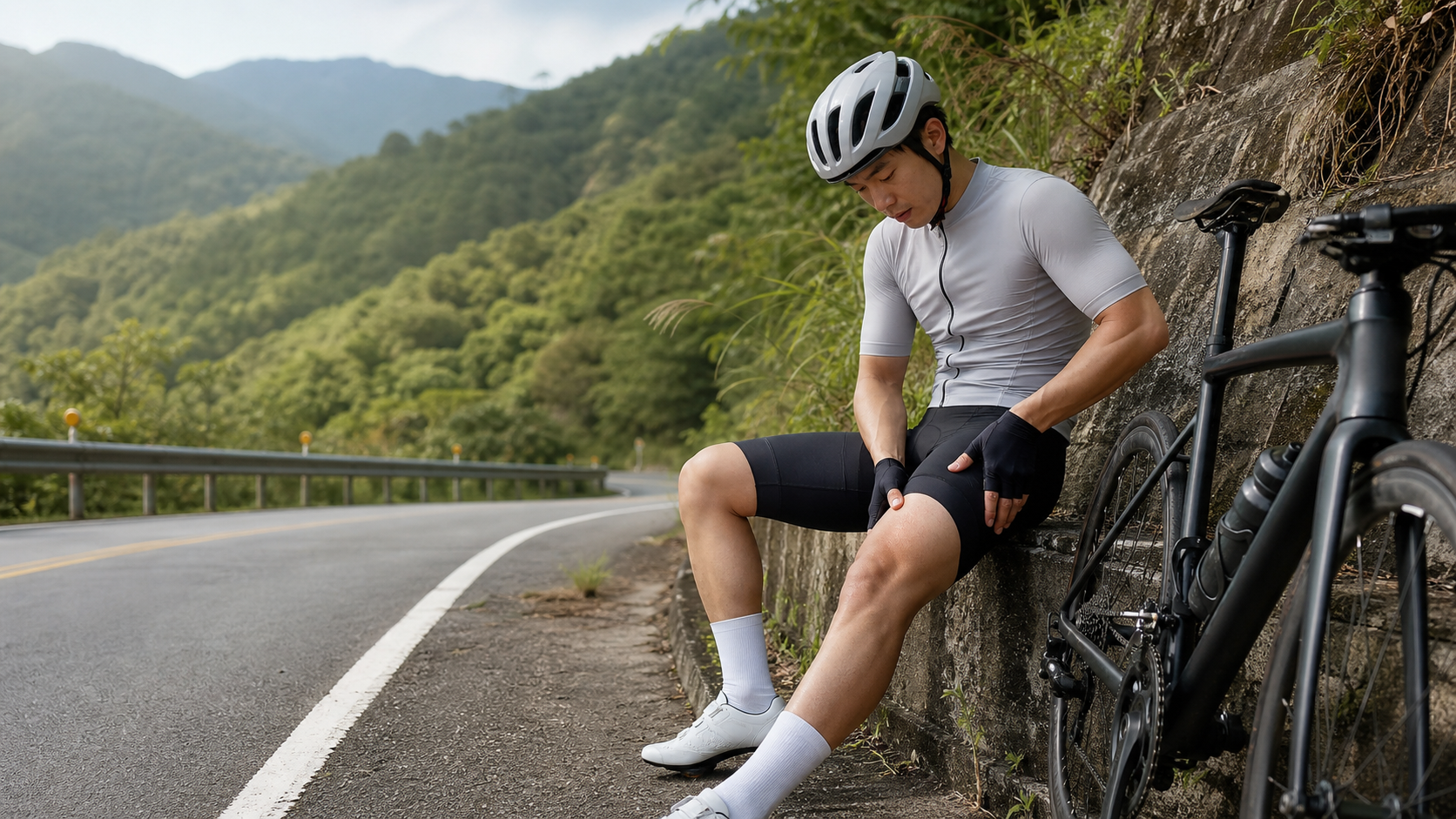
Cycling culture thrives in Taiwan, from weekend summits of Wuling to laps around Sun Moon Lake, with more and more riders targeting long-distance rides. However, as training volume climbs, a stabbing pain on the outside of the knee quietly appears. Iliotibial Band Syndrome (ITBS) is the most common source of lateral knee pain among cyclists, with studies estimating a prevalence of 15–24% in endurance riders—a classic overuse injury that can derail all your hard work.
This article starts from biomechanical principles, combined with the practical realities of Taiwan’s riding environment, to provide riders with a practical guide to prevention and management.
Anatomy of the Iliotibial Band and Injury Mechanism
What is the Iliotibial Band?
The iliotibial (IT) band is a thick band of fascia extending from the outer pelvis (iliac crest) to the lateral condyle of the tibia, stabilizing the outer thigh and assisting dynamic control of the knee joint along its path. When the knee flexes to approximately 30 degrees, the IT band slides over the bony prominence of the lateral femoral condyle, and repeated friction triggers local inflammation and pain.
The knee flexion arc of the cycling pedal stroke repeatedly passes through this “danger zone.” In a 100-kilometer ride, for example, pedal strokes exceed 8,000 revolutions, accumulating considerable mechanical friction.
Major Risk Factors
| Factor Category | Specific Risk Factors |
|---|---|
| Training factors | Sudden mileage increase exceeding 10%, sharp rise in mountain climbing volume |
| Biomechanics | Weak gluteus medius, excessive foot pronation, pelvic drop |
| Bike fit | Saddle too low, cranks too long, insufficient pedal float |
| Personal factors | Insufficient lower limb strength, leg length discrepancy, previous ITBS history |
Symptom Recognition and Self-Assessment
Typical Symptoms
- Lateral knee pain, approximately 2–3 cm above the lateral femoral condyle
- Normal at the start of a ride, sharp stabbing pain appears after 20–40 minutes
- Symptoms worsen on descents (increased knee flexion angle)
- Relieves after stopping, recurs upon resuming riding
- Palpable tenderness near the lateral femoral condyle
Distinguishing from Other Knee Injuries
- Patellofemoral Pain Syndrome: Pain is located around or directly below the patella, not lateral
- Lateral Collateral Ligament Injury: Clear history of trauma, accompanied by joint instability
- Meniscus Tear: May present with joint locking sensation or significant swelling
If symptoms persist for more than 2 weeks and affect daily walking, it is recommended to visit a sports medicine clinic for ultrasound or MRI evaluation.
Optimizing Bike Fit
Saddle Height
This is the most critical adjustment affecting ITBS. A saddle that is too low causes excessive knee flexion at the bottom of the pedal stroke, continuously irritating the IT band. The Holmes rule is recommended: at the bottom of the stroke, the knee should maintain a slight bend of 25–35 degrees, confirmed with a goniometer or video analysis.
Pedal Float
If fixed pedals provide insufficient float, the knee is forced to move in a fixed, unnatural position. Riders with a history of knee pain are advised to choose a cleat system with at least 6 degrees of float, allowing the knee to move freely according to individual movement patterns.
Crank Length
Overly long cranks increase knee flexion at the top of the pedal stroke, indirectly tightening the IT band. Riders under 170 cm in height may consider crank lengths below 170 mm.
Preventive Training: Strengthening the Hip Stabilizers
The gluteus medius is the key muscle controlling lateral pelvic stability, and gluteus medius weakness is the core biomechanical factor in ITBS development. The following exercises are recommended 3 times per week, 2–3 sets each:
- Clamshell: Lie on your side with knees bent, open the hip upward to strengthen the gluteus medius
- Lateral Band Walk: Trains dynamic control of the hip abductors
- Single-Leg Glute Bridge: Strengthens the gluteus maximus and core stability
- Single-Leg Squat: Mimics the pedal stroke, ensuring the knee tracks over the toes
Training Load Management
- Follow the “10% rule”: increase weekly mileage by no more than 10%
- When preparing for long climbs like Wuling, progressively accumulate elevation gain 8–12 weeks in advance
- Maintain a higher cadence (85–95 rpm) to reduce torque per pedal stroke and decrease IT band tension
Acute Phase Self-Management
- Stop the training intensity that triggers pain; you may switch to flat, low-intensity, short-distance rides to maintain fitness
- Ice: 15–20 minutes per session within the first 48 hours, 3–4 times daily
- Foam Rolling: Relax along the outer thigh, avoiding direct pressure on the painful point
- IT Band Stretch: Stand and cross the affected leg behind the healthy leg, lean the torso sideways to feel tension on the outer side, hold for 30 seconds per set, 3 sets daily
- Non-Steroidal Anti-Inflammatory Drugs (NSAIDs): Short-term use under medical supervision to control acute inflammation
If conservative treatment shows no improvement after 4–6 weeks, corticosteroid injections or extracorporeal shockwave therapy may be considered.
Practical Advice
- Check saddle height every season; weight changes or shoe sole wear can alter effective height
- Schedule 10 minutes of foam rolling and hip stretching after long rides
- Taiwan’s hot, humid summers accelerate muscle fatigue; on long rides, stay hydrated and shorten high-intensity intervals
- Start a glute strengthening program 6–8 weeks before a round-island tour or long expedition
- Address lateral knee pain as soon as it first appears—don’t push through and worsen the injury
Conclusion
Iliotibial band syndrome is, at its core, a preventable and recoverable overuse injury. With proper bike fit, a progressive training plan, and targeted glute strengthening, the vast majority of riders can successfully prevent and recover from ITBS, continuing to enjoy Taiwan’s magnificent mountain and coastal cycling scenery.
Related Reading
- Iliotibial Band Syndrome (IT Band): Complete Prevention and Rehabilitation Guide
- Runner’s Knee (Iliotibial Band Syndrome) Complete Guide: Causes, Diagnosis, Treatment, and Prevention
- The Complete Guide to Foam Rolling the Iliotibial Band: Say Goodbye to Lateral Knee Pain
- Iliotibial Band Syndrome (IT Band Syndrome): The Most Common Lateral Knee Pain in Long-Distance Running
一日北高常見問題大集合 | 攻略 | 路線 | 訓練 | 補給 | 自行車 單車 | 一日雙城 | 雙塔 | TWB北高360 | 屁股痛
6 年前
一日北高/長距離團騎 常見問題補充篇 / 組團或跟團的眉角 / 壯車友容易被瘦車友慢性拉爆 / 原來屁股痛可能是這個原因...? / 風場配速法 / 公路車 / CT Yeh
2 年前
高雄綠園道鐵路自行車道 / 外地人能輕鬆駕馭 還是整路崩潰? / 2025 全線開通 春節實地探索一次!(附GPS連結)/ 公路車 / CT Yeh
1 年前
多到選擇障礙... 換個單車把帶想一個小時 / BTP / 編織&軟木特有材質超吸睛! / 公路車 / CT Yeh
1 年前
再一組! 全碳幅條 碟煞/無內胎輪組 開箱! 到底好騎嗎? UNAAS X40 | 公路車 | CT Yeh
4 年前
Never Stop 西進武嶺 前後雙機 完整全程錄影 訓練台 實境
8 年前
單車 一日北高 ( 雙城 ) 肥宅雙人瘋狂行 紀錄片 REACTO
10 年前
2022台北國際自行車展 訓練台 試騎心得大全 差點腿軟走出! 元宇宙武嶺!| Garmin Tacx Oreka Xpedo Wahoo | 公路車 | CT Yeh
4 年前