Introduction
“My entire perineum goes numb after a ride” — this complaint is all too familiar in Taiwan’s cycling community, yet it is often brushed off as a minor issue. However, perineal numbness is more than just temporary discomfort. Research shows that riders who ignore saddle pressure problems over the long term may face Pudendal Nerve Neuropathy, and in severe cases, it can even affect sexual and urinary function.
This article starts from an anatomical perspective, systematically analyzing the mechanisms of saddle pressure damage and providing prevention strategies that can be implemented immediately.
Anatomy: Why Cycling Is Particularly Hard on the Perineum
Shift in Sit-Bone Support
In a natural seated posture, body weight is primarily supported by the two ischial tuberosities. However, when cycling, the body leans forward and the sit bones shift forward, transferring body weight to the soft tissue beneath the pubic arch — an area densely traversed by the pudendal nerve and pudendal arteries and veins.
Research shows that perineal blood flow can decrease by as much as 70–91% while cycling, leading to local ischemia. Over time, this accumulation can cause neurological damage.
Key Structures Under Pressure
| Structure | Consequences of Compression |
|---|---|
| Pudendal Nerve | Numbness, tingling, sexual dysfunction |
| Pudendal arteries and veins | Local ischemia, tissue damage |
| Urethra (male) | Urinary discomfort, urethral irritation |
| Vestibular bulbs (female) | Vulvar pain, reduced sensation |
Risk Factor Assessment
Saddle-Related Risk Factors
- Traditional nose saddles: The prominent protruding front end is the design that exerts the greatest pressure on the perineum
- Saddle tilt angle: An upward-tilted nose directly increases perineal pressure; the nose should be kept level or tilted slightly downward 1–2 degrees
- Saddle too narrow: Fails to support the sit bones, forcing soft tissue to bear the load instead
- Overly rigid base: Carbon fiber bases are lightweight but deliver greater impact to soft tissue
Riding-Related Risk Factors
- Single rides exceeding 3 hours without standing to pedal
- Long-distance climbing (leaning forward with sustained pressure)
- Rapidly increasing training mileage without giving skin and tissue time to adapt
Symptom Grading and Management Principles
| Severity | Symptom Description | Recommended Action |
|---|---|---|
| Mild | Numbness appears in the latter half of a ride, resolves within 30 minutes of stopping | Adjust fit immediately; do not ignore the warning sign |
| Moderate | Numbness persists for 1–2 hours, accompanied by tingling | Pause long-distance riding and conduct a fit assessment |
| Severe | Numbness lasting over 24 hours, sexual dysfunction, urinary discomfort | Seek medical attention immediately; nerve conduction studies may be warranted |
Common symptoms in men include erectile dysfunction; women may experience vulvodynia, clitoral numbness, and more. Any persistent symptom should be actively evaluated by a physician — do not delay treatment out of embarrassment.
The Science of Saddle Selection
Measuring Sit-Bone Spacing
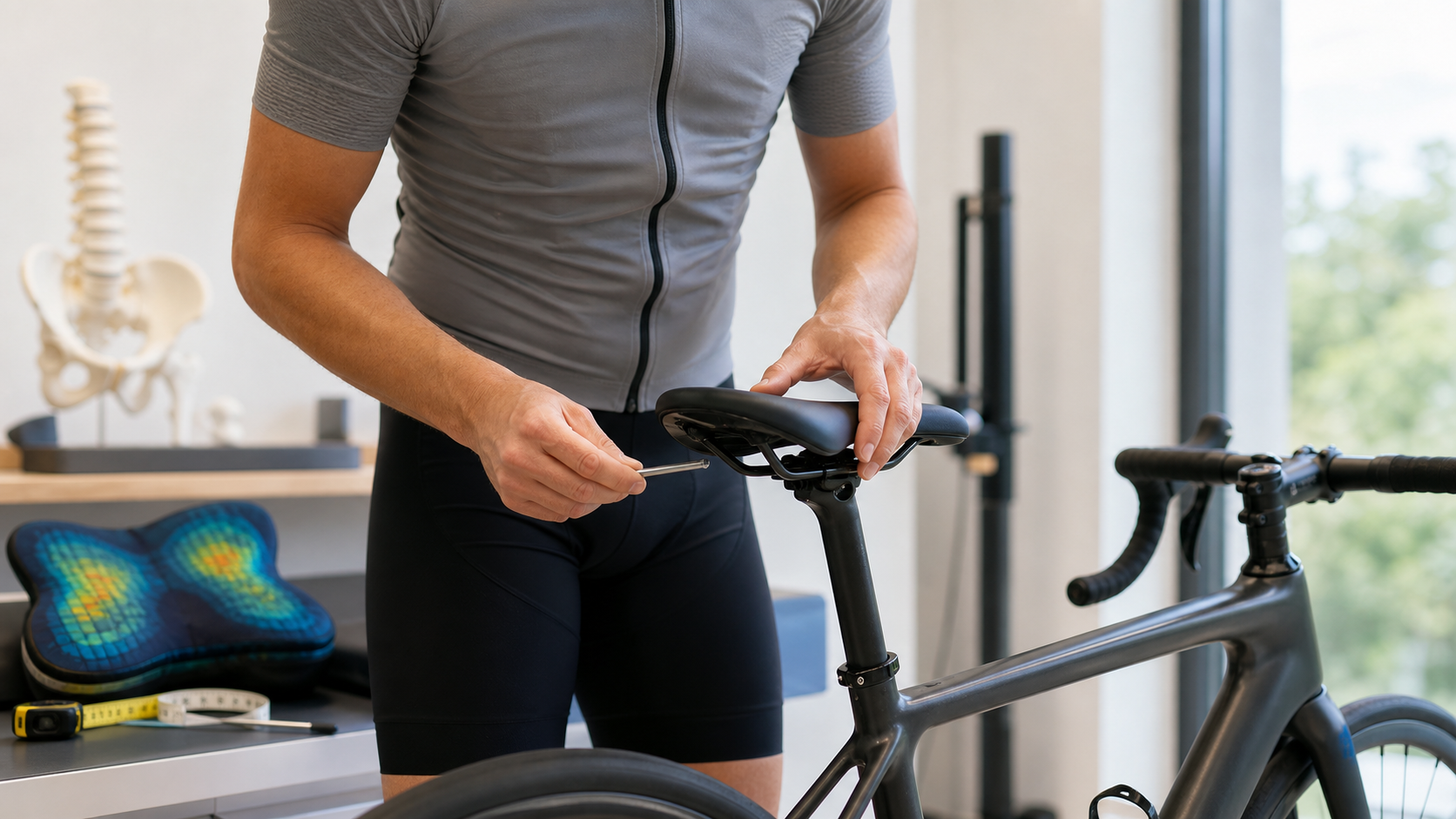
Many bike shops offer sit-bone pressure mapping services. The recommended saddle width = sit-bone spacing + 20–30 mm. A saddle that is too narrow is a direct cause of perineal compression.
Benefits of Cutout Saddles
Research shows that saddles with a central channel or full cutout can reduce perineal pressure by 20–50%, significantly improving local blood flow. When choosing, note the following:
- The channel must extend to the front section of the saddle (covering the area of highest perineal pressure)
- Female riders are advised to choose designs with a wider opening to protect the vestibular area
- Noseless saddles offer the best prostate protection and are suitable for recreational riding
Key Fit Adjustments
- Saddle angle: Keeping the nose level or tilted slightly downward 1–2 degrees is the most commonly overlooked critical adjustment
- Saddle height: At the bottom of the pedal stroke, the knee should maintain a 25–35 degree bend; a saddle that is too low causes the rider to slide forward onto the nose
- Reach: An appropriate stem length allows the arms to bear part of the body weight, reducing saddle pressure
Bib Shorts and Auxiliary Equipment
High-quality bib shorts are a protective measure that cannot be overlooked:
- Choose a chamois with density-zoned design; areas of concentrated pressure need adequate cushioning
- Seams should not fall on the pressure points of the sit bones or perineum
- For long rides, apply chamois cream to reduce friction and keep the skin moisturized
- Change and wash bib shorts immediately after every ride to maintain hygiene
Adjusting Riding Habits
- Every 10–15 minutes of riding, stand and pedal for 30–60 seconds to restore blood flow
- Taiwan’s summer heat brings heavy sweating, so breathable bib short materials are especially important
- A new saddle requires a 2–3 week adaptation period; do not give up on it due to initial discomfort
Practical Recommendations
- As a saddle ages, the padding’s protective capacity declines; assess every 1–2 years whether replacement is needed
- If symptoms persist after changing saddles, seek professional bike fitting services
- Intervene when symptoms are mild to avoid progression to chronic nerve damage
- Taiwan round-island riders in particular should schedule multiple standing-pedal active relief breaks into their itinerary
Conclusion
Pudendal nerve protection is a health issue every serious cyclist should take seriously. Through proper saddle selection, fit adjustments, and auxiliary equipment, the vast majority of pressure-related problems are preventable. The warning signs your body sends deserve to be taken seriously — healthy nerve function is what allows you to keep enjoying every magnificent cycling route in Taiwan, year after year.
Related Reading
- Perineal Numbness: The Impact of Saddle Design on Perineal Pressure and Improvement Strategies
- Urinary Health in Cycling: Preventive Measures for Saddle Compression and Numbness
- Cycling Saddle Soreness: The Science of Perineal Compression and Saddle Selection
- Genital Numbness in Cycling: The Relationship Between Saddle Choice and Pelvic Tilt
碟煞公路車 銑面器 !? 原來銑完差這麼多! 降低蹭碟機率! | TIME 公路車 保養小記錄 | CT Yeh
3 年前
一日北高/長距離團騎 常見問題補充篇 / 組團或跟團的眉角 / 壯車友容易被瘦車友慢性拉爆 / 原來屁股痛可能是這個原因...? / 風場配速法 / 公路車 / CT Yeh
2 年前
單車胎壓觀察到的有趣現象,SRAM Quarq TyreWiz 2.0 無內胎胎壓計 / 裝了有哪些幫助? / Tubeless / 公路車 / CT Yeh
1 年前
摔車後補裝備: 好市多新款單車安全帽& Specialized Romin 北高整路屁股都不痛的坐墊 | 一千元居然有MIPS | CT Yeh | 公路車
4 年前
再一組! 全碳幅條 碟煞/無內胎輪組 開箱! 到底好騎嗎? UNAAS X40 | 公路車 | CT Yeh
4 年前
一日北高常見問題大集合 | 攻略 | 路線 | 訓練 | 補給 | 自行車 單車 | 一日雙城 | 雙塔 | TWB北高360 | 屁股痛
6 年前
鉅齒紋輪組!? ControlTech MEG-T50 EVO 碳纖維幅條輪組/ 功率對比實驗 / 公路車 / CT Yeh
2 年前
Nepest NOVA 碳條輪組:輕量、空力、舒適一次滿足!/ 公路車 / CT Yeh
7 個月前