Introduction
In a 200-meter freestyle race, swimmers need to complete 3 turns; in a 400-meter race, 7 turns. If each turn (including the approach to the wall, rotation, push-off, and underwater glide) can be 0.1 seconds faster than an opponent, the cumulative difference can decide the final ranking. For swimmers with mature technique, the flip turn is almost a seamless process, but for those with poor technique, it can waste 0.5–1.0 seconds each time. This article takes a mechanical perspective to help Taiwanese swimmers systematically optimize this skill.
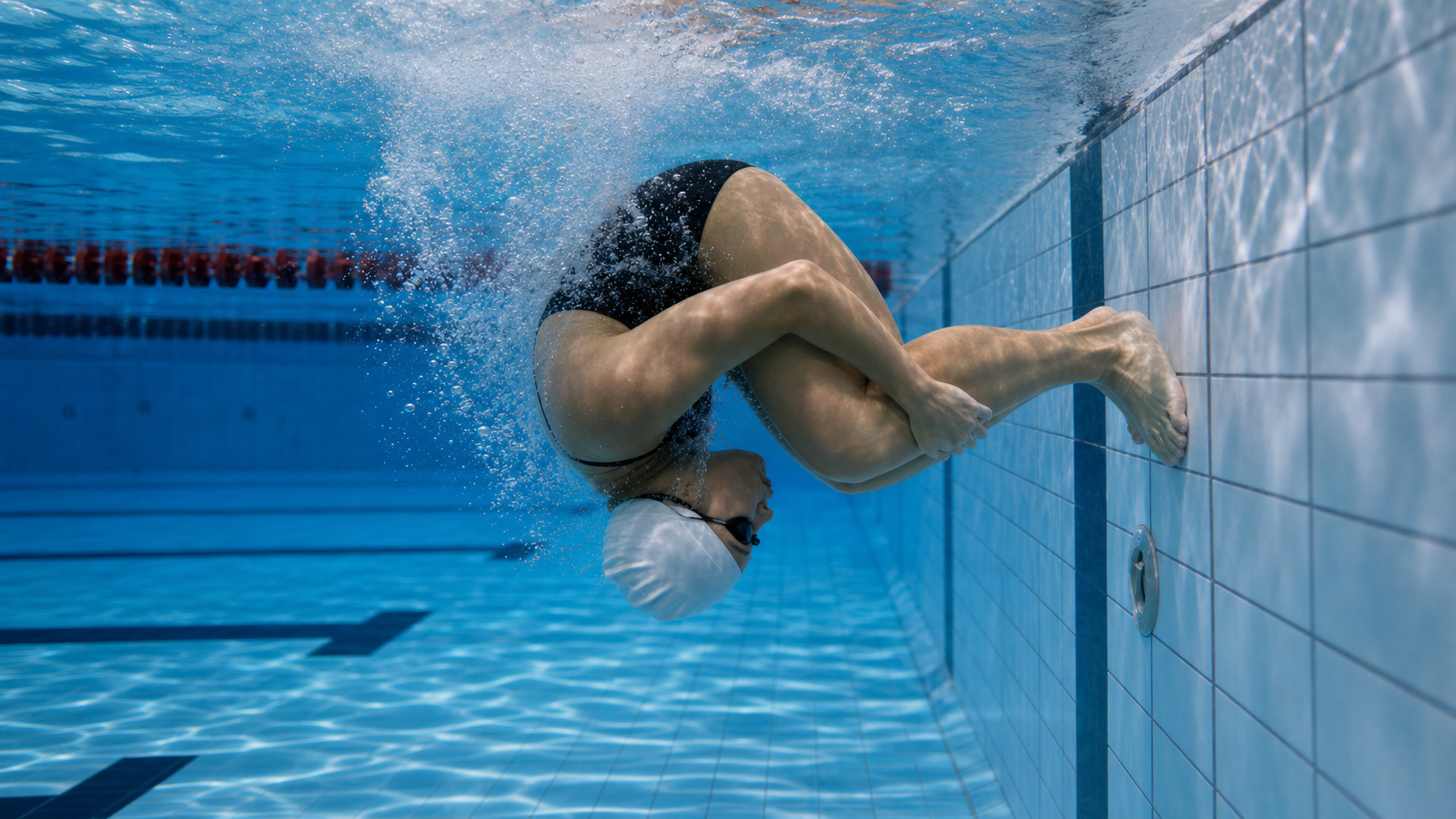
The Mechanics of the Flip Turn
Time Allocation Across Four Phases
A complete flip turn can be broken down as follows:
| Phase | Description | Target Time (World-Class) |
|---|---|---|
| Approach | Final 1–2 stroke lengths | — |
| Rotation | Forward somersault of 180° | 0.35–0.45 seconds |
| Push-off | From feet contacting the wall to fully leaving it | 0.25–0.35 seconds |
| Glide | From leaving the wall to the first stroke | 0.8–1.2 seconds |
Angular Momentum of the Rotation
The speed of the flip is determined by the conservation of angular momentum. If a swimmer can maintain a higher forward speed before initiating the flip, combined with a compact body position (reducing moment of inertia), the angular velocity of the rotation will increase. This is why “excessive deceleration before the wall should be avoided”—slowing down reduces the angular momentum carried into the flip, which in turn slows the rotation.
Force Transfer During Push-off
The ideal position for both feet to contact the wall is approximately 30–40 cm below the water surface, with knees bent at about 90–120°. If the feet are too shallow, the body may burst above the water surface; if too deep, a longer ascent path is required. The push-off direction should be horizontal (parallel to the water surface) to maximize horizontal velocity.
Research shows that elite swimmers generate peak push-off forces of approximately 2.5–3.5 times body weight, lasting about 0.15–0.25 seconds, which requires solid lower-body explosive power as a foundation.
Common Errors and Corrections
Error 1: Starting the Flip Too Far from the Wall
- Symptom: After the flip, the feet fail to make solid contact with the wall, requiring a “treading water” adjustment that wastes time.
- Correction: Mark a point 1.5–2.0 arm spans (approximately 3.0–3.5 meters) from the wall in the training pool. Initiate the flip immediately after the final breath taken past this point.
Error 2: Excessive Deceleration When Approaching the Wall
- Symptom: Fear of hitting the wall causes swimmers to slow down significantly in the final 3–4 meters, resulting in a slow flip and weak push-off.
- Correction: Trust the distance awareness built through repeated practice. Maintain stroke rate when approaching the wall, and only omit the final breath (keeping the head low).
Error 3: Asymmetric Foot Placement After the Flip
- Symptom: When the feet contact the wall, one is higher than the other, causing the push-off force to be misaligned and pushing the swimmer toward the lane edge.
- Correction: Practice “wall squat push-offs” on land to ensure symmetric foot placement; during water training, have a coach observe foot position from the side.
Error 4: Starting the Push-off Before the Body Is Streamlined
- Symptom: At push-off, the hands have not yet fully stacked above the ears, increasing form drag and shortening the glide distance.
- Correction: The flip and arm extension must be completed simultaneously; break it down into a “flip → extend → push” three-step sequence and practice slowly and repeatedly.
Progressive Training Methods
Phase 1: Land Simulation
- Practice forward rolls on a yoga mat to feel the rhythm of tucking the head, chin, and body.
- Simulate the push-off against a wall: with your back to the wall and feet planted on it, explosively push your body away (perform this while seated on a low chair).
Phase 2: Slow Water Decomposition
- Flip only: Stop stroking 1 meter before the wall and focus solely on completing the flip, without timing the push-off.
- Push-off only: Push off from the wall to feel the optimal foot placement and push-off angle.
Phase 3: Timed Continuous Motion
- Use a stopwatch to record the time from wall contact to the first stroke, aiming for 1.2–1.5 seconds (beginner) and under 1.0 second (advanced).
- Include 10–15 deliberate flip turns per session to build muscle memory.
| Training Level | Training Method | Volume per Session |
|---|---|---|
| Beginner | Land forward rolls + slow water decomposition | 20 reps |
| Intermediate | Continuous motion + timed feedback | 15 reps |
| Advanced | Full-speed swimming + timed turns + video analysis | 10 high-quality reps |
Practical Recommendations
- Schedule dedicated turn training weekly: Aim for at least one 15–20 minute turn-focused session per week, which can be added to the warm-up portion of the main workout.
- Use split timers: Some timing systems can record “wall contact + wall exit” times. If equipment allows, leverage this data to track progress.
- Find a partner for mutual observation: Ask a teammate to observe foot placement and streamline position at the pool wall for each turn and provide immediate verbal feedback.
- Special considerations for backstroke swimmers: The backstroke flip turn requires first rolling to the prone position, completing the flip, then pushing off and rolling back to the supine position—a more complex sequence that warrants a dedicated training block.
Conclusion
The flip turn is a highly technical movement, but it also offers an extremely high return on improvement—every gain in training can be directly reflected on the stopwatch. For Taiwanese swimmers preparing for major events such as the National Intercollegiate Athletic Games or the University Cup, turn technique should be prioritized in technical optimization. Consistent segmented practice, data tracking, and video analysis are the most reliable path to elevating this skill from “good enough” to a “competitive weapon.”
Related Reading
- Refining Swimming Turn Technique: Push-off Timing and Streamline Maintenance in Flip Turns
- Applying Swimming Turn Technique in Competition: How to Gain Time with Flip Turns
- Improving Swimming Turn Efficiency: 5 Technical Detail Corrections for Flip Turns
- Complete Turn Technique Analysis: Foot Placement Timing and Push-off Angle in Freestyle Flip Turns
FTL 與 SYB 車隊專訪 西進武嶺 實用攻略分享! 2小時 如何練?!你不知道的眉角!新手準備武嶺必看 EP1 | 實力派女車友 | 精華版 | 公路車 | CTYeh
4 年前
Live) 備戰2019彰化經典百K 賽前攻略 (已完賽請看新影片
7 年前
西進武嶺 免費訓練分析服務 Intervals | 練不夠還是練過頭?你哪一種類型選手?AI模型告訴你! | 備戰神器 | 公路車 訓練 | CT Yeh
4 年前
CT 喇低賽) 武嶺牽車 才是王道 西進牽車四小時內秘訣 攝手位置 如何判斷 防抽筋小秘訣
7 年前
風櫃嘴時間 預測西進武嶺時間?13000名車友統計數據分析告訴你 !
5 年前
2023桃園團體繞圈賽 / 海鷗繞圈賽 | 全程空拍數據版 | 公路車 | CT Yeh
2 年前
一起升級!海鷗盃LSD團練...JJSC Zone2招待 騎到手抖 / 公路車 / CT Yeh
1 天前
實景訓練台) 彰化經典百K 高強度喵團 90分鐘 跟著一起練功 2019 Indoor workout Changhua Classic 100 Taiwan
7 年前