Introduction
Many runners spend a great deal of time accumulating mileage while overlooking the most fundamental key to running efficiency—core stability. Have you ever felt your pelvis start to sway and your stride fall apart in the later stages of a long run? This is a classic sign of core muscle fatigue. Research shows that endurance training of the core muscles can significantly improve running economy, allowing you to consume less oxygen at the same pace.
In Taiwan, whether on the climbing sections of the Yangmingshan Marathon or the flat city course of the Taipei Marathon, stable pelvic control makes every step more efficient. This article takes an in-depth look at the core training strategies runners need.
Why Pelvic Stability Is the Core Issue for Runners
The pelvis is the hub of the kinetic chain connecting the upper and lower body. With every foot strike, the body absorbs impact forces of approximately 2–3 times body weight. If the core stabilizer muscles such as the gluteus medius and quadratus lumborum are weak, the pelvis will tilt toward the opposite side of the supporting leg (Trendelenburg Sign), causing the following chain of problems:
- Decreased running efficiency: Energy leaks into pelvic sway rather than forward propulsion
- Knee valgus: Increases the risk of iliotibial band syndrome (ITB Syndrome) and patellofemoral pain syndrome (PFPS)
- Lumbar compensation: Lower back pain appears after long distances
- Stride asymmetry: Differences in left and right step length affect pace stability
Research indicates that core muscle weakness is positively correlated with injury rates in long-distance runners, so core training should be a weekly staple.
Essential Core Training Exercises for Runners
Static Stability
Static training builds foundational endurance and is suitable for the early stages of training or recovery weeks:
| Exercise | Target Muscles | Recommended Sets | Time/Reps |
|---|---|---|---|
| Plank | Transversus abdominis, erector spinae | 3 sets | 30–60 seconds |
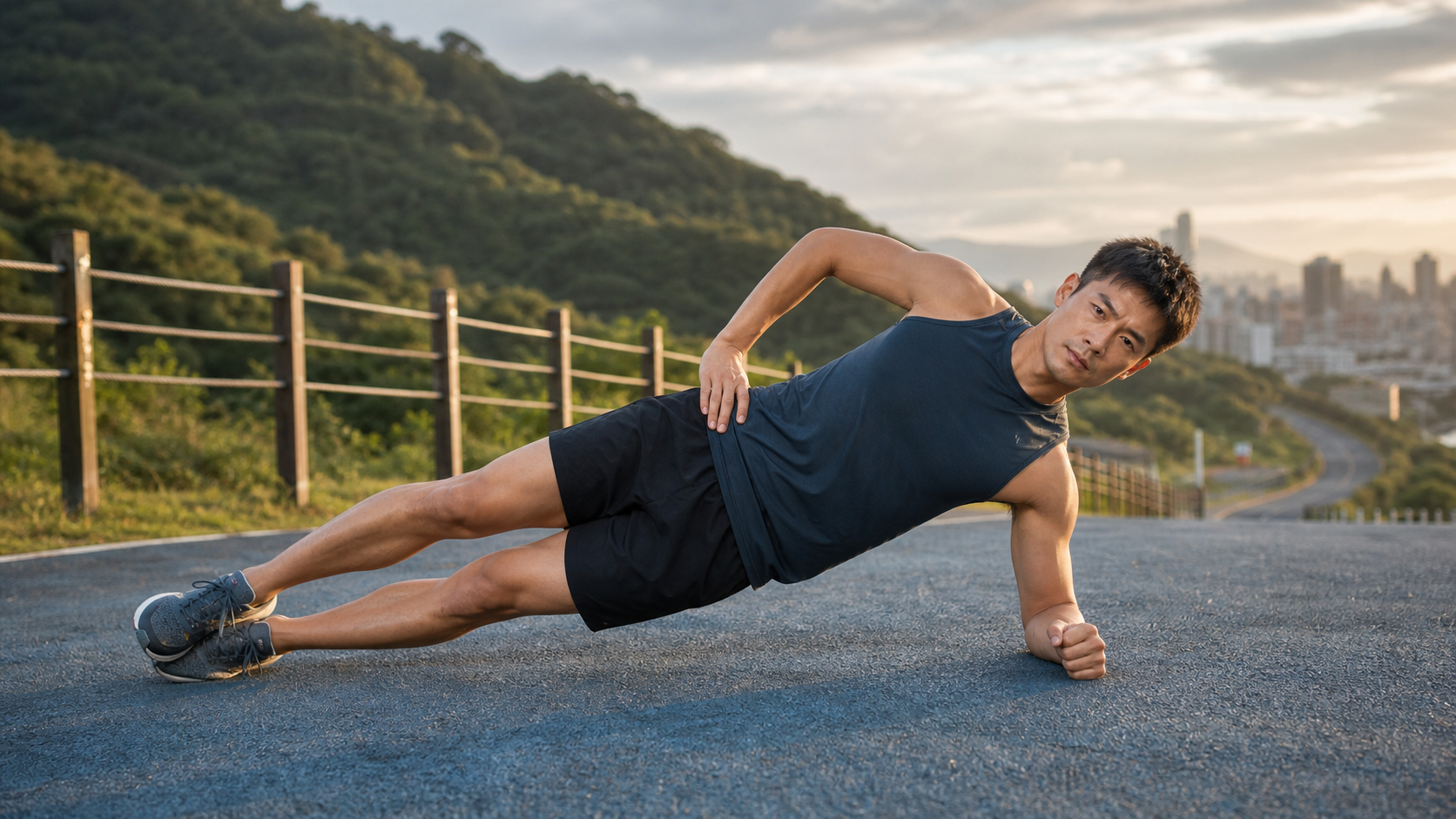
| Side Plank | Quadratus lumborum, gluteus medius | 3 sets/side | 20–40 seconds |
| Dead Bug | Transversus abdominis, multifidus | 3 sets | 10 reps/side |
| Bird Dog | Erector spinae, gluteus maximus | 3 sets | 10 reps/side |
Dynamic Stability
Dynamic training more closely mimics the neuromuscular demands of running:
- Single-leg Romanian Deadlift (Single-leg RDL): Strengthens the gluteus medius and hamstrings, simulating the stability demands of the single-leg stance phase
- Lateral Band Walk: Direct training for a weak gluteus medius to prevent knee valgus
- Plank with Knee Drive: Combines core stability with hip flexor movement, mimicking the running movement pattern
- Copenhagen Adduction: Strengthens the contralateral pelvic stabilization mechanism
Functional Integration
These exercises combine core stability with running movement patterns:
- Running Posture Plank: Alternating knee lifts while holding a plank position, maintaining a neutral spine
- Swiss Ball Leg Curl: Simultaneously trains core stability along with the glutes and hamstrings
How to Integrate Core Training into Your Weekly Plan
Core training doesn’t require a large amount of extra time; consistency is what matters. Here is a suggested weekly schedule:
- Before running (5–10 minutes): Perform dynamic core activation, such as 2 sets each of Dead Bug and Bird Dog, to awaken the neuromuscular connection
- After running (10–15 minutes): Perform a more complete core strengthening session, taking advantage of the elevated body temperature after running
- Non-running days (15–20 minutes): Higher-intensity core training, which can be combined with glute and pelvic stability exercises
Recommended weekly frequency: Beginners 2 times per week, advanced runners 3 times per week. Consistency in training matters more than occasional high-intensity sessions.
Practical Applications for Runners in Taiwan
In Taiwan’s road running environment, the benefits of core training are especially evident in several specific scenarios:
- Mountain climbs (such as the Zhuzihu section of Yangmingshan): Pelvic stability makes your stride more powerful on uphill sections, preventing collapse from fatigue
- The latter half of a full marathon (30–42 km): Core endurance determines whether you can maintain proper form after “hitting the wall”
- Continuous descents (such as the downhill sections of the Wuling Farm Marathon): Core stability reduces the risk of knee injury during eccentric contractions
Practical Advice
- Start with the basics: If you have never systematically trained your core, start with Plank and Bird Dog, 2 times per week, and progress after 4 weeks
- Don’t neglect lateral stability: Side Plank and Lateral Band Walk target the gluteus medius and are the most effective training for preventing ITB
- Use single-leg exercises to assess your weak side: Left-right asymmetry is a common issue; single-leg training can identify the weak side and strengthen it specifically
- Core training is not sit-ups: Sit-ups offer limited benefit for running; focus on anti-rotation and anti-lateral-flexion stability training
- Coordinate with breathing: Use diaphragmatic breathing during training so the transversus abdominis naturally contracts to stabilize the spine with each exhale
Conclusion
Core training is the hidden weapon for improving your running. It won’t increase your mileage in the short term, but it will make every kilometer you run more efficient and less injury-prone. Invest 15 minutes of core training 2–3 times per week, and within a few months you will see tangible changes in the mirror, in photos, and most importantly, in your race results. Stabilize the pelvis and let running return to its most essential form of force transfer.
Related Reading
- The Impact of Core Stability on Running Speed: More Than Just Abdominal Training
- Core Stability and Running Efficiency: Which Core Exercises Are Most Effective
- Core Muscle Activation During Running: The Scientific Link Between Stability and Efficiency
- Integrating Core Training for Road Runners: How to Embed a 20-Minute Core Routine Twice a Week
[教學] Premiere 影片 手震 修正 教學 防抖 單眼 影像 GoPro 穩定 Video Stabilization
8 年前
西進武嶺 免費訓練分析服務 Intervals | 練不夠還是練過頭?你哪一種類型選手?AI模型告訴你! | 備戰神器 | 公路車 訓練 | CT Yeh
4 年前
一日北高/長距離團騎 常見問題補充篇 / 組團或跟團的眉角 / 壯車友容易被瘦車友慢性拉爆 / 原來屁股痛可能是這個原因...? / 風場配速法 / 公路車 / CT Yeh
2 年前
一日北高常見問題大集合 | 攻略 | 路線 | 訓練 | 補給 | 自行車 單車 | 一日雙城 | 雙塔 | TWB北高360 | 屁股痛
6 年前
實景訓練台) 彰化經典百K 高強度喵團 90分鐘 跟著一起練功 2019 Indoor workout Changhua Classic 100 Taiwan
7 年前
中秋團練!GoPro Hero 9 拍攝絲般順滑,ft. 新竹某校隊 公路車
5 年前
單車 一日北高 ( 雙城 ) 肥宅雙人瘋狂行 紀錄片 REACTO
10 年前
大禹嶺 到 武嶺牌樓 全程前後實況錄影 | 北進武嶺 | 東進武嶺 | KOM | 訓練台 | 坡度分析 | Taiwan KOM Last 10 km HARD | 公路車
6 年前