Introduction
“Running training only requires running”—this concept has been thoroughly overturned by modern sports science. In recent years, systematic reviews of multiple studies consistently show that strength training twice a week improves running economy by 5–8%, which translates to being able to run faster with the same effort.
Taiwanese runners generally place great emphasis on accumulating mileage, but the adoption rate of strength training remains relatively low. Many runners worry that strength training will make their muscles bigger, increase body weight, and consequently hurt their running performance. However, in reality, strength training programs designed for running focus on neuromuscular efficiency and muscular endurance rather than hypertrophy, making them a training tool every serious runner should master.
Squats: The Foundation for Building Propulsive Force
The squat is the core movement for lower-body strength training, directly targeting the gluteus maximus, quadriceps, and hamstrings—precisely the primary power sources during the push-off phase of running.
Specific Benefits of Squats for Running
- Increased Tendon Stiffness: Strengthens the elastic energy storage capacity of the Achilles tendon and quadriceps tendon, making the “spring effect” of each stride more pronounced
- Improved Maximum Strength: A higher absolute strength reserve lowers the relative effort required during running, delaying fatigue
- Better Eccentric Control of the Quadriceps: Enhances knee shock absorption during downhill running, helping prevent Runner’s Knee
Squat Variations Suitable for Runners
| Exercise | Load Intensity | Sets × Reps | Specific Benefit |
|---|---|---|---|
| Goblet Squat | Moderate | 3 × 10–12 | Core stability + movement quality |
| Back Squat | Moderate-high | 4 × 5–6 | Maximum strength development |
| Split Squat | Moderate | 3 × 8/side | Left-right strength balance |
| Assisted Pistol Squat | Bodyweight | 3 × 6/side | Functional single-leg stability |
| Box Squat | Moderate | 3 × 8 | Power and strength transition |
Technical Key Points: During the squat, track the knees toward the second toe and avoid knee valgus (knees caving inward); keep the pelvis neutral without excessive anterior tilt; descend until the thighs are at least parallel to the ground to ensure full glute engagement.
Deadlifts: The King of Posterior Chain Training
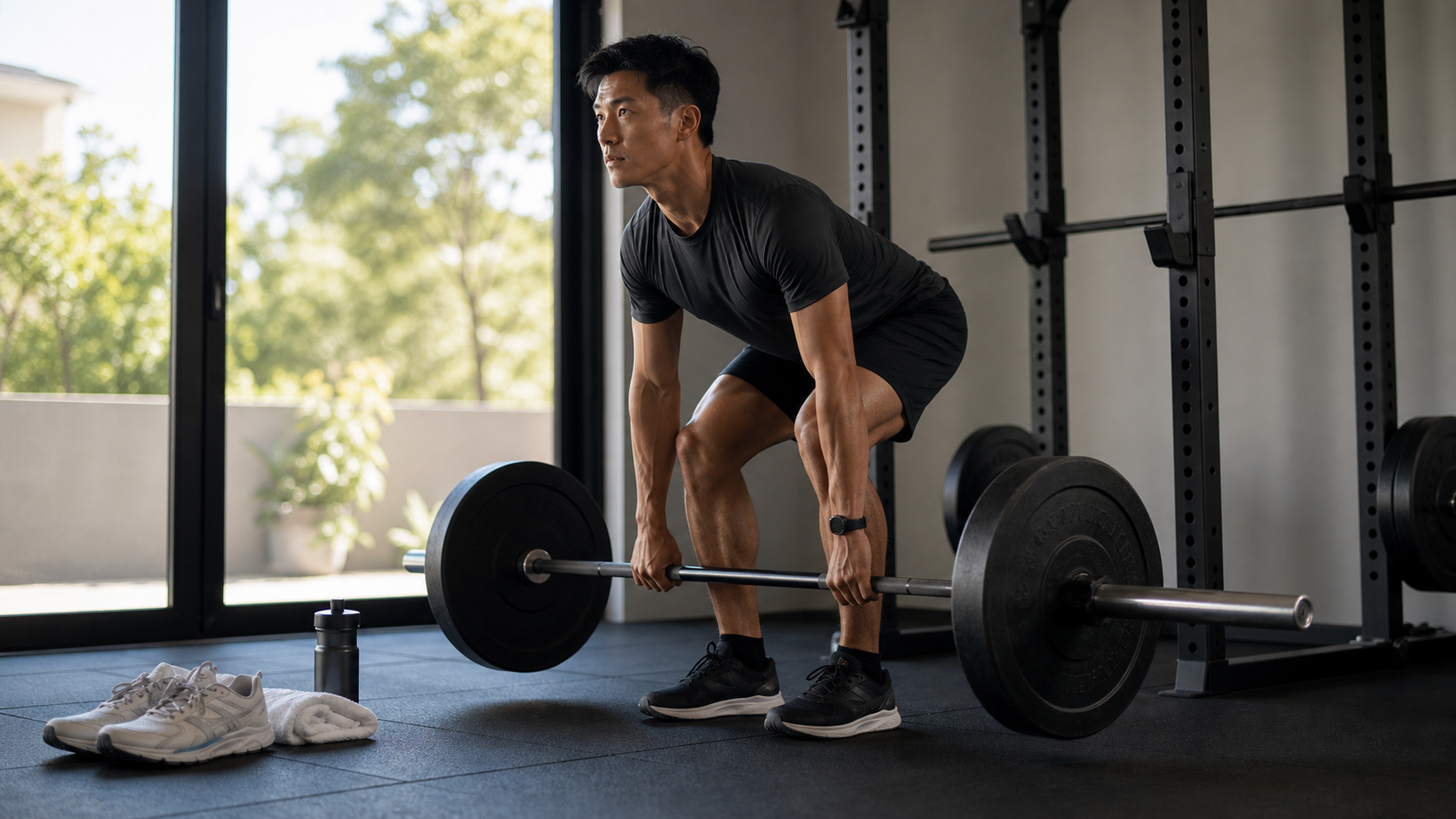
If squats train the anterior chain (quadriceps), the deadlift is the best exercise for the posterior chain (glutes, hamstrings, erector spinae). Posterior chain strength is crucial during both the push-off and stance phases of running.
Specific Benefits of Deadlifts for Running
- Strengthens the Gluteus Maximus: As the primary power source during the push-off phase, stronger glutes generate greater forward propulsion with each stride
- Strengthens the Hamstrings: Reduces the risk of hamstring strains, one of the most common muscle injuries among runners
- Strengthens the Erector Spinae: Maintains an upright torso during long-distance running, reducing postural breakdown caused by fatigue
- Enhances Overall Posterior Chain Power: Research shows that posterior chain power is significantly positively correlated with 5K performance
Deadlift Variations Suitable for Runners
- Romanian Deadlift (RDL): The most recommended version for runners, emphasizing eccentric control of the hamstrings, 3 sets × 8–10 reps
- Single-leg RDL: Mimics the single-leg support phase of running while also training core stability, 3 sets × 8/side
- Conventional Deadlift: Builds maximum posterior chain strength, suitable for runners with a strength training foundation, 4 sets × 3–5 reps
- Kettlebell Swing: Explosive posterior chain training that develops rapid hip extension—the core movement pattern of the running push-off
Periodizing Strength Training for Road Runners
Integrating strength training with running requires careful planning to avoid excessive fatigue compromising run quality:
Suggested Weekly Schedule (for runners running 5 days per week):
- Monday: Easy Run → Strength session (lower body: squats + deadlifts)
- Tuesday: Interval training — no strength training scheduled
- Wednesday: Easy run + core training (15 minutes)
- Thursday: Tempo Run — no strength training scheduled
- Friday: Strength session (lower body: power-focused)
- Saturday: Long Run
- Sunday: Complete rest or light recovery
Strength Loading Recommendations:
- Base phase (12+ weeks before race): 3–4 sets per exercise, heavier loads (5–6 RM), to develop maximum strength
- Race preparation phase (6–12 weeks before race): 2–3 sets per exercise, moderate loads (8–10 RM), to maintain strength while reducing fatigue
- Pre-race taper (2 weeks before race): 2 sets per exercise, light loads, to maintain neuromuscular sensitivity
Debunking Common Myths
- “Strength training will make me heavier”: A strength program designed for road running (not a bodybuilding program) will not cause significant hypertrophy; weight gain is typically within 0.5–1 kg, and the strength gains more than offset this minimal increase
- “Strength training makes my legs sorer”: Delayed onset muscle soreness (DOMS) may occur in the first 1–2 weeks, but once the body adapts, it can actually accelerate recovery after running
- “My running volume is already enough to train my muscles”: Aerobic running cannot effectively stimulate fast-twitch muscle fibers, which are exactly what is needed for power and final sprinting; strength training is the only effective way to strengthen them
Practical Recommendations
- Start with bodyweight or light loads: Ensure proper movement technique before progressively adding weight to avoid compensatory patterns
- Prioritize squats and deadlifts: Schedule these two compound movements early in each strength session when energy levels are highest
- Perform strength training the day after running: Avoid strength training on the same day as high-intensity runs (intervals, tempo runs)
- Use a 12-week training cycle: The benefits of strength training require 6–12 weeks of consistency to show up in running performance
- Track strength progress: Assess every 2–3 weeks whether to increase load (the 5–10% rule) to ensure continued training stimulus
Conclusion
Squats and deadlifts are not exclusive to weightlifters—they are among the most direct tools for road runners to improve performance. By combining a scientific running volume plan with twice-weekly strength training, you will feel stronger push-off power, a more stable second half, and a faster PB (personal best) at Taiwan’s major marathon events. Add strength training to your training plan now.
Related Reading
- How Squats and Lunges Help Runners Build Strength
- Strength Supplementation Plan for Road Running: Weekly Schedule Design with Squats, Single-leg Deadlifts, and Bridges
- Strength Training for Running: A Complete Program with Squats, Lunges, and Single-leg Exercises
- Combining Running and Strength Training: Why Runners Need to Lift Weights
實景訓練台) 彰化經典百K 高強度喵團 90分鐘 跟著一起練功 2019 Indoor workout Changhua Classic 100 Taiwan
7 年前
Fitting訓練兩用功率車 ! Thinkrider ST900 完整實測!/ 坡度升降 / 鄰居測試/ smart bike/公路車/ CT Yeh
2 年前
西進武嶺 免費訓練分析服務 Intervals | 練不夠還是練過頭?你哪一種類型選手?AI模型告訴你! | 備戰神器 | 公路車 訓練 | CT Yeh
4 年前
CT暗黑廚房) 車友必備 宇宙無敵鮮蚵湯 幫助訓練恢復 天然食補 好市多 超肥鮮蚵 破PR
7 年前
一個測試有沒有認真練車的方法😂 #公路車
10 個月前
一日北高常見問題大集合 | 攻略 | 路線 | 訓練 | 補給 | 自行車 單車 | 一日雙城 | 雙塔 | TWB北高360 | 屁股痛
6 年前
元宇宙單車運動!智騎 X7 Pro 智能訓練台 ThinkRider 居家線上練功
5 年前
ThinkRider 智騎 XXPRO 訓練台,高階機種功能 只要 1/3價格!? 實測功率對比、噪音實測 / 公路車 / CT Yeh
1 年前