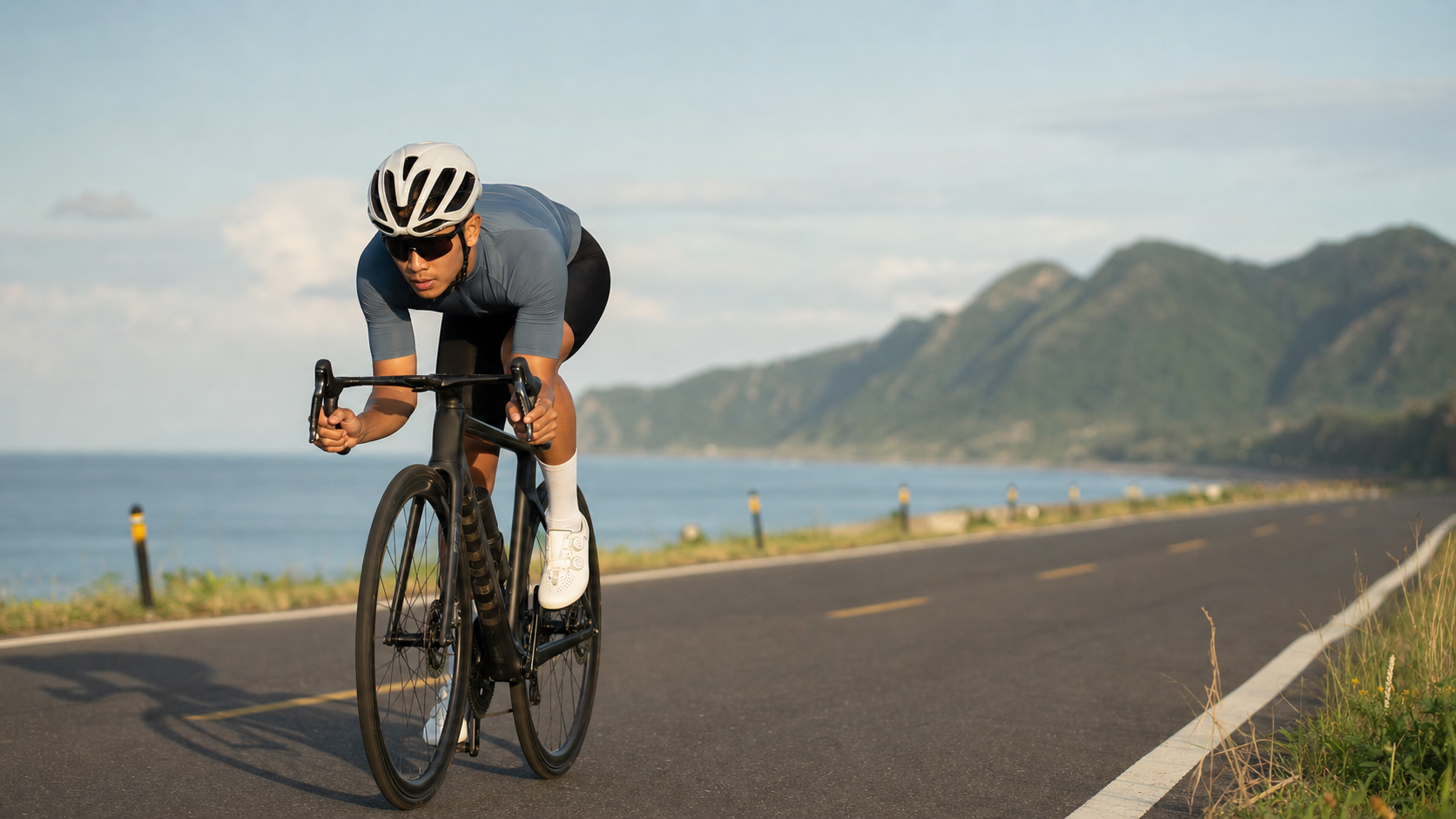
Introduction
When riding at 40 km/h on flat ground, approximately 80% of energy expenditure goes toward overcoming air resistance. This means that even if power output increases by 5%, a posture that reduces wind resistance by 10% could yield a more significant overall speed gain. Biomechanical research on cycling reveals that riding posture is not just a matter of comfort—it is central to efficiency and speed.
The Physics of Air Resistance
Drag force is determined by the following formula:
F_drag = 0.5 × ρ × v² × C_d × A
- ρ: Air density (approximately 1.2 kg/m³ at sea level in Taiwan)
- v²: The square of velocity (the faster you go, the sharper the increase in drag)
- C_d: Drag coefficient (determined by posture)
- A: Frontal area (determined by torso size)
For riders, the main controllable factor is C_d × A (the CdA value). Research shows that elite road cyclists have a CdA of approximately 0.3–0.4 m², while a general posture can reach 0.5–0.6 m². The speed difference this gap creates on flat ground can be 3–5 km/h.
Biomechanical Analysis of Posture
Upper Body: The Golden Range of Torso Angle
The torso inclination angle directly determines frontal area:
| Torso Angle (relative to horizontal) | Posture Description | Estimated CdA | Suitable Scenario |
|---|---|---|---|
| 10–20° | Time trial / low TT position | 0.20–0.25 | Flat-ground time trialing |
| 20–35° | Standard drops attack position | 0.30–0.35 | Fast riding on flat ground |
| 35–50° | Hoods resting position | 0.40–0.50 | Easy cruising |
| >50° | Upright comfort position | 0.55–0.65 | Sightseeing / rehabilitation |
Bending the elbows (rather than locking them straight) allows the upper arms to absorb some of the wind pressure while letting the torso tilt forward more naturally. Research shows that bending the elbows to approximately 90° can reduce CdA by about 0.02–0.04 m² compared to straight arms.
Head Position
The head is a significant source of wind resistance—its frontal area is approximately 0.03–0.05 m². Pro riders deliberately lower their heads to align with the spine during sprints or time trials. However, excessive head lowering compromises vision and steering reaction. For general training, the principle is to keep your eyes able to clearly see the road ahead.
Lower Body: The Interaction Between Pedaling Mechanics and Posture
Lower-body pedaling posture affects power output, but it also influences pelvic stability:
- Anterior Pelvic Tilt: A moderate forward tilt allows the hip flexors to generate greater torque at the top of the pedal stroke, but excessive tilt increases stress on the lumbar spine
- Sit-bone contact points: With correct saddle height, the sit bones should rest stably on the saddle, with no body rocking, reducing unnecessary wind resistance
The Scientific Basis of Bike Fit
The optimal riding posture must strike a balance between aerodynamic benefit and power output:
- Excessive lowering (chasing CdA) → restricted hip flexors, reduced pedaling efficiency, and decreased power output
- Excessive sitting height (chasing comfort) → excessive wind resistance and speed loss
The core of Bike Fit is finding an individual’s “optimal efficiency posture,” taking into account:
Static Assessment:
- Torso length, arm length, and leg length proportions
- Shoulder joint mobility and hip flexion angle
- Core muscle stability
Dynamic Assessment (while riding):
- Pedaling smoothness (whether there are dead spots)
- Knee tracking direction (whether the knees cave inward or bow outward)
- Pelvic stability (whether there is side-to-side rocking)
Practical Advice
- Long, straight flat roads in Taiwan, such as those in Tainan and Chiayi, are especially suitable for practicing low-drag postures, where the speed difference is clearly noticeable
- Use a fan on a trainer to simulate wind resistance and practice holding a low posture for extended periods (gradually increasing from 10 minutes)
- Use a GoPro or smartphone to film your riding posture from the side, and have an experienced riding buddy or coach evaluate it
- Professional Bike Fit services cost approximately NT$3,000–8,000, which is a high-return investment for serious riders
- Aero components (aero helmets, aero handlebars) are less effective at improving CdA than posture adjustment—optimize your posture first before considering equipment
- On climbs, the importance of wind resistance decreases; standing pedaling is beneficial on steep climbs, so there is no need to force a low posture
Conclusion
The biomechanics of riding posture is the “cheapest speed gain” in cycling. Without replacing expensive components, simply through proper Bike Fit and disciplined posture training, the same power output can be converted into greater speed. Next time you ride, try to feel the change in wind resistance in the drops attack position—that is science accelerating you.
Related Reading
- Cycling Aerodynamics: Quantifying the Impact of Riding Posture and Equipment on Wind Resistance
- The Aerodynamics of Cycling: The Science of Wind Resistance Optimization from Helmet to Riding Position
- Applications of Aerodynamics in Cycling: Riding Position, Helmets, and Apparel
- The Biomechanical Cost of an Aero Riding Position: The Compromise Between Speed and the Body
靠單車減肥35公斤 心得分享與整理
7 年前
CT 喇低賽) 單車 比賽總是沒照片? 攝影師的觀點大公開 姿勢就是力量! 請加速1.25倍收看
7 年前
#公路車 #Fitting 靠人工智慧APP 幫你調整單車
6 年前
風櫃嘴 | 全台最多大砲的單車路線 | 尋寶網攝影師告訴你怎麼擺拍起來才好看 | 熱門攝影地點巡禮
6 年前
3D 列印車褲墊 / 舒適改善? / 無痕 x 分區壓縮 / ATK & Decider系列 / JE22黑科技 / #公路車 #CTYEH
11 個月前
一日北高/長距離團騎 常見問題補充篇 / 組團或跟團的眉角 / 壯車友容易被瘦車友慢性拉爆 / 原來屁股痛可能是這個原因...? / 風場配速法 / 公路車 / CT Yeh
2 年前
再快都跟的上!? 單車跟隨攝影機之王 HOVERAir X1 PROMAX 全面實測 / 唯一!8K畫質&自行車專用模式和跟蹤信標&前後避障 / DJI Neo 可參考/ 公路車 / CT Yeh
1 年前
CT 喇低賽) 武嶺牽車 才是王道 西進牽車四小時內秘訣 攝手位置 如何判斷 防抽筋小秘訣
7 年前