The Scientific Impact of Strength Training on Cycling Performance: Eccentric and Concentric Training
Introduction
For a long time, many cyclists in Taiwan have considered strength training to be “something for land-based athletes,” believing that cyclists only need to ride more to improve. However, over the past decade, a large body of scientific research has consistently shown that appropriate weight training not only fails to make cyclists “too heavy,” but can significantly improve pedaling efficiency, climbing power, and sprinting ability, while even reducing the risk of injury.
The Scientific Benefits of Strength Training for Cycling
Improving Cycling Economy
Cycling economy refers to oxygen consumption at the same power output—the higher the economy, the more power can be produced from the same amount of oxygen. Research shows that regular Maximum Strength Training can improve cycling economy by 5–10%.
Mechanisms:
- Greater lower-limb strength → reduced relative muscle recruitment ratio during submaximal pedaling → fatigue sets in more slowly
- Improved neural recruitment efficiency → the same muscle mass generates greater force
A Norwegian study (Rønnestad et al., 2010) found that after 12 weeks of half-squat strength training, subjects improved cycling economy by 7%, 30-minute time trial performance by 4%, without significant increases in body weight.
Improving Climbing Power
Climbing requires higher pedaling torque, and strength training can directly increase maximum torque output, allowing cyclists to climb more effortlessly.
Improving Sprint Power
The correlation coefficient between maximum sprint power (5-second peak power) and maximum muscle strength is above 0.8, making strength training one of the most effective means of improving sprinting ability.
Muscle Contraction Types: The Division of Labor Between Eccentric and Concentric
Concentric Contraction
The muscle produces force while shortening; this is the primary mechanism of the pedaling downstroke:
- Representative movements: Squat ascent, leg press extension
- Cycling equivalent: The downward force applied toward the 6 o’clock position of the pedal stroke
Eccentric Contraction
The muscle produces force while lengthening; this is the mechanism of “braking” and “elastic energy storage”:
- Representative movements: Squat descent, leg press retraction
- Characteristics: Muscles can produce greater force during eccentric contraction than concentric (approximately 1.2–1.3 times)
- Primary cause of DOMS: Delayed-onset muscle soreness is mainly triggered by eccentric contractions
| Contraction Type | Muscle Length Change | Force Potential | Neural Recruitment | Injury Risk |
|---|---|---|---|---|
| Concentric | Shortening | Moderate | Lower | Low |
| Isometric | Unchanged | High | Moderate | Low |
| Eccentric | Lengthening | Highest | High | Moderate (initially) |
Applications in Cycling-Specific Strength Training
Bulgarian Split Squat: Mimics the single-leg force pattern of cycling pedaling, strengthening both eccentric (descent) and concentric (ascent) phases.
Nordic Hamstring Curl: Emphasizes eccentric strength of the hamstrings, significantly reducing the risk of knee and hamstring injuries.
Eccentric Squat: Lower over 3–5 seconds, rise in 1 second, strengthening eccentric control of the quadriceps.
Cycling-Specific Strength Training Program Design
Base Strength Phase (10–12 weeks, off-season)
Goal: Build a maximum strength foundation, improve neural efficiency
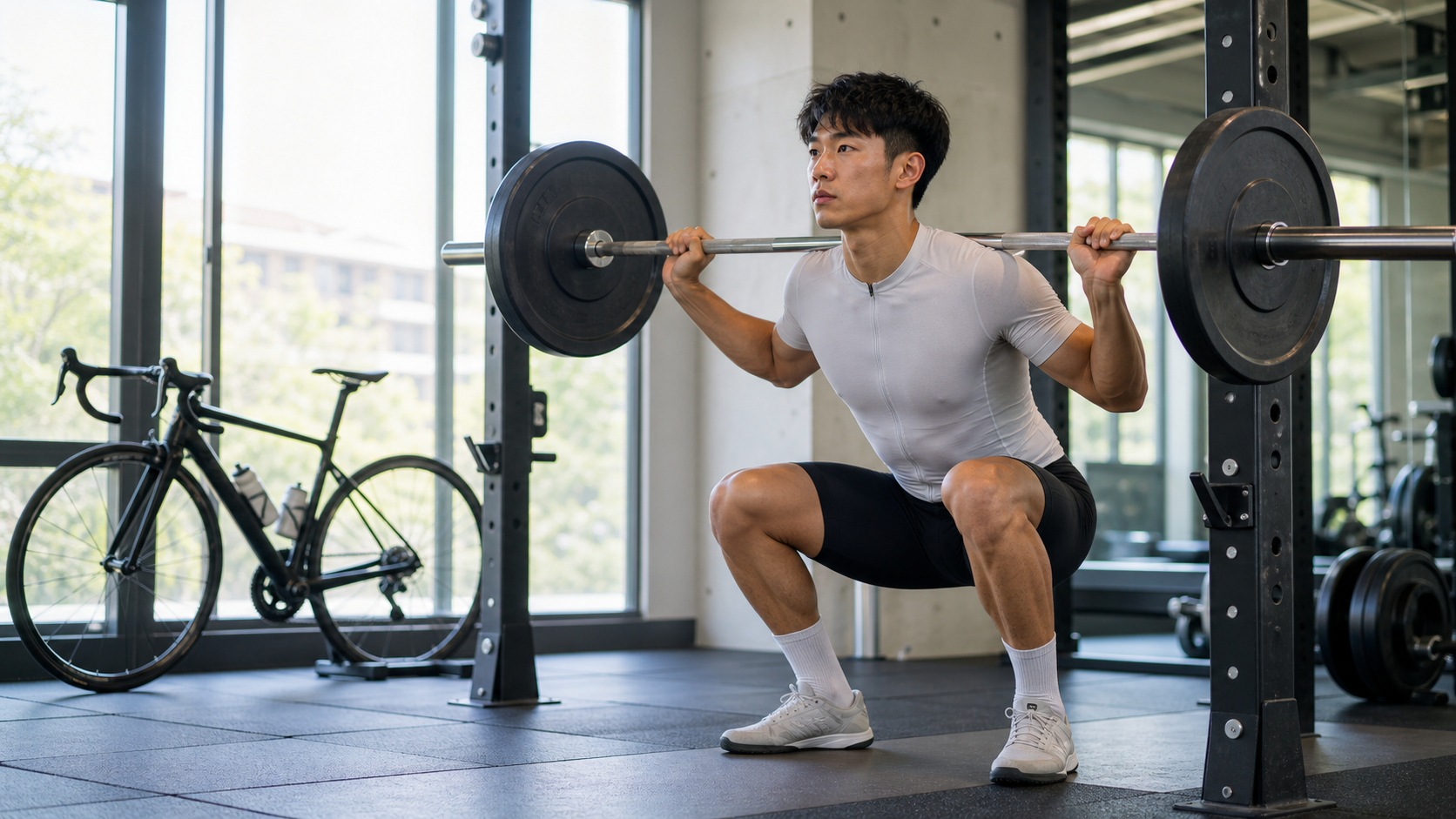
- Main lifts: Back Squat or Leg Press
- Sets/Reps: 3–4 sets × 4–6 reps (75–85% of 1RM)
- Accessory movements: Bulgarian Split Squat 3×8, Nordic Hamstring Curl 3×6, Hip Thrust 3×10
- Frequency: Twice per week, scheduled separately from high-intensity cycling sessions
Power Phase (4–6 weeks, pre-season)
Goal: Convert maximum strength into explosive power
- Main lift: Jump Squat 3×5 (30–40% of 1RM, performed at maximum speed)
- Accessory movements: Plyometric drills, single-leg explosive jumps
- Frequency: 1–2 times per week
Maintenance Phase (in-season)
Goal: Maintain strength gains without compromising riding training
- One light strength session per week (2–3 sets × 6–8 reps, 60–70% of 1RM)
Practical Recommendations
- Strength training should be scheduled after (or on the day following) indoor trainer sessions, to avoid heavy lifting compromising pedaling quality
- Significant DOMS is expected in the first 2 weeks of strength training—don’t stop because of it; your body is adapting
- Concerns about weight gain are usually unnecessary: appropriate strength training (1–2 sessions per week, not bodybuilding-style) will not significantly increase body weight and may actually improve body composition
- Core strength training (planks, Russian twists, dead bugs) is particularly important for improving riding stability and protecting the lower back
- Cyclists with knee discomfort should consult a physical therapist before performing squat-type movements
Conclusion
Strength training is a long-underestimated tool in the cyclist’s training toolbox. Science has made it clear: weight training will not make cyclists “heavier and slower,” but rather improves pedaling efficiency, delays fatigue, and enhances sprint power. Step into the gym and use scientific eccentric and concentric training to build the foundation for your riding performance—the stronger you become will ride more easily and faster on those mountain roads.
Related Reading
- Analysis of Pedaling Force Vectors in Cycling: The Most Effective Pedaling Angles and Muscle Coordination
- A Cyclist’s Weight Training Program: Strength Training to Boost Power Output
- The Science of Cycling Efficiency: A Comprehensive Analysis of Pedaling Technique, Aerodynamics, and Equipment
- Neuromuscular Training for Cyclists: Scientific Methods to Improve Explosive Power and Pedaling Efficiency
靠單車減肥35公斤 心得分享與整理
7 年前
全台首發!邁金P715踏板功率計!市場價格撼動者再出招 / 功率對比實測 / FAVERO ASSIOMA 可參考! / 公路車 / CT Yeh
1 年前
ThinkRider 智騎 XXPRO 訓練台,高階機種功能 只要 1/3價格!? 實測功率對比、噪音實測 / 公路車 / CT Yeh
1 年前
Fitting訓練兩用功率車 ! Thinkrider ST900 完整實測!/ 坡度升降 / 鄰居測試/ smart bike/公路車/ CT Yeh
2 年前
本週北高前練習,連同天比的226們也來⋯鐵車真的太猛了 #cycling #北高
2 年前
訓練台體驗) 2019台北自行車展 三大家 訓練台體驗 Tacx Neo Flux 2 Xepdo Apx Wahoo Kickr
7 年前
#公路車 #Fitting 靠人工智慧APP 幫你調整單車
6 年前
單車元宇宙新霸主?TrainingPeaks Virtual 實測 / Zwift 完美平替? 還是超越?/ 有台灣國旗!前身 indieVelo / 公路車 / CT Yeh
1 年前