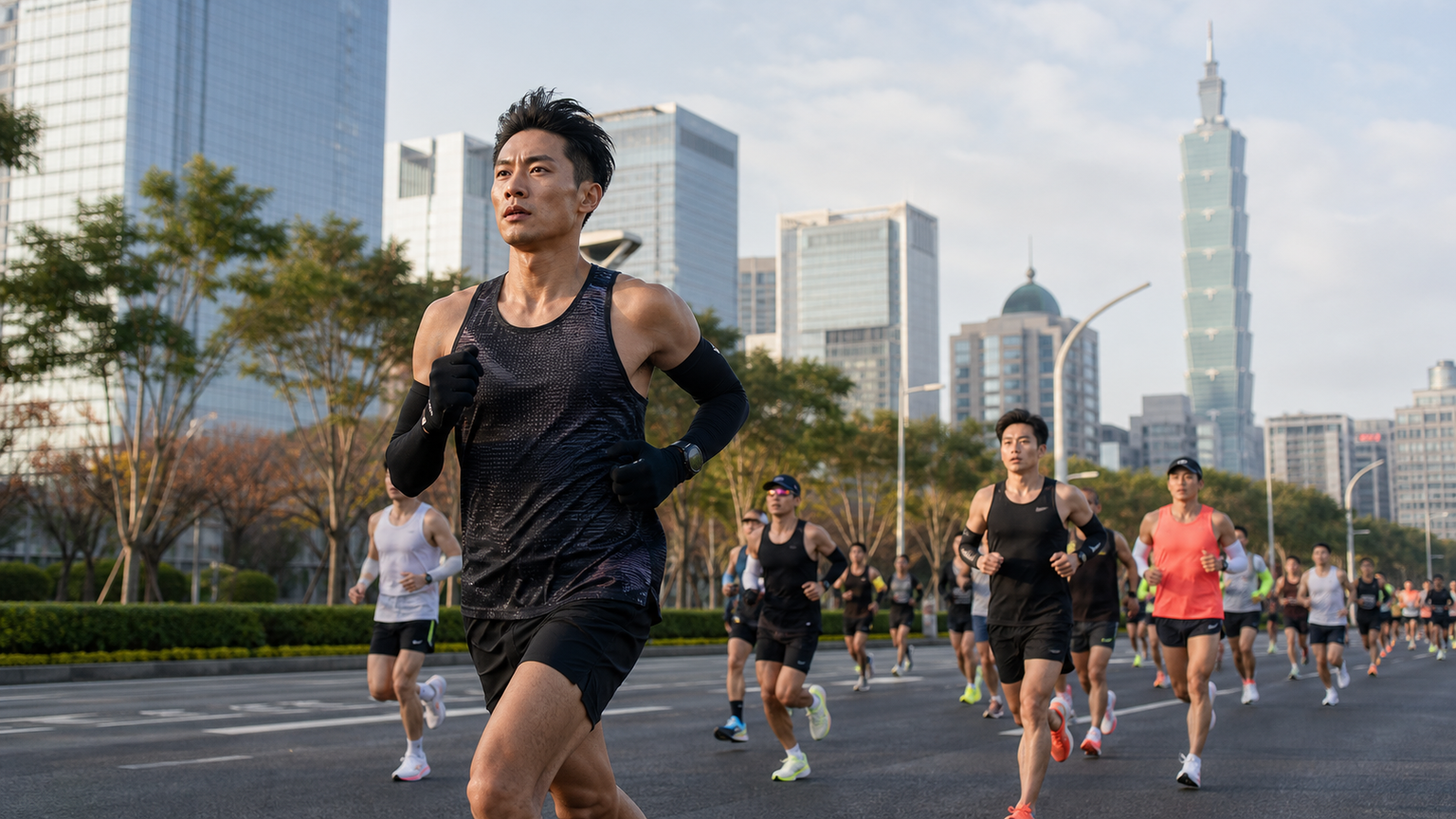
Introduction
The Taipei Marathon is held every December, starting and finishing at the City Hall Plaza, connecting Taipei’s prime sections such as Xinyi District, Ren’ai Road, and Zhongshan North Road. It is an annual highlight for many runners. For those aiming to set a personal best (PB) at this event, understanding the race’s characteristics and developing a pacing strategy in advance is often more critical than relying on race-day performance.
Registration and Preparation
The Taipei Marathon typically opens registration in August, with limited spots across the full marathon, half marathon, and 9K categories, often filling up within one to two weeks. Here are the key registration points:
- Registration System: Uses the official designated platform (in recent years, mostly Sports Note), and it is recommended to log in on time on the opening day
- Corral Standards: Full marathon runners choose their starting corral (A–E) based on past results or estimated finish time; choosing the wrong corral will affect your early-race rhythm
- Gear Drop-off: Baggage storage services are available on-site; it is recommended to confirm the location when picking up your bib number in advance
- Transportation Advice: Many roads in Taipei are under traffic control on race day; it is recommended to take the MRT to Taipei City Hall Station or Xiangshan Station
Route Analysis: Elevation and Key Sections
The Taipei Marathon has minimal overall elevation change and is a flat city course, but there are still several sections that require attention:
| Section | Distance Range | Characteristics | Recommended Strategy |
|---|---|---|---|
| Xinyi Planned Area | 0–5K | Crowded, slight incline | Start conservatively; avoid being pulled into a faster pace by the crowd |
| Ren’ai Road | 5–15K | Flat, wide, tailwind | Maintain steady pace and rhythm |
| Northern Zhongshan North Road | 15–25K | Gentle uphill transitioning to gentle downhill | Conserve energy on the uphill; do not surge on the downhill |
| Return on Xinyi Road | 30–42K | Mentally taxing stretch | Adjust based on heart rate; do not push through stubbornly |
It is worth noting that although the tree-lined boulevard on Ren’ai Road is visually pleasant, the winter months occasionally bring crosswinds from the northeast monsoon. Runners often feel increased resistance around the 10K mark, so reserve extra energy in advance to cope.
Pacing Strategy: Full Marathon Segment Plan
Research shows that the most effective marathon finish strategy is “negative splitting” or “even pacing”—where the second half is run at a pace equal to or slightly faster than the first half. For the Taipei Marathon’s flat terrain, here are recommended paces for different target times:
- Sub-4 (5:41 per km): First half at 5:45–5:50, second half at 5:35–5:40
- Sub-3:30 (4:58 per km): First half at 5:02–5:05, second half at 4:55–5:00
- Sub-3 (4:15 per km): First half at 4:17–4:20, second half at 4:10–4:15
The first 5 kilometers are densely crowded, and almost all runners will run slower—this is normal. Do not panic or force your way through gaps in the crowd, as this can easily cause sprains or disrupt your breathing rhythm.
Aid Stations and On-Site Resources
Aid stations at the Taipei Marathon are spaced approximately 2.5 kilometers apart, offering water and sports drinks (provided in recent years), with some sections also providing solid fuel such as bananas and candies. Recommended planning:
- First 15K: One cup of water per station is sufficient; no need for heavy eating
- 15–30K: Take one energy gel (self-supplied) every 5–7 kilometers, paired with water at aid stations
- After 30K: Supplement with solid sugars based on energy levels to maintain stable blood sugar
Practical Tips
- Avoid excessive shopping or prolonged standing two days before the race; Taipei’s department store anniversary sales happen to coincide with this period, so exercise extra restraint
- December mornings in Taipei are around 15–18°C; wear a disposable thin jacket at the start and discard it after 10K once temperatures rise
- The course surface is asphalt; it is recommended to wear marathon racing shoes with cushioning, avoiding pure carbon-plated shoes that may cause plantar fatigue after 35K
- The night before, consider staying in Taipei’s eastern district to shorten travel time and ensure at least 7 hours of sleep
Conclusion
The appeal of the Taipei Marathon lies in its urban scenery and race scale, but to achieve a good time amid the crowds requires more meticulous advance planning than other races. Master the course characteristics, set a reasonable pacing goal, and prepare your fueling plan—then you can leave your own personal best on the streets of Taipei.
Related Reading
- The Ultimate Guide to the Taipei Marathon: Route Analysis and Pacing Strategy
- Complete Guide to the Taipei Marathon: Route, Aid Stations, and Pacing Strategy
- Taipei Marathon Guide: Course Analysis, Pacing Advice, and Aid Station Locations
- The Complete Taipei Marathon Guide: From Registration to Finish Line
Live) 備戰2019彰化經典百K 賽前攻略 (已完賽請看新影片
7 年前
單車 一日北高 ( 雙城 ) 肥宅雙人瘋狂行 紀錄片 REACTO
10 年前
車隊介紹) 台北 一年開團365天 車隊 Apollo Ride 晨騎 好選擇 ( 陽明山 風櫃嘴 冷水坑 平等里 聖人 關渡 大稻埕 ) 找人騎車
7 年前
2018 田中馬拉松 全程健跑 VR 360 環景錄影 體驗現場狂野加油氣氛! Insta 360
7 年前
一日北高/長距離團騎 常見問題補充篇 / 組團或跟團的眉角 / 壯車友容易被瘦車友慢性拉爆 / 原來屁股痛可能是這個原因...? / 風場配速法 / 公路車 / CT Yeh
2 年前
一日北高前的高裝檢 | 北高 360 | 挑戰11小時的裝備 | 一日雙塔 | 補給
6 年前
如何 搶 #中央山脈 報名 #公路車 #報名 #搶票
7 年前
西進武嶺 免費訓練分析服務 Intervals | 練不夠還是練過頭?你哪一種類型選手?AI模型告訴你! | 備戰神器 | 公路車 訓練 | CT Yeh
4 年前