Introduction
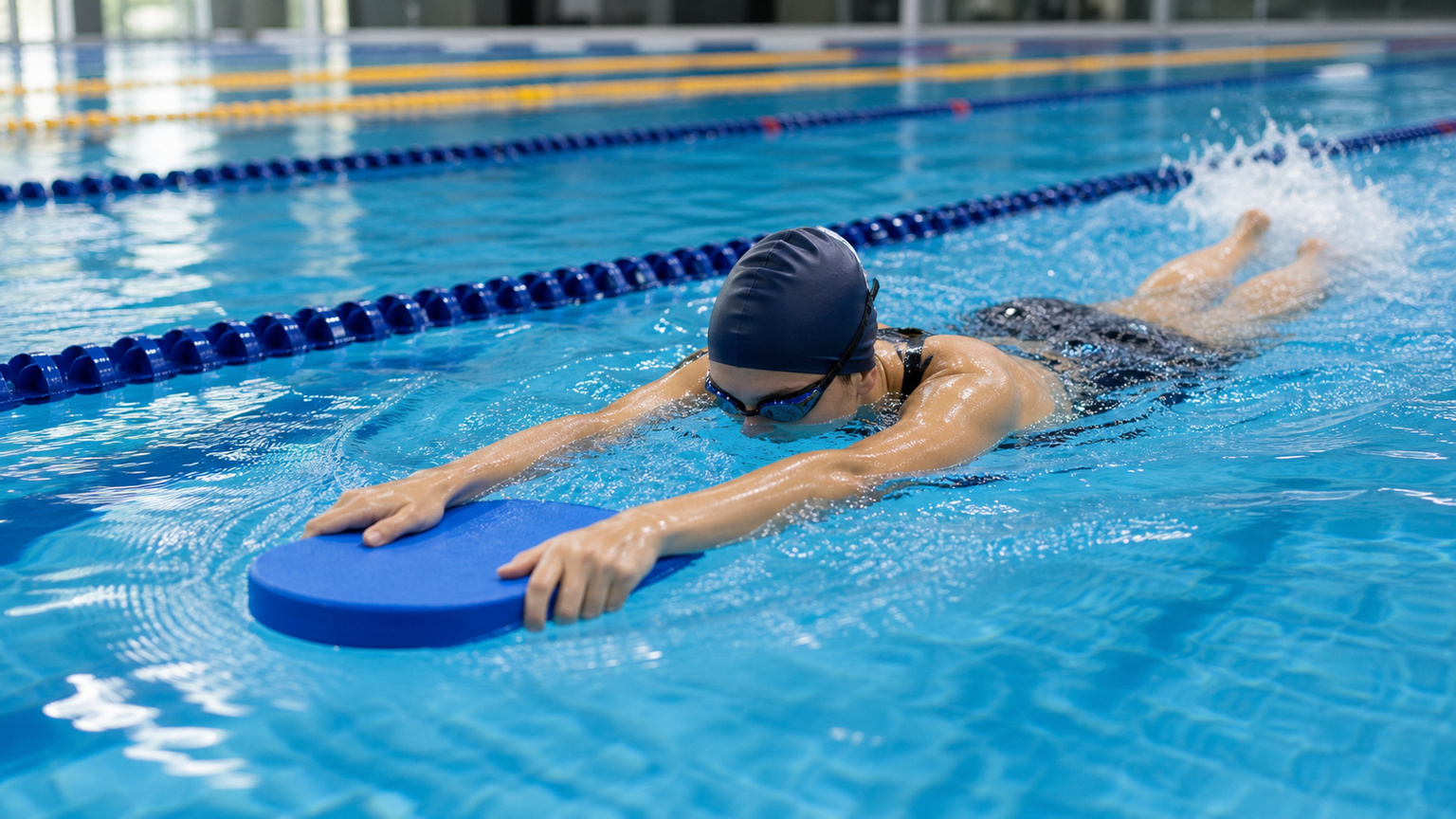
Walk into the equipment room of almost any pool and you’re bound to see a row of brightly colored foam kickboards stacked neatly on a shelf. The kickboard is standard swim-class equipment, used by everyone from a child taking their first swim lesson to elite athletes preparing for the Olympics. Yet most people’s understanding of the kickboard stops at “hold the board and kick,” with little awareness of the training science behind it. This article takes kickboard use to a deeper level of training understanding.
The Evolution of Kickboard Design
From Traditional to Modern Kickboards
The traditional kickboard is a simple rectangular foam board that mainly provides upper-body buoyancy support so swimmers can focus on kick training. Modern kickboard designs have become quite diverse:
| Kickboard Type | Design Features | Suited Training |
|---|---|---|
| Traditional rectangular board | Large surface area, high buoyancy | Beginner kicking, basic leg training |
| Streamlined short board | Shortened version, less drag | Advanced swimmers, simulating swim posture |
| FINIS core board | Built-in hand grooves | Forces a high-elbow catch position |
| Vertical training board | Upright grip design | Core stability training |
| Contoured kickboard | Shaped to fit the arm’s curve | Reduces shoulder strain |
The Relationship Between Material and Buoyancy
Most pool kickboards are made of EVA (ethylene-vinyl acetate) foam, which is lightweight, waterproof, and abrasion-resistant. Lower-density EVA offers greater buoyancy but slightly less durability, while higher-density versions are more durable but slightly less buoyant. For training purposes, a standard pool-issue kickboard is usually more than sufficient.
The Biomechanics of Kicking
A Physical Analysis of the Freestyle Kick
The freestyle flutter kick is not the primary source of propulsion — most studies show that kicking contributes only about 10–20% of overall speed (with the remaining 80–90% coming from the arm pull). Even so, the kick is essential for keeping the body horizontal in the water and reducing the drag caused by the hips sinking.
The key to kick efficiency is ankle flexibility. The freestyle kick requires substantial range of motion in plantarflexion (pointing the foot) so the foot can act like a fin to generate propulsion. Research suggests that as ankle flexibility increases, kick efficiency improves accordingly, which is why swim training programs commonly include ankle-stretching exercises.
The Special Training Demands of the Breaststroke Kick
The breaststroke kick is often underrated in a freestyle-dominated swim culture, but it matters greatly for triathletes or swimmers who occasionally need to swim breaststroke. It requires coordinated internal and external rotation of the hips together with a rhythmic bending and extending of the knees — a complex movement pattern that demands a great deal of repetition to master.
The dolphin kick is a key technique in modern competitive swimming; the quality of the underwater dolphin kick often decides the outcome of short-distance races. Practicing side-lying dolphin kicks with a kickboard is a common training variation.
Advanced Kickboard Training Applications
Kicking Without Holding the Board
Many coaches actually recommend reducing the traditional “hold the board with both hands” kick drill, because:
- Holding the board with straight arms pressing down on it tends to round the shoulders forward, distorting natural body position
- Relying on the board’s high buoyancy can push the body position too high, out of line with how the body actually sits during real swimming
Advanced alternatives include:
- Streamline kick: Hands stacked and extended straight in front of the head — the drill that most closely mirrors actual swimming posture
- Side kicking: Trains body-roll coordination while also strengthening the core stabilizing muscles
- Kicking on the back: Backstroke-style kicking, which strengthens the leg extensor muscles (using different muscles than the standard backstroke kick)
The Training Advantages of the Short Board
A smaller, lower-buoyancy short board (sometimes called a “hand board” or “small board”) more closely approximates race-pace body position and is the preferred choice for intermediate-to-advanced swimmers. In Taiwan’s training environment, the large traditional kickboard is far more common, so swimmers with higher demands for speed-focused training may want to purchase a short board on their own.
Common Mistakes and How to Fix Them
- Mistake 1: Kicking with too large an amplitude — An overly large kick amplitude generates more drag than propulsion; keep the kick amplitude to roughly 30–40 cm
- Mistake 2: Bending the knees too much — The kick should originate primarily from the hips, not rely excessively on knee bend
- Mistake 3: Letting the toes droop downward — Insufficient plantarflexion greatly reduces kick efficiency; regular ankle-flexibility training is recommended
- Mistake 4: Holding your breath while kicking — Maintain a normal breathing rhythm during kickboard drills to avoid forming a habit of breath-holding
Practical Tips
- Kickboard drills should generally make up about 20–30% of total training volume per session; too much can lead to shoulder fatigue
- University swim teams across Taiwan typically stock kickboards in various sizes — once you join a training program, ask the coach which size is recommended
- Children’s swim lessons can rely heavily on the kickboard to build confidence, but should transition as early as possible to full swimming technique that doesn’t depend on the board
- Ankle-flexibility exercises (such as kneeling ankle-stretch positions) can be done on dry land and are a great complement to pool training
Conclusion
The kickboard is an underrated training tool — not just a way to help beginners kick safely, but also an important aid for advanced swimmers refining kick technique and training core stability. Stepping outside the “hold the board and kick” mindset and exploring the kickboard’s many other training applications is how this most basic piece of pool equipment can deliver its greatest value.
Related Reading
- Kickboard Buying Guide: An In-Depth Comparison of Standard vs. Streamlined Kickboards
- Choosing a Kickboard: The Feel and Training Benefits of Hard vs. Soft Boards
- Kickboards vs. Paddles: How These Training Aids Serve Very Different Purposes
- Using the Kickboard for Pull Drills: Correct Form and Purpose for Upper-Body-Focused Training
#PUSHBIKE 原來這麼好玩! 小朋友 滑步車 初體驗 超可愛
6 年前
滑雪新手們慘摔學習全紀錄(請開字幕),滑雪好好玩 | Snowboard + Ski | 岩原 スキー場 | 滑雪APP使用 | GoPro Max
6 年前
一日北高 實用 單車手機架!Bone蹦克磁吸單車手機綁 //環島/室內訓練 / 導航的APP推薦 / 日本島波海道取景 / 公路車 / CT Yeh
2 年前
一日北高常見問題大集合 | 攻略 | 路線 | 訓練 | 補給 | 自行車 單車 | 一日雙城 | 雙塔 | TWB北高360 | 屁股痛
6 年前
#公路車 #Fitting 靠人工智慧APP 幫你調整單車
6 年前
Nepest NOVA 碳條輪組:輕量、空力、舒適一次滿足!/ 公路車 / CT Yeh
7 個月前
訓練台體驗) 2019台北自行車展 三大家 訓練台體驗 Tacx Neo Flux 2 Xepdo Apx Wahoo Kickr
7 年前
CT暗黑廚房) 車友必備 宇宙無敵鮮蚵湯 幫助訓練恢復 天然食補 好市多 超肥鮮蚵 破PR
7 年前