Introduction
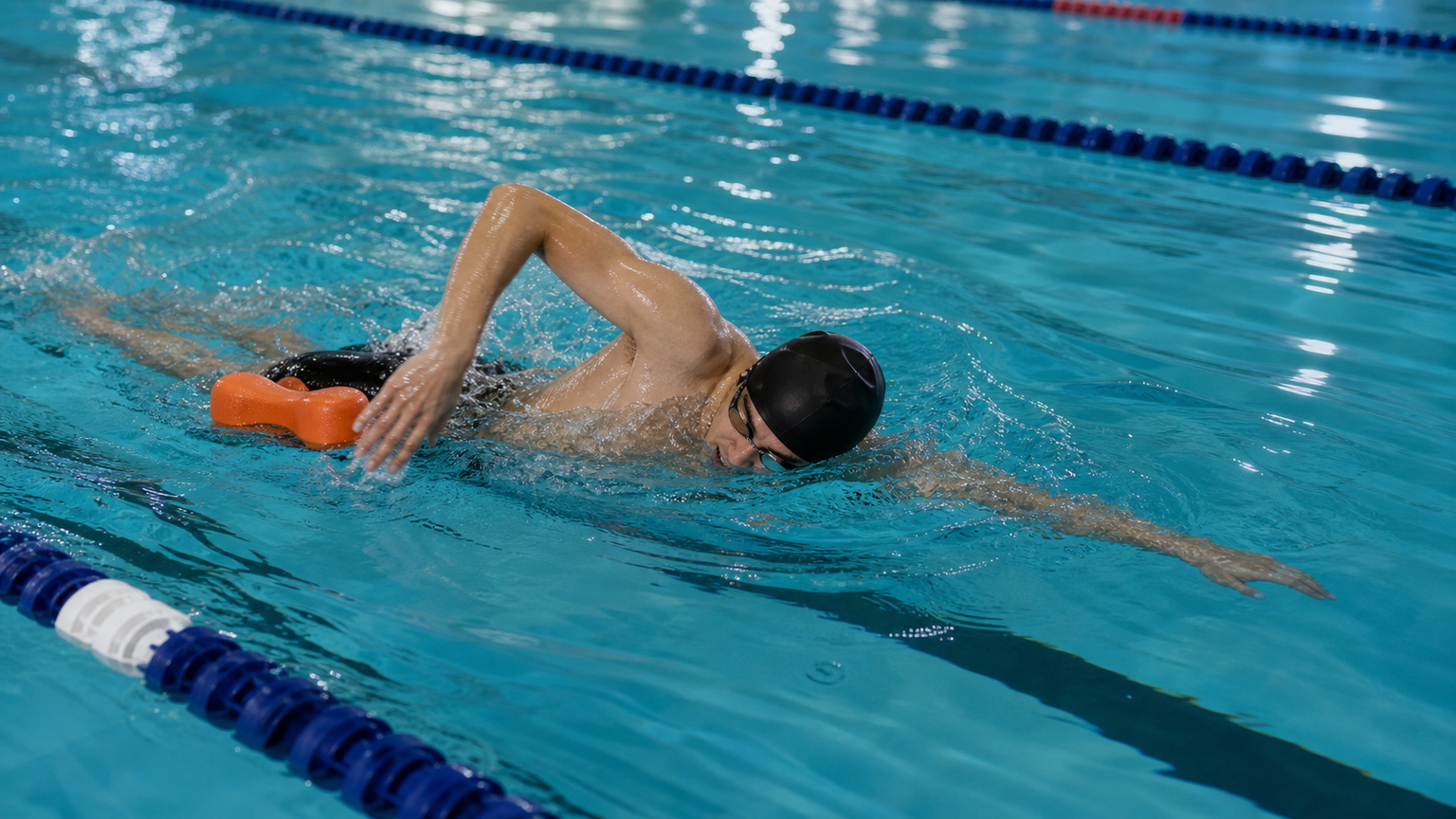
The swim pull buoy, correctly referred to in Chinese as “拉浮” or “夾腿浮球”, is a foam flotation device shaped like the number 8. Clamped between the thighs, it lifts the lower body to the surface, allowing swimmers to focus entirely on upper-body pulling drills. At pools across Taiwan, you’ll see many swimmers doing freestyle with an orange pull buoy clamped between their legs—this is the most common form of upper-body isolation training. However, the correct way to use a pull buoy and the training benefits it can deliver go far beyond what meets the eye.
How the Pull Buoy Works
Biomechanical Effects of Lower-Body Flotation Support
When the pull buoy is clamped between the thighs, its buoyancy lifts the entire lower body, positioning the body horizontally at the water’s surface and completely eliminating the propulsive contribution of kicking. This creates an “upper-body isolation training environment” where all forward speed relies solely on the pulling motion.
This isolation effect has several important implications for training:
- Technical magnifying-glass effect: With kicking removed, flaws in pulling technique (such as poor timing on the catch or deviations in the pull path) become more apparent, helping to identify problems
- Upper-body overload: The upper body must generate all propulsion on its own, making training intensity higher than full-stroke swimming
- Energy conservation: For some swimmers, kicking is a waste of energy (especially for those with weaker leg muscular endurance); using a pull buoy allows more energy to be directed toward pulling drills
How Pull Buoy Size Affects Training
| Pull Buoy Size | Buoyancy | Suitable For | Training Effect Characteristics |
|---|---|---|---|
| Small (children’s model) | Low | Teenagers, lighter swimmers | Requires some kicking to maintain body position |
| Medium (standard model) | Medium | Most adults | Full flotation, ideal for technique training |
| Large (competition model) | High | Heavier swimmers | Very high buoyancy, allows athletes to focus more on pulling |
Advanced Applications of Pull Buoy Training
Basic Pull Buoy Training
The most basic use: clamp the pull buoy and do freestyle without kicking, pulling with both arms normally to move forward. First-time users are advised to try short distances of 25 or 50 meters to feel the body’s balance point without kicking assistance.
Combined Training with Hand Paddles
Pull buoy + hand paddles is the “golden combination” for upper-body training. The pull buoy removes the kicking variable, while the hand paddles increase the pulling surface area; together they create the most efficient upper-body strength training environment. This combination is commonly abbreviated in training as “P+P (Pull + Paddle).”
Example of an advanced combination set:
Main set: 10×100m P+P, 20 seconds rest
Purpose: Maximum upper-body strength-endurance training
Note: Only suitable for swimmers with a solid foundation; beginners should reduce distance or number of reps
Breathing Rhythm Training Opportunities
When swimming with a pull buoy, since the lower body is fully supported, practicing breathing rhythm becomes easier to control. Coaches often use pull buoy sets to have athletes experiment with different breathing frequencies (such as breathing every 3/5/7 strokes) to develop breathing cadence for longer-distance races.
Pull Buoy Application for Backstroke
The pull buoy isn’t just for freestyle. When backstroke swimmers use a pull buoy, the device is clamped above the knees (rather than at the upper thighs), effectively eliminating backstroke kicking and training the backstroke pulling motion in full isolation.
Common Misconceptions About Pull Buoy Use
Misconception One: The Tighter You Clamp, the Better
Clamping the pull buoy too tightly restricts the natural rotation of the hips, limiting the pulling motion. The correct approach is to hold the pull buoy naturally with the thighs, firm enough to keep it from slipping out, without squeezing hard.
Misconception Two: Prolonged Pull Buoy Use Can Replace Full-Stroke Swimming
Pull buoy training is a supplementary tool and should not replace complete swimming training. Over-reliance on the pull buoy (such as spending more than 50% of each session with it clamped) can lead to a decline in kicking ability and problems with integrating upper- and lower-body coordination in actual swimming.
Misconception Three: The Pull Buoy Is Suitable for Everyone
Swimmers with lower-back pain or lumbar instability should use the pull buoy with caution. The high buoyancy provided by the pull buoy can cause the lumbar spine to arch (hyperextension), potentially aggravating lower-back stress over time.
Buying Guide
- Material selection: The mainstream material is EVA foam; choose a model with moderate density and a non-slip textured surface
- Size recommendation: Base it on body weight; adults weighing 60–80 kg can opt for the standard medium model
- Brand recommendations: Pull buoys from Speedo, Arena, TYR, and FINIS are all available in Taiwan with consistent quality
- Budget reference: Between NT$ 200–600; there’s no need to chase the most expensive model, as functional differences are limited
Practical Tips
- Add 1–2 dedicated pull buoy sessions per week, 600–1500 meters each, to effectively improve pulling efficiency
- When you feel your pulling technique has plateaued, use the pull buoy for single-arm pulling drills (one arm pulling while the other extends forward) to better feel the pull path
- Triathletes are especially encouraged to strengthen pull buoy training, because the first leg of open-water swimming often offers no wall to push off from, making upper-body propulsion especially critical
- Maintenance: rinse with clean water and air-dry naturally; avoid prolonged direct sunlight (UV accelerates EVA foam aging)
Conclusion
The pull buoy is one of the few tools in swimming training that can truly “isolate” the upper body. Used scientifically, it can bring significant improvements in pulling technique in a short period. The key is to treat it as a supplement for technique and strength training, rather than a crutch for everyday swimming, in order to realize the full long-term benefits of pull buoy training.
Related Reading
- Using the Pull Buoy: Correct Posture and Purpose for Upper-Body Specialized Training
- Swimming Resistance Training: Integrating Paddles, Resistance Parachutes, and Pull Buoys into Your Workouts
- When to Use the Pull Buoy: Core Stability and Stroke Decomposition in Swim Training
- Swimming Resistance Training: Designing Workouts with Band Swimming, Resistance Parachutes, and Resistance Cords
一日北高 實用 單車手機架!Bone蹦克磁吸單車手機綁 //環島/室內訓練 / 導航的APP推薦 / 日本島波海道取景 / 公路車 / CT Yeh
2 年前
大家都在開箱的...單車用藍芽對講耳機真的有幫助嗎? SENA BiKom 20 長距離旅遊 & 海鷗繞圈賽 實際體驗心得 / 公路車 / CT Yeh
9 個月前
CT 喇低賽) 武嶺牽車 才是王道 西進牽車四小時內秘訣 攝手位置 如何判斷 防抽筋小秘訣
7 年前
#PUSHBIKE 原來這麼好玩! 小朋友 滑步車 初體驗 超可愛
6 年前
一日北高/長距離團騎 常見問題補充篇 / 組團或跟團的眉角 / 壯車友容易被瘦車友慢性拉爆 / 原來屁股痛可能是這個原因...? / 風場配速法 / 公路車 / CT Yeh
2 年前
單車 重低音 藍芽喇叭 音質實測 SoundBot SB525 Real Sound Test
8 年前
訓練台體驗) 2019台北自行車展 三大家 訓練台體驗 Tacx Neo Flux 2 Xepdo Apx Wahoo Kickr
7 年前
一個測試有沒有認真練車的方法😂 #公路車
10 個月前