The Fatigue Mechanisms in Swimming: The Interplay Between Central Fatigue and Peripheral Muscle Fatigue
Introduction
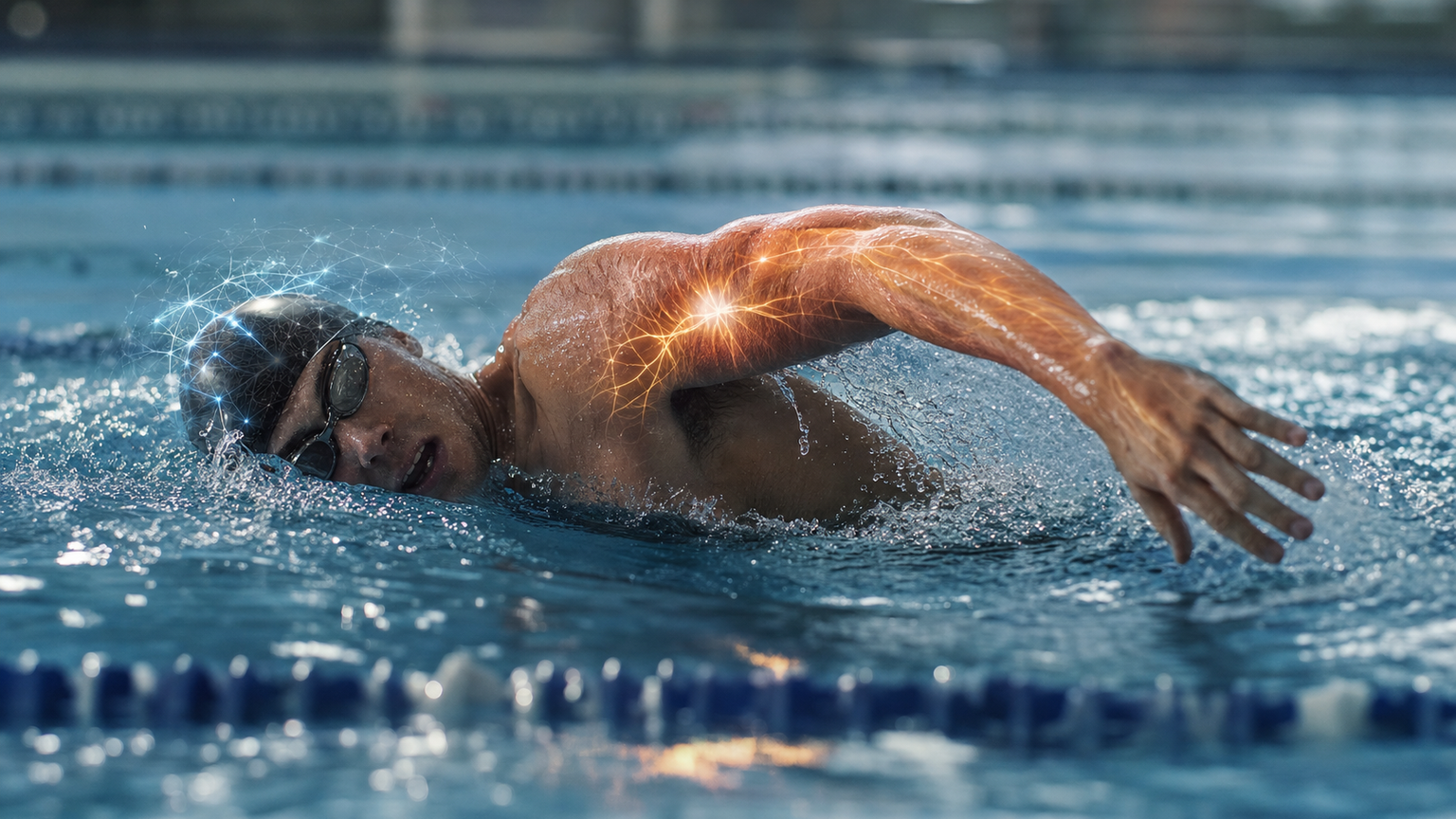
Every swimmer has experienced this: knowing full well that the body “can still push through,” yet the pace unconsciously slows down; or as the muscles begin to burn, the brain still commands to continue. This tug-of-war between willpower and physiological signals is precisely the result of the combined action of Central Fatigue and Peripheral Fatigue. The mechanism of fatigue in swimming is more complex than in most sports because it is additionally influenced by water pressure, thermoregulation, and breathing rhythm.
The Biochemical Mechanisms of Peripheral Muscle Fatigue
Peripheral fatigue refers to the decline in the ability of skeletal muscle itself to generate force. Its main mechanisms include:
Metabolite Accumulation
During high-intensity swimming, the anaerobic glycolytic system operates rapidly, producing the following metabolic by-products:
- Hydrogen Ion (H⁺) Accumulation: pH levels drop (from a normal 7.4 to below 7.0), inhibiting the actin-myosin cross-bridge, directly reducing force output
- Phosphate (Pi) Accumulation: Inhibits myosin ATPase activity, reducing the force output of each cross-bridge cycle
- Lactate Itself: Traditionally considered the direct cause of fatigue, modern research suggests lactate is more likely an “indicator of fatigue” rather than the “culprit of fatigue”
Impaired Calcium Handling
After prolonged high-intensity contractions, the ability of the Sarcoplasmic Reticulum to release calcium ions declines, preventing effective activation of muscle fibers. This leads to functional “fatigue,” where generating force becomes difficult even when energy substrates remain sufficient.
| Fatigue Mechanism | Time Scale | Recovery Time | Manifestation in Swimming |
|---|---|---|---|
| H⁺ Accumulation | Seconds to minutes | 5–20 minutes | Sudden drop in speed, breakdown of technique |
| Calcium Pump Dysfunction | Minutes to hours | 1–12 hours | Persistent feeling of weakness |
| Muscle Glycogen Depletion | Over 60 minutes | 24–48 hours | Difficulty maintaining pace in the latter stages of long-distance events |
| Muscle Micro-damage | After eccentric contractions | 48–72 hours | Next-day soreness, most noticeable in breaststroke kicking |
The Neuroscience of Central Fatigue
Central fatigue occurs at the level of the brain and spinal cord, with the core concept being the “Central Governor Theory”:
The brain continuously assesses the body’s physiological state (body temperature, blood glucose, metabolite concentrations) and proactively reduces the motor cortex’s drive signals to the muscles to protect vital organs (heart, brain) from excessive damage. This “protective brake” intervenes before reaching the true physiological limit.
Factors that particularly trigger central fatigue in swimming:
- Serotonin System: After prolonged swimming, the rate of tryptophan entering the brain increases, serotonin synthesis rises, leading to subjective feelings of fatigue and reduced motivation
- Elevated Body Temperature: When brain temperature exceeds 39°C, the brain actively limits muscle output. This is especially pronounced in Taiwan’s summer pools with high water temperatures
- Hypoglycemia: Brain cells rely on glucose; when blood sugar drops, the central drive to sustain exercise significantly decreases
The Interplay Between Central and Peripheral Fatigue
The two types of fatigue are not independent; rather, they form a cyclical feedback system:
- Peripheral muscle metabolites (H⁺, Pi) send signals to the brain via afferent nerves (Group III/IV afferents)
- Upon receiving these pain/fatigue signals, the brain proactively reduces the firing rate of motor neurons (central fatigue is initiated)
- The central reduction in speed gives the muscles a temporary “breather,” allowing metabolites to begin clearing
- The athlete adjusts pacing based on subjective perception, entering a new state of equilibrium
The “fatigue resistance” of elite swimmers is often not because their bodies don’t fatigue, but because their brains, upon receiving the same fatigue signals, can more accurately assess “where the true limit lies,” allowing them to get closer to their actual limits.
Swimming-Specific Fatigue Accelerators
- Breathing Restriction: In swimming, you cannot breathe at will; CO₂ accumulation accelerates the formation of an acidic environment, causing fatigue to set in faster than running at the same intensity
- High Water Temperature: Taiwan’s summer pools (>30°C) accelerate the rate of core body temperature rise, causing central fatigue to intervene prematurely
- Technique Dependence: Once peripheral fatigue causes technique to break down, form drag increases significantly, requiring more energy at the same speed, creating a vicious cycle of accelerated fatigue
Practical Recommendations
- Pacing Awareness Training: Between each high-intensity set, deliberately assess the correspondence between your “Rating of Perceived Exertion (RPE)” and actual speed, gradually calibrating subjective perception with objective physiological state.
- Maintain Technique Under Moderate Fatigue: Design “technique sets under fatigue”—first swim 3×100 meters at intensity, then immediately swim a 50-meter technique awareness lap, training motor control under fatigue resistance.
- Carbohydrate Supplementation to Prevent Central Fatigue: Before and after long-distance training (>60 minutes), supplement with an appropriate amount of carbohydrates (30–60g) to maintain blood glucose stability and delay the onset of central fatigue.
- Lower Water Temperature Training in Summer: If pool water temperature exceeds 30°C, it is recommended to reduce intensity by 10–15%, or shorten the main set distance, to avoid overheating triggering the central governor to intervene too early.
- The Scientific Basis of Active Recovery: Low-intensity easy swimming between sets (rather than remaining stationary) accelerates lactate clearance and H⁺ rebalancing, with recovery quality 20–30% better than complete rest.
Conclusion
Fatigue is not the enemy; it is the body’s most sophisticated protective system. Understanding the mechanisms of central and peripheral fatigue allows you to make smarter decisions in training: when to push forward and when to respect the body’s protective signals. For swimmers in Taiwan, whether competitive athletes or recreational swimmers, mastering the science of fatigue is a key tool for breaking through training plateaus and building long-term, sustainable training habits.
Related Reading
- The Fatigue Mechanism in Swimming: Central Fatigue vs Peripheral Fatigue in Long-Distance Swimming
- Neuromuscular Fatigue in Swimming: The Physiological Mechanisms of Technique Breakdown
- Central Fatigue and Peripheral Fatigue: Decoding the Dual Mechanisms of Exercise Exhaustion
- The Science of Running Fatigue: How Central and Peripheral Fatigue Jointly Determine Your Limits
西進武嶺 免費訓練分析服務 Intervals | 練不夠還是練過頭?你哪一種類型選手?AI模型告訴你! | 備戰神器 | 公路車 訓練 | CT Yeh
4 年前
一起升級!海鷗盃LSD團練...JJSC Zone2招待 騎到手抖 / 公路車 / CT Yeh
1 天前
一日北高/長距離團騎 常見問題補充篇 / 組團或跟團的眉角 / 壯車友容易被瘦車友慢性拉爆 / 原來屁股痛可能是這個原因...? / 風場配速法 / 公路車 / CT Yeh
2 年前
一日北高常見問題大集合 | 攻略 | 路線 | 訓練 | 補給 | 自行車 單車 | 一日雙城 | 雙塔 | TWB北高360 | 屁股痛
6 年前
2025 海鷗團體繞圈賽 網路直播 超激烈裁判長視角 / EIPC 李廷威、Waypoint 等眾多高手競爭 / feat. 卡密兒主持 / 海鷗繞圈賽
9 個月前
2023桃園團體繞圈賽 / 海鷗繞圈賽 | 全程空拍數據版 | 公路車 | CT Yeh
2 年前
CT暗黑廚房) 車友必備 宇宙無敵鮮蚵湯 幫助訓練恢復 天然食補 好市多 超肥鮮蚵 破PR
7 年前
一日北高前的西濱集訓 | 跟著11小時軍團 | 300W踩不動的大逆風 | 輪車破風差幾瓦?
6 年前