The Physiological Challenges of Open Water Swimming: Waves, Currents, Navigation, and Psychology
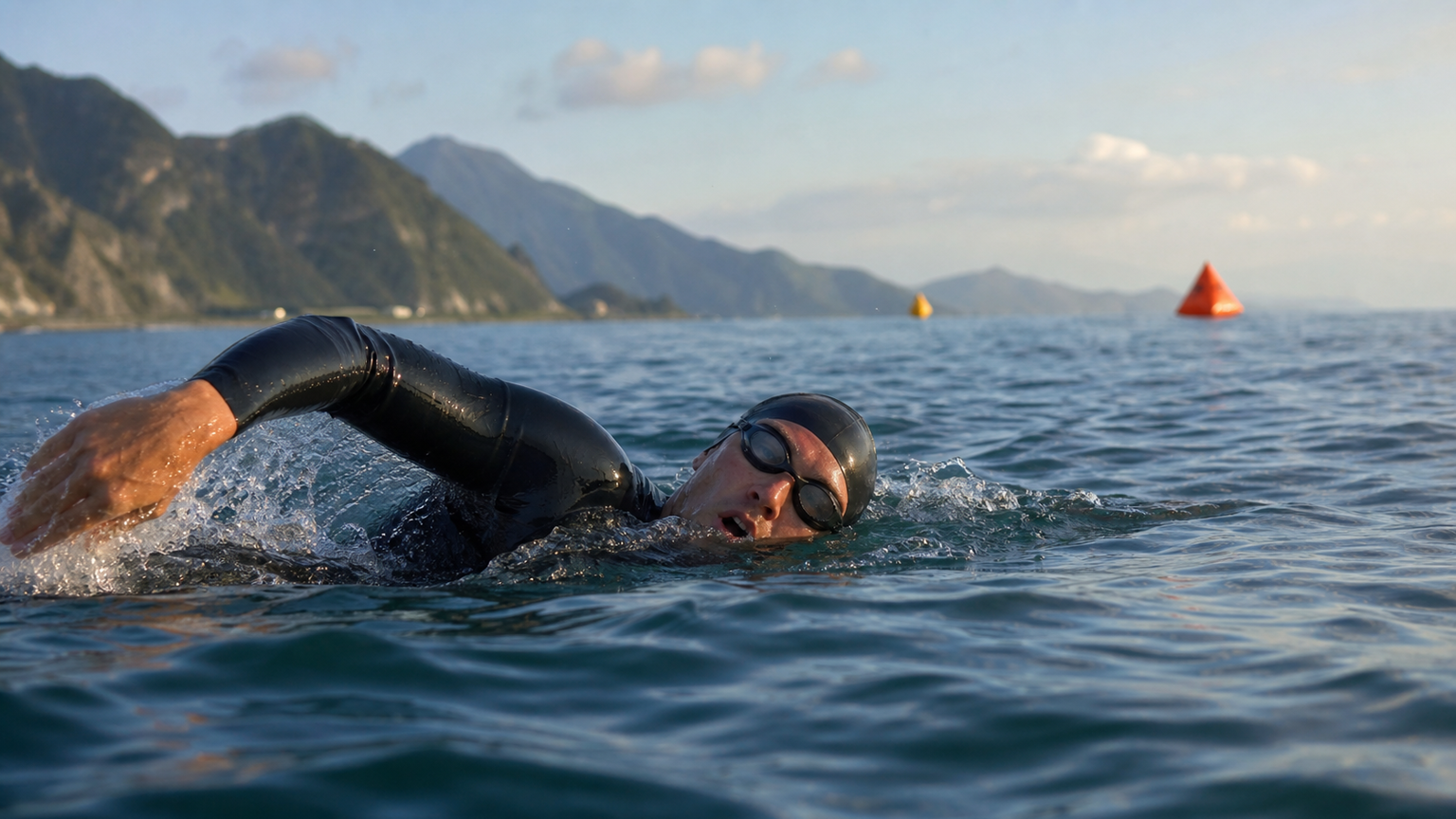
Introduction
Surrounded by ocean on all sides, and blessed with superb aquatic environments such as Kenting, Sun Moon Lake, and the East Rift Valley, open water swimming has grown rapidly in Taiwan in recent years. However, many swimmers who perform excellently in the pool often see their performance drop significantly when first tackling open water—not because of insufficient fitness, but because they lack preparation for the unique physiological and psychological challenges of open water. This article systematically analyzes these challenges and provides scientific training strategies.
The Physiological Impact of Currents and Waves
Extra Energy Expenditure from Fighting Currents and Waves
Currents and waves in open water can increase the actual swimming distance by 10–20% over the straight-line distance (depending on navigation accuracy), and fighting lateral currents and head-on waves requires additional muscular work:
- Head-on waves: Each stroke must overcome the kinetic energy of the wave, increasing energy expenditure by 15–25% compared to calm water
- Side currents: Force the body to continuously correct direction, adding ineffective lateral force; every 1 m/s of side current can add approximately 1–2 minutes to a 1500-meter swim time
- Following-wave propulsion: Under favorable conditions, can reduce energy expenditure by 8–15%, but requires adjusting stroke rate and pacing to harness wave energy
The Impact of Waves and Currents on Breathing Rhythm
The predictable breathing timing available in the pool becomes completely unreliable in open water. A wave may submerge the face exactly at the moment of breathing, forcing the swimmer to:
- Inhale some saltwater (triggering irritating coughs that disrupt rhythm)
- Delay breathing (causing rapid CO₂ accumulation, triggering premature fatigue)
- Alter stroke rate (breaking familiar rhythm patterns)
| Challenge Type | Physiological Impact | Training Countermeasure |
|---|---|---|
| Head-on waves | Energy expenditure increases 15–25% | Wave swimming adaptation training |
| Side current correction | Lateral muscle fatigue | Diagonal swimming drills |
| Sudden wave covering the face | Breathing interruption, heart rate spikes | Breathing drills in varied wave conditions |
| Prolonged water temperature changes | Continuous core temperature fluctuation | Open water temperature adaptation |
The Cognitive Load of Navigation
Pool swimming requires almost no thought about direction, but in open water, “sighting” is needed every 5–10 strokes:
- Energy cost per sighting: Lifting the head breaks the streamlined position; each sighting is estimated to consume approximately 0.5–1% more energy than a normal stroke. A 1500-meter race requires 30–50 sightings, and the cumulative cost cannot be ignored.
- Navigation cognitive load: Simultaneously processing stroke mechanics, observing buoy positions, and correcting direction occupies working memory, reducing the resources available for technical awareness and easily leading to technique breakdown.
- Directional deviation: Research shows that swimmers swimming with eyes closed deviate an average of more than 80 meters from a straight line after 400 meters. Taiwanese swimmers, accustomed to the black lane lines in pools, need specific navigation training.
The Unique Psychological Challenges of Open Water
Water-Related Fear and Anxiety
The depth, low visibility, and marine life of the ocean or lakes can trigger an “open-space anxiety” (agoraphobia-like response), manifesting as:
- Heart rate spikes (exceeding normal exercise heart rate ranges)
- Hyperventilation (reducing CO₂ tolerance)
- Muscle tension (reduced stroke efficiency)
The Psychological Pressure of Mass Starts
Taiwan triathlon races typically use mass starts. Beginners facing the crowded scene of hundreds of swimmers around them often experience panic reactions, leading to excessively high heart rates in the first 200–300 meters and prematurely depleting anaerobic reserves.
Systematic Open Water Race Preparation Strategies
- Graduated exposure: Start with “eyes-closed swimming” at the pool edge, progress to short distances in small open water venues, and finally to formal race environments, building psychological adaptation step by step.
- Sighting technique training: Practice the “head-down, head-up” sighting motion in the pool at least twice a week—lift the head only enough for the eyes to clear the water to reduce energy loss.
- Simulated mass-start training: Practice swimming side-by-side with training partners and maintaining rhythm amid contact to reduce the psychological pressure of mass starts.
- Breathing pattern diversification: Deliberately practice asymmetric patterns such as “unilateral breathing” and “occasionally skipping a breath” during pool training to increase adaptability of breathing rhythm in open water.
Practical Recommendations
- Pay attention to ocean currents when training in eastern Taiwan: The waters off Hualien and Taitung have southward currents. When racing, plan a “start upstream” strategy to avoid being pushed off course.
- Reconnoiter the race venue in advance: If possible, enter the water the day before the race to acclimate to water temperature, visibility, and buoy positions, greatly reducing cognitive load on race day.
- Use a brightly colored swim cap: Taiwanese regulations require a safety buoy for open water swimming, but a bright swim cap also increases the chance of being spotted by boats. Swimmer safety should never be taken lightly.
- Set a sighting frequency strategy: Establish a fixed sighting interval based on your navigation ability (e.g., sight every 8 strokes), which is more energy-efficient and provides more stable direction than “looking only when needed.”
- Heart rate monitoring: Wear a waterproof heart rate strap or watch to record heart rate patterns during open water training. Compare these with pool training data to quantify the additional physiological load of open water.
Conclusion
Open water swimming is a comprehensive art that integrates physiological adaptation, technical application, and psychological management. Taiwan’s abundant water resources provide a natural training ground, but they also present unique challenges. Through systematic scientific preparation—from wave and current adaptation, navigation training, to psychological desensitization—every swimming enthusiast can find their own rhythm in Taiwan’s oceans and lakes, swimming safely and confidently toward the horizon.
Related Reading
- Pool vs. Open Water Fitness Differences: How to Simulate Open Water Intensity in Pool Training
- Wave Swimming Technique in Open Water: Harnessing Wave Rhythm and Managing Energy Expenditure
- Energy Management in Open Water Swimming: Pacing and Intensity Control for Long-Distance Swims
- Swimming in Open Water Waves: Technical Differences of Following, Head-On, and Side Waves
一日北高前的西濱集訓 | 跟著11小時軍團 | 300W踩不動的大逆風 | 輪車破風差幾瓦?
6 年前
西進武嶺 免費訓練分析服務 Intervals | 練不夠還是練過頭?你哪一種類型選手?AI模型告訴你! | 備戰神器 | 公路車 訓練 | CT Yeh
4 年前
一起升級!海鷗盃LSD團練...JJSC Zone2招待 騎到手抖 / 公路車 / CT Yeh
2 天前
2023桃園團體繞圈賽 / 海鷗繞圈賽 | 全程空拍數據版 | 公路車 | CT Yeh
2 年前
備戰 戀戀197 賽前關門點分析 西濱團練 #公路車 4K高畫質
6 年前
#公路車 #Vo2Max #最大攝氧量 測驗 體驗 | 心肺測試
6 年前
2025 海鷗團體繞圈賽 網路直播 超激烈裁判長視角 / EIPC 李廷威、Waypoint 等眾多高手競爭 / feat. 卡密兒主持 / 海鷗繞圈賽
9 個月前
風櫃嘴時間 預測西進武嶺時間?13000名車友統計數據分析告訴你 !
5 年前