Introduction
Altitude training is the secret weapon of endurance athletes. Kenyan runners live and train at 2,000–2,400 meters above sea level, and European and American marathoners head to Colorado (approximately 1,600–2,400m) for training camps—this is not superstition, but a scientifically grounded strategy backed by solid exercise physiology.
Taiwan’s terrain is uniquely blessed, with high mountains such as Hehuan Mountain (3,417m), Jade Mountain (3,952m), and Wuling (3,275m) close at hand, offering Taiwanese runners rare opportunities for altitude training. But altitude training is not simply “the higher you go, the better it works”—understanding its physiological mechanisms is essential to truly harnessing its advantages.
The Physiological Basis of Altitude Training
The Trigger Response to Hypoxic Conditions
At high altitudes, atmospheric pressure decreases, and the partial pressure of oxygen (PO₂) drops accordingly:
| Altitude (meters) | Atmospheric Pressure (kPa) | Oxygen Partial Pressure (kPa) | Relative Oxygen Content vs. Sea Level |
|---|---|---|---|
| 0 (Sea Level) | 101.3 | 21.2 | 100% |
| 1,500 | 84.5 | 17.7 | 83% |
| 2,500 | 74.7 | 15.7 | 74% |
| 3,000 | 70.1 | 14.7 | 69% |
| 3,500 (Wuling) | 65.8 | 13.8 | 65% |
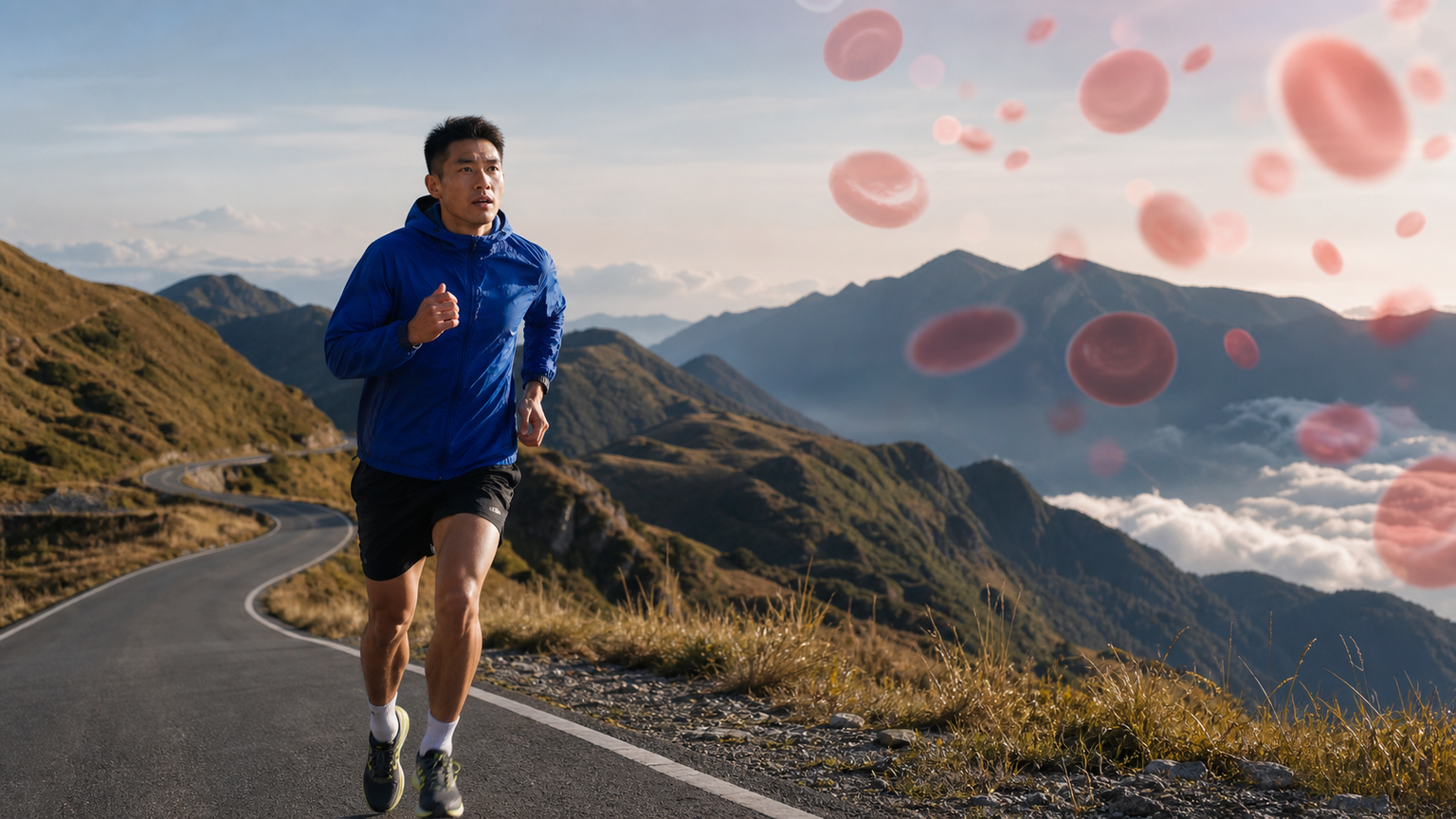
When the body senses hypoxia (low blood oxygen), the kidneys secrete erythropoietin (EPO). EPO stimulates the bone marrow to produce more red blood cells, increasing the blood’s oxygen-carrying capacity—this is the core mechanism by which altitude training enhances endurance.
Changes in EPO and Red Blood Cells
Research shows that after living at 2,000–3,000 meters for 3–4 weeks:
- EPO secretion peaks within 24–48 hours (can increase by 30–100%)
- Hemoglobin concentration can rise by 5–10% within 2–3 weeks
- Hematocrit increases correspondingly
- After returning to low altitude, these adaptations can be maintained for 3–4 weeks
The “Live High, Train Low” Model (LHTL)
The most scientifically supported strategy in modern altitude training is “Live High, Train Low (LHTL)”:
- Live High: Reside at 2,200–2,500 meters to maximize hypoxic stimulation and EPO secretion
- Train Low: Descend to low altitude (1,000–1,500m or sea level) for high-intensity training
This strategy resolves a key contradiction: although high altitude stimulates EPO secretion, the absolute speed (vVO2max) of training at high altitude decreases, making it impossible to maintain sufficient neuromuscular stimulation. Live High, Train Low allows runners to gain both the hematological adaptations of high altitude and the training quality of low altitude.
Taiwan’s Altitude Training Resources
Although Taiwan lacks professional altitude training facilities, its terrain conditions are quite favorable:
- Hehuan Mountain Area (3,000–3,400m): The Taiwu Mountain range and Hehuan Mountain trails are suitable for easy runs during the acclimatization period
- Wuling (3,275m): The highest point of the Central Cross-Island Highway, and Taiwan’s most accessible running venue above 3,000m
- Alishan (2,200m): Moderate altitude, relatively stable climate, with a well-developed trail system
- Taipingshan (2,000m): Located in Yilan, with accommodation facilities, suitable for 2–3 day altitude acclimatization training
Challenges of Altitude Training in Taiwan
- Limited accommodation: Lodging options at Wuling and Hehuan Mountain are scarce and expensive, making long-term residence difficult
- Low temperatures: Nighttime temperatures at 3,000m can drop below 15°C even in summer, requiring adequate cold-weather gear
- Limited training venues: No track facilities, making precise interval training difficult
A practical approach is 2–3 day weekend altitude training, rather than a full 3–4 week altitude training camp. Although short-term altitude exposure cannot fully trigger the EPO response, it still helps with altitude acclimatization and psychological preparation.
Precautions for Altitude Training
Acute Mountain Sickness (AMS)
When ascending rapidly above 2,500m, approximately 25% of people will experience acute mountain sickness:
- Symptoms: Headache (most common), nausea, insomnia, fatigue
- Prevention: Do not ascend more than 300–500m per day, and rest fully for 24–48 hours after arrival before beginning training
- Management: Stop exercising immediately when symptoms appear; in severe cases, descend to lower altitude
Adjusting Training Volume and Intensity
During the early phase of altitude training (first 3–5 days):
- Reduce total training volume by 20–30%
- Pace should be 10–20% slower than at sea level (at the same heart rate, slower speeds at high altitude are normal)
- High-intensity interval training should be postponed until after the acclimatization period (after days 5–7)
The Optimal Timing for Returning to Low Altitude
After returning from high altitude to low altitude, there is an “optimal window” for performance improvement:
- Days 1–2 after return: Oxygen is abundant and you feel especially light, but the neuromuscular system has not yet fully adapted
- Days 3–5 after return (optimal window): Red blood cell count remains elevated, and neuromuscular function has returned to normal—this is the best time for competition
- Weeks 2–4 after return: The altitude-induced increases in EPO and red blood cells gradually subside
It is recommended to schedule important races 3–5 days after returning to low altitude.
Practical Recommendations
- For amateur runners, using long weekends (such as Dragon Boat Festival or Mid-Autumn Festival) to arrange 2–3 days of altitude training at Wuling or the Hehuan Mountain area is a realistic and feasible option
- Supplement with iron two weeks before altitude training (under a physician’s guidance): altitude-stimulated EPO secretion requires sufficient iron as a raw material
- Increase water intake by 30–50% during altitude training, because the dry air and faster breathing rate at high altitude accelerate fluid loss
- After returning to sea level, schedule 1–2 races on days 3–5 to take advantage of the “altitude dividend”
- Record resting heart rate and HRV before and after altitude training to track objective indicators of physiological adaptation
Conclusion
Taiwan’s unique mountain terrain gives Taiwanese runners altitude training resources that runners in many countries can only dream of. Although we do not have Kenya’s long-term high-altitude environment, by making good use of Taiwan’s mountain terrain for weekend altitude training, combined with scientific adaptation strategies, Taiwanese runners can still benefit from altitude physiology and face the autumn and winter marathon season with a richer supply of red blood cells.
Related Reading
- The Benefits of Altitude Training for Cyclists: The Effect of Altitude on Red Blood Cells
- Altitude Adaptation in Running: How Altitude Training Stimulates Red Blood Cell Production and Enhances Endurance
- The Benefits of Altitude Training for Cyclists: The Natural Advantage of Taiwan’s Wuling
- The Red Blood Cell Production Benefits of Altitude Training: A Simulation Study Analysis of 3 Weeks at Wuling’s Altitude
實景訓練台) 彰化經典百K 高強度喵團 90分鐘 跟著一起練功 2019 Indoor workout Changhua Classic 100 Taiwan
7 年前
CT 喇低賽) 武嶺牽車 才是王道 西進牽車四小時內秘訣 攝手位置 如何判斷 防抽筋小秘訣
7 年前
#公路車 北部貼地飛行 週六特快車 黃文忠高鐵團 首次體驗! 石碇小七到公車站前 直接開高高
7 年前
單車 一日北高 ( 雙城 ) 肥宅雙人瘋狂行 紀錄片 REACTO
10 年前
CT暗黑廚房) 車友必備 宇宙無敵鮮蚵湯 幫助訓練恢復 天然食補 好市多 超肥鮮蚵 破PR
7 年前
FTL 與 SYB 車隊專訪 西進武嶺 實用攻略分享! 2小時 如何練?!你不知道的眉角!新手準備武嶺必看 EP1 | 實力派女車友 | 精華版 | 公路車 | CTYeh
4 年前
台北闊瀨陡坡 騎旅 / 日本單車雜誌編輯車友臨時加入!/ 髮香才是最強的 / feat. 北迴歸線小隊 / 公路車 CT Yeh
6 個月前
#公路車 #Vo2Max #最大攝氧量 測驗 體驗 | 心肺測試
6 年前