Swimming for Chronic Back Pain Relief: A Water-Based Approach to Spinal Decompression and Core Strengthening
Introduction
“Back pain” is almost a universal complaint among modern people in Taiwan. According to National Health Insurance Administration statistics, spine-related conditions account for over a million medical visits every year, with chronic lower back pain (lasting more than three months) being the most common type. Prolonged sitting at work, looking down at smartphones, and weak core muscles are lifestyle factors that place sustained, improper stress on the spine, leading to disc degeneration, muscle tightness, and nerve compression.
Many back pain sufferers rely for years on painkillers, physical therapy with electrical stimulation, or chiropractic treatment. While these can temporarily relieve symptoms, they often fail to address the root cause: weak and imbalanced spinal support muscles (the core muscle group). Swimming offers an ideal solution — the buoyancy of water fully decompresses the spine while simultaneously training the core muscles, addressing the problem of back pain at its source.
How the Aquatic Environment Protects the Spine
The Decompression Effect of Buoyancy
In an upright position, the spine must bear the weight of the entire body, and accumulated poor posture keeps the intervertebral discs under constant compression. When the body enters water, buoyancy largely counteracts gravity, and the compressive force on the spine can be reduced by 50-90% (depending on water depth).
This “spaciousness” gives the intervertebral discs a chance to absorb water and expand, restoring their normal height and cushioning function. Compressed nerve roots can also relax, reducing pain signals radiating to the buttocks or legs (sciatica).
The Warming Effect of Water and Muscle Relaxation
Chronic back pain is often accompanied by persistent tightness in the back muscles (protective muscle spasm), and this tightness is itself one source of pain. Warm water (28-32°C) effectively promotes blood circulation in the back muscles and reduces muscle tension, breaking the vicious cycle of “pain → muscle tightness → more pain.”
A Fully Multidirectional Training Plane in Water
Land-based back rehabilitation exercises are limited by the direction of gravity, and many movements must be performed against gravity, making them difficult for patients with more severe pain. The aquatic environment provides even resistance across three dimensions of movement, allowing for more varied and natural core-training exercises, with intensity that can be finely adjusted at any level.
Which Swimming Strokes Are Best for Back Pain
Different strokes have markedly different effects on the spine, and back pain sufferers should pay special attention when choosing a stroke:
| Stroke | Effect on the Spine | Suitable Back Pain Types | Precautions |
|---|---|---|---|
| Freestyle | Moderate spinal rotation, neutral lumbar spine | Most types of lower back pain | Watch the cervical spine angle when turning the head to breathe |
| Backstroke | Natural spinal extension, reduced lumbar lordosis | Lumbar spinal stenosis, herniated discs | The most recommended stroke for back pain |
| Breaststroke | Excessive lumbar lordosis, rapid pelvic movement | Not recommended for patients with acute-phase back pain | The breaststroke kick increases lumbar spine pressure |
| Butterfly | Large-amplitude lumbar flexion and extension, highest impact | Not recommended for those with disc problems | May be attempted under a coach’s guidance once the chronic phase has stabilized |
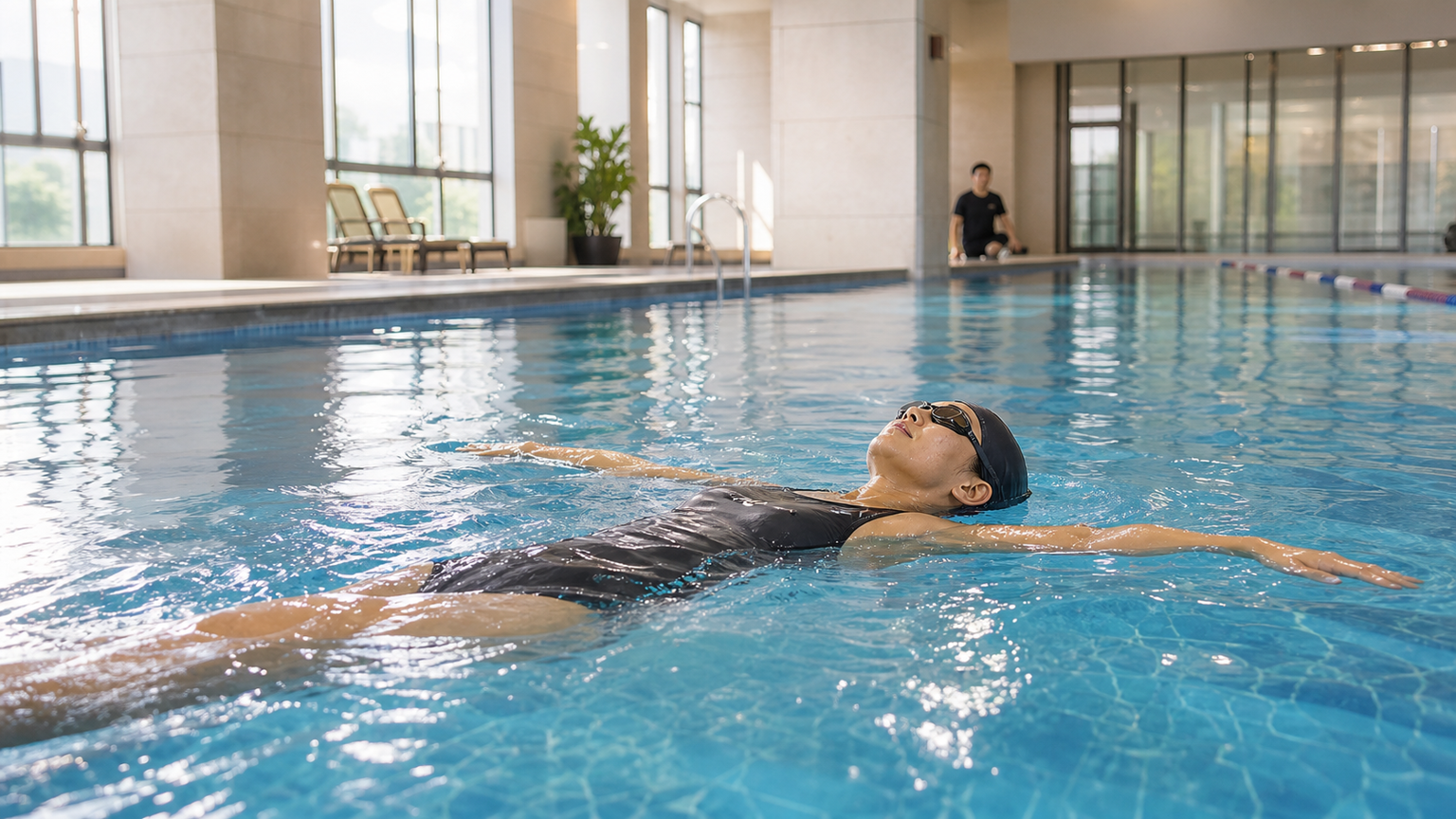
Backstroke is the stroke of choice for back pain sufferers. The face-up position keeps the spine close to a natural neutral alignment, and the arm-pulling motion strengthens the scapular stabilizing muscles (rhomboids, middle and lower trapezius) — weakness in these muscles is one of the main causes of many cases of upper back pain.
An In-Water Core Training Program
Below is a set of in-water core training exercises designed specifically for back pain, recommended to be performed in a pool 1-1.2 meters deep:
Basic Movements (Weeks 1-4)
-
In-water squats: Stand with your back against the pool wall, feet shoulder-width apart, and slowly squat until your thighs are parallel to the water surface, keeping the spine neutral. 10 reps per set, 3 sets. Strengthens the quadriceps and glutes, reducing the load on the spine.
-
Single-leg stance: Stand on one leg on the pool floor and slowly lift the other leg, keeping the core braced. Hold for 20-30 seconds on each side to improve pelvic stability.
-
In-water walking: Walk forward, backward, and sideways in the water for 2 minutes each to train multidirectional core stability.
Intermediate Movements (Weeks 5-8)
-
Prone-float leg drills with a kickboard: Hold a kickboard with both hands, float face-down, and propel yourself using only your legs. Keep the core continuously engaged to maintain a stable body position, holding each set for 25-50 meters.
-
In-water bridge: With your back against the pool wall and hands holding the edge, float in a semi-supine position and alternately pull both knees toward your chest, training the abdominal muscles and hip flexors.
-
In-water Pilates leg circles: Stand in the water holding the pool edge, and slowly draw large circles with one leg in the water, mobilizing the hip joint while training core stability.
Advanced Integration (After Week 9)
- Introduce the full backstroke technique, strengthening core coordination while swimming
- Add resistance-band training in water (dedicated aquatic resistance bands are available for purchase), targeting specific weak muscle groups
- Try an “aqua yoga” class, combining breath control with spinal mobility training
Practical Recommendations
Before starting a water-based exercise program, the following points are essential for back pain sufferers:
-
Rule out red-flag symptoms first: If back pain is accompanied by fever, unexplained weight loss, changes in bladder or bowel function, or pain that does not ease at night, see a doctor first to rule out serious causes such as tumors or infection, rather than starting exercise directly.
-
Get an assessment from a rehabilitation physician: The causes of chronic back pain are varied (herniated disc, spondylolisthesis, scoliosis, etc.), and the recommended water exercises may differ depending on the diagnosis — a professional assessment should not be skipped.
-
Rest first during the acute phase (initial onset or acute flare-up): Acute back pain (lasting less than 4 weeks) usually requires 2-3 days of rest first; only after the most severe pain has eased should you gradually progress into the water.
-
Pay attention to how you enter and exit the pool: Back pain sufferers are more prone to injury when not careful. Before entering the water, walk down the steps slowly rather than diving in; when getting out of the water, turn to one side first and climb out using the rail, avoiding lifting your whole body weight directly with your lower back.
-
Stretch in the water after every swim: After swimming, spend 5-10 minutes doing spinal stretches in the water, including the in-water downward-dog stretch (holding the pool wall and extending the body backward) and in-water lateral bends, helping the spine regain its length in a relaxed state.
-
Combine with land-based rehabilitation exercises: Swimming is a complementary therapy and cannot fully replace land-based rehabilitation training (such as the McKenzie Method or Pilates). The two work best together.
Conclusion
Chronic back pain is not an inevitable fate — it is a condition that can be actively improved through the right exercise strategy. Swimming offers an almost zero-risk environment for spinal rehabilitation, allowing people in Taiwan who have long suffered from back pain to gradually rebuild the muscular strength that supports the spine in comfortable water, and reclaim a pain-free daily life.
The healing power of water is waiting for you to discover it in the pool.
Related Reading
- How Swimming Improves Chronic Back Pain and What to Watch For
- In-Water Core Training for Chronic Lower Back Pain: Activating the Spinal Stabilizing Muscles in Water
- Preventing and Relieving Neck and Shoulder Pain Through Swimming
- Protecting the Lumbar Spine Through Swimming: Stroke Recommendations for People with Spinal Conditions
一日北高/長距離團騎 常見問題補充篇 / 組團或跟團的眉角 / 壯車友容易被瘦車友慢性拉爆 / 原來屁股痛可能是這個原因...? / 風場配速法 / 公路車 / CT Yeh
2 年前
[防寒衣體驗] 鐵人魂 三鐵 防寒衣試穿會 於松運 深水游泳池 鯨魚池
8 年前
一日北高常見問題大集合 | 攻略 | 路線 | 訓練 | 補給 | 自行車 單車 | 一日雙城 | 雙塔 | TWB北高360 | 屁股痛
6 年前
[教學] Premiere 影片 手震 修正 教學 防抖 單眼 影像 GoPro 穩定 Video Stabilization
8 年前
水金九不厭五分 10度寒流冷到不願停!feat. 卡卡 / 公路車 / CT Yeh
6 個月前
抖肩舞 台灣x日本交流版 (台灣 vs 前橋) 赤城山登山賽 coincidance
8 年前
靠單車減肥35公斤 心得分享與整理
7 年前
CT暗黑廚房) 車友必備 宇宙無敵鮮蚵湯 幫助訓練恢復 天然食補 好市多 超肥鮮蚵 破PR
7 年前