Introduction
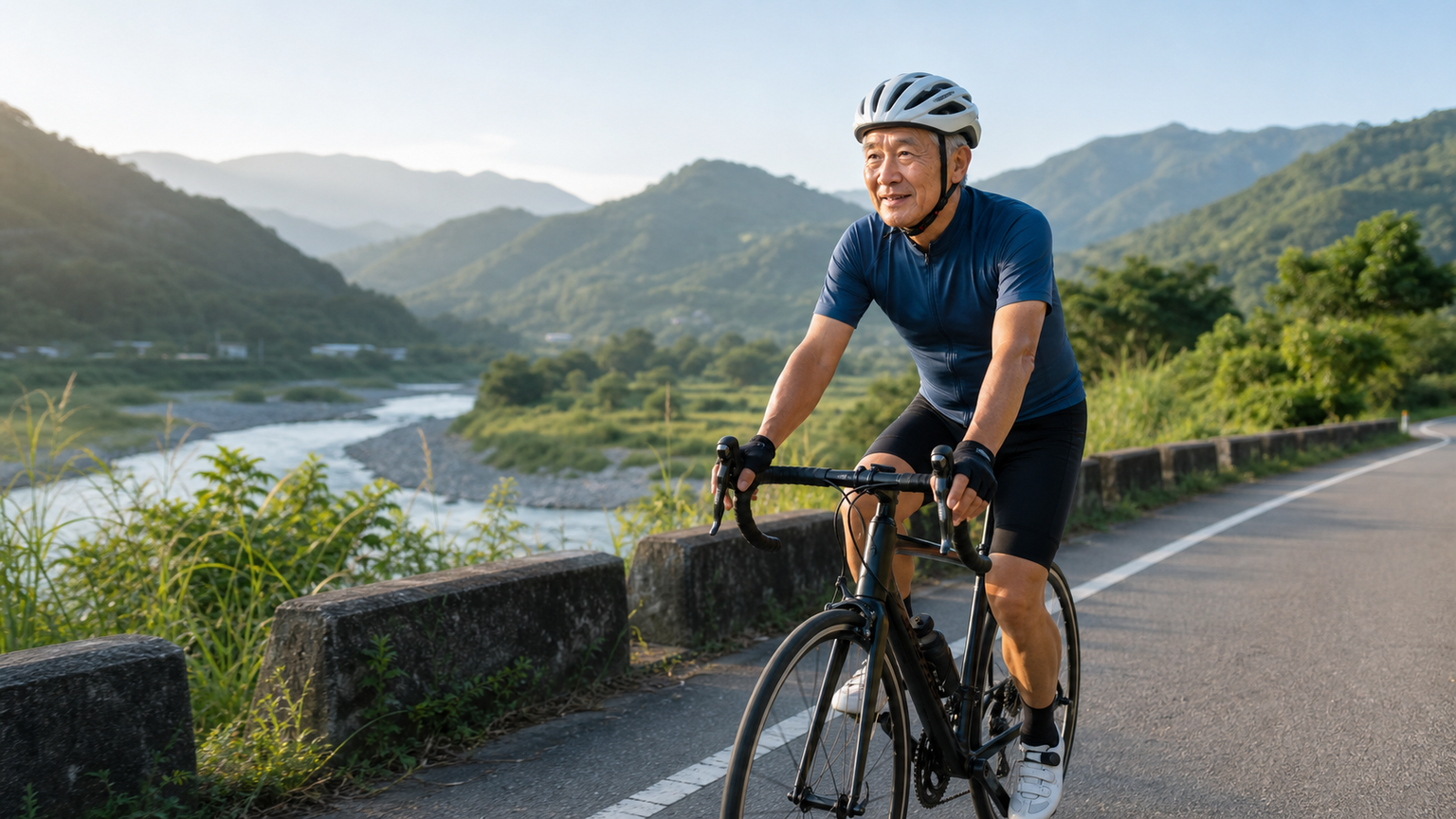
One of the defining features of Taiwan’s cycling culture is the active participation of older riders. Among those who summit Wuling, riders over 70 are not uncommon, and riders aged 50–65 make up a substantial share of those cycling around the island. Cycling truly is an age-friendly sport: low-impact, adjustable in intensity, and easy to make part of daily life. But “age-friendly” does not mean “risk-free.” Understanding how the body changes physiologically after 50 is the foundation for enjoying safe riding.
This article offers a complete guide for Taiwanese riders over 50, covering training adjustments, injury prevention, and special health management.
Major Physiological Changes After 50
Muscle and Skeletal System
| Physiological Change | Average Annual Decline | Impact on Riding |
|---|---|---|
| Muscle mass (sarcopenia) | About 1–2%/year (after age 50) | Reduced pedaling power, longer recovery needed |
| Maximum strength | About 1.5–2%/year | Less explosive power for sprints and climb crests |
| Bone density | About 0.5–1%/year | Higher fracture risk in falls |
| Joint cartilage elasticity | Progressive degeneration | More joint discomfort after long rides |
Cardiopulmonary System
- Maximum heart rate: Declines by about 1 bpm per year; a 50-year-old rider’s max heart rate is roughly 160–170 bpm (versus 180–200 bpm for younger riders)
- VO₂max: Declines about 10% per decade, though regular training can cut that decline roughly in half
- Heart rate recovery: Time to return to baseline after high-intensity effort is longer than for younger riders
Nervous System and Coordination
- Slower reaction time (reduced ability to respond to emergencies)
- Mild decline in balance (increased fall risk)
- Slower dark adaptation (reduced safety for night riding or tunnels)
Training Principles for Senior Riders
Adjusting Intensity Distribution
Training after 50 should place greater emphasis on aerobic base, with a reduced share of high-intensity work:
- Low intensity (Zone 1–2): 85–90% of training time (higher than for younger riders)
- Moderate intensity (Zone 3): 1–2 sessions per week, 30–60 minutes each
- High intensity (Zone 4+): Use cautiously, no more than once per week, with a thorough warm-up
Extending Recovery Time
Senior riders’ muscle repair rate is 30–50% slower than younger riders’, so training plans should be adjusted accordingly:
- After heavy training, increase rest days from 1 to 2
- After long rides (> 100 km), rest for 3–5 days before resuming high-intensity training
- “Feeling recovered” doesn’t mean the body has truly recovered — learn to use objective markers such as HRV
Essential Supplementary Training
Cycling alone cannot maintain the overall fitness senior riders need. The following supplementary training, done 2–3 times per week, is essential:
- Resistance training: Squats, leg press, deadlifts — maintain lower-body strength and bone density
- Balance training: Single-leg stands, balance boards — counteract age-related balance decline
- Flexibility training: Yoga or stretching — maintain the hip and lower-back mobility needed for riding posture
- Core training: Prevent postural lower back pain associated with aging
Special Health Considerations for Senior Riders
Cardiovascular Screening
Riders over 50, especially beginners or those returning to exercise after a long break, should consider:
- Exercise ECG: Rule out silent heart disease
- Echocardiogram: Assess heart structure
- Lipid panel and blood glucose testing: Regular annual monitoring
Taiwan’s National Health Insurance offers regular health checkups for adults over 40 — make full use of this benefit.
Actively Managing Osteoporosis Risk
As noted above, cycling is a low-impact sport that does little to maintain bone density. Riders over 50 should:
- Get a DXA bone density scan every 2–3 years
- Ensure adequate daily calcium intake (1000–1200 mg) and vitamin D (1000–2000 IU)
- Do weight-bearing or impact training at least twice a week
Medication and Cycling Interactions
Many riders over 50 take medications for chronic conditions, and the following deserve special attention:
| Medication Class | Potential Impact on Riding | Recommendation |
|---|---|---|
| Beta-blockers (blood pressure medication) | Suppress maximum heart rate, making heart rate metrics unreliable | Use RPE (rate of perceived exertion) to gauge intensity instead |
| Diuretics | Increased risk of dehydration and hyponatremia | Increase fluid and electrolyte intake |
| Statins (lipid-lowering drugs) | Some patients experience muscle soreness | Monitor symptoms and discuss with a physician if needed |
| Anticoagulants | Increased bleeding risk after a fall | Strengthen protective gear, avoid high-risk riding |
Special Safety Precautions for Senior Riders
Equipment Upgrades
- Helmet: Invest in a high-quality helmet; consider one with MIPS technology for better protection against rotational impact
- Protective pads: Beginners or those with rusty technique should consider knee and elbow pads
- Eyewear: Make sure cycling glasses accommodate presbyopia (prescription cycling glasses if needed)
- Lighting: With slower reaction times at night, choose high-brightness front and rear lights so others can spot you sooner
Choosing a Riding Environment
- Prioritize dedicated bike paths or routes with low traffic volume
- Avoid mountain roads at night; opt for flat riverside paths or well-lit urban areas instead
- Adjust your route flexibly based on weather and physical condition — don’t stubbornly insist on completing a planned distance
Practical Recommendations
- Find a community suited to senior riders who look out for each other’s health and safety (to avoid exceeding personal limits due to peer pressure)
- Tell family your riding plan and expected return time before every ride
- Cycling events across Taiwan’s counties and cities offer age-group categories — take advantage of events suited to your age group
- Don’t use your younger self’s performance as a benchmark; appreciate and accept your current ability
- Communicate regularly with your doctor about your exercise routine, making your medical team a partner in your training plan
Conclusion
Riding after 50 isn’t a continuation of youthful peak performance — it’s a wiser way of practicing the sport. By understanding the physiological realities of your body, adjusting your training approach, and filling in the gaps that cycling alone can’t cover, a senior rider can not only enjoy every ride safely, but carry this healthy habit into their 70s and 80s, continuing to write their own riding story among Taiwan’s mountains and coastlines.
Related Reading
靠單車減肥35公斤 心得分享與整理
7 年前
2025 自行車錶排行榜 兩萬車友大數據 / Garmin Bryton 排名會大洗牌嗎? / 全新的碼表前身分析 /公路車 / CT Yeh
1 年前
一日北高/長距離團騎 常見問題補充篇 / 組團或跟團的眉角 / 壯車友容易被瘦車友慢性拉爆 / 原來屁股痛可能是這個原因...? / 風場配速法 / 公路車 / CT Yeh
2 年前
單車 一日北高 ( 雙城 ) 肥宅雙人瘋狂行 紀錄片 REACTO
10 年前
日本公路最高登山賽,台灣首位YT挑戰實錄,乘鞍登山賽40週年,賽前篇完整版,請到我的YT收看 #公路車 #cycling
10 個月前
高雄綠園道鐵路自行車道 / 外地人能輕鬆駕馭 還是整路崩潰? / 2025 全線開通 春節實地探索一次!(附GPS連結)/ 公路車 / CT Yeh
1 年前
2019 夏季KOM 5小 完賽心得 準備攻略 東進武嶺 夏季登山王之路 Taiwan KOM Challenge
7 年前
2025 乘鞍 KOM 登山賽挑戰實錄 / 日本公路最高 ! 賽前探路篇 / 比富士山厲害,無敵絕景!/ 40週年 / 中文YT首發 / 公路車 / CT Yeh #乘鞍ヒルクライム
10 個月前