Land-Based Supplementary Training for Swimmers: A Complete Guide to Resistance Bands, Pull Racks, and Explosive Power Development
Introduction
In a professional swimmer’s training schedule, typically 20–30% is dedicated to Dryland Training. This is not because land training is more effective than swimming itself, but because it provides specific physiological stimuli that water-based training cannot fully replicate—particularly explosive power development, core stability reinforcement, and balanced training of antagonistic muscle groups (to prevent the most common shoulder injuries in swimmers).
Land training for Taiwanese swimmers is often treated as “homework” and lacks a systematic approach. This article provides a land-based supplementary training framework designed around the demands of competitive swimming, helping athletes maximize the benefits of land training within limited training time.
Four Key Objectives of Land Training for Swimmers
| Training Objective | Direct Benefit to Swimming | Primary Training Methods |
|---|---|---|
| Pulling Explosive Power | Increases force per stroke, increasing stroke length | Swim bench, TRX rows |
| Kicking Explosive Power | Stronger wall push-off and kicking propulsion | Box jumps, single-leg squats, plyometric training |
| Core Stability | Maintains streamlined position in water, reduces energy waste | Plank variations, anti-rotation training |
| Shoulder Antagonists | Prevents rotator cuff injuries, maintains stroke integrity | Resistance band external rotation, Y-T-W exercises |
Tool 1: Resistance Band
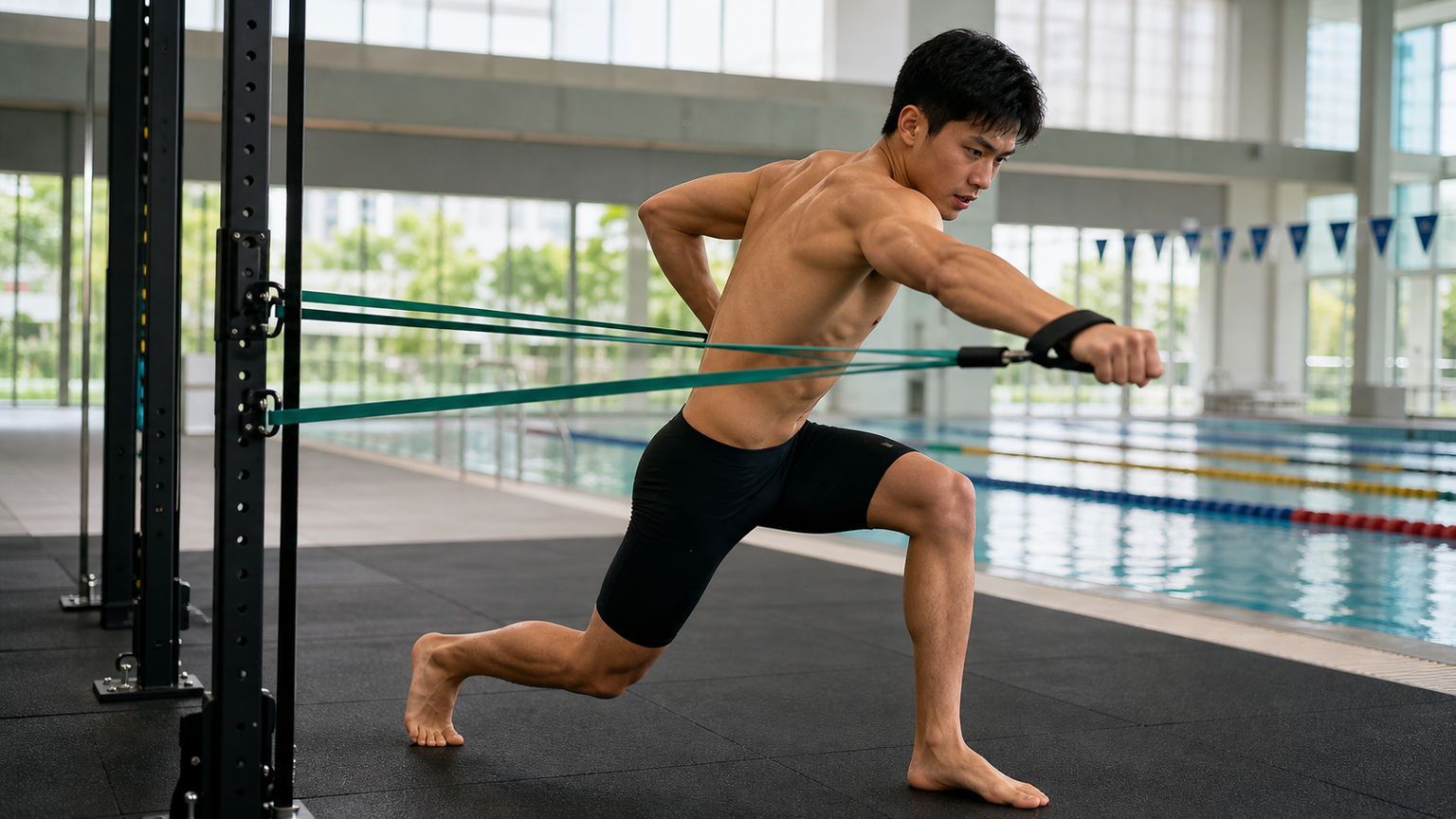
Resistance bands are the most cost-effective tool in swimmer land training, capable of simulating nearly all water-based pulling and pushing movement patterns.
Core Exercises
1. Swim Pull Pattern
- Anchor the band overhead and perform a standing freestyle stroke simulation (high elbow, catch, pull-through), feeling the water-pressing force through the palm and forearm.
- 15–20 reps × 3 sets, slow and controlled, emphasizing a complete pull-through.
2. External Rotation
- Anchor the band to the side, keep the upper arm close to the body, rotate the forearm outward to 90°, hold for 1 second, then slowly return.
- This exercise strengthens the infraspinatus and teres minor, making it one of the most important exercises for preventing shoulder injuries in swimmers.
- 20–25 reps per side × 3 sets, using a low-resistance band.
3. Backstroke Pull
- Face the wall with the band anchored high in front, simulating the backstroke pull path (entry → catch → pull-through → exit).
- 15 reps × 3 sets.
4. Butterfly Recovery
- Anchor the band low, simulating the butterfly straight-arm recovery (exit → swing forward → entry), enhancing coordination of the muscles around the shoulder joint.
Tool 2: Swim Bench / Biokinetic Swim Bench
The swim bench is the land training equipment that most closely replicates the actual swimming stroke. Lying prone on the bench, athletes pull the swim handles with both hands to simulate the swimming pull-through.
Training Benefits
Research indicates that swim bench training 3–4 times per week for 15–20 minutes per session can improve short-distance sprint speed by 1.5–3% within 6–8 weeks, primarily through increased maximal pulling strength and stroke efficiency.
Usage Recommendations
- Beginners: Start at 60–70% of maximal resistance to familiarize yourself with the movement pattern, emphasizing the feel of a “high-elbow catch.”
- Advanced Training: Incorporate sprint sets (8–12 maximal-speed pulls) to simulate the neuromuscular stimulation of race cadence.
- Training Volume per Session: Recommended 4–6 sets × 20–30 reps (aerobic maintenance sets) or 6–8 sets × 8–12 reps (power sets).
Municipal swimming centers across Taiwan (such as venues in Taipei City) and university sports facilities typically have swim benches available; athletes should take advantage of these resources.
Explosive Power Training: Strengthening Lower-Body Push-Off Power
Why Lower-Body Explosive Power Matters for Swimming
The force of the starting block push-off, the wall push-off after turns, and the breaststroke leg drive—all require powerful lower-body explosive strength. Research shows a strong positive correlation between vertical jump height and swimming start speed (r ≈ 0.7).
Lower-Body Explosive Power Training Program
| Exercise | Description | Weekly Volume |
|---|---|---|
| Box Jump | Jump from the ground onto a box, enhancing explosive quadriceps activation | 3×8–10 reps |
| Jump Squat | Squat down then explode upward, simulating the block start | 4×6–8 reps |
| Single-Leg Squat (Assisted Pistol Squat) | Builds single-leg stability, similar to the unilateral force of wall push-offs | 3×8–10 reps (per side) |
| Plyo Bounds | Continuous jumping, enhancing the stretch-shortening cycle (SSC) | 2×15–20 bounds |
Core Stability Training
The focus of core training for swimmers is not on the appearance of a six-pack, but on the ability to maintain spinal stability during dynamic movement, which directly affects streamlined body position in the water.
- Progressive Planks: From static plank → alternating leg lifts → TRX suspension plank, gradually increasing the instability challenge.
- Pallof Press: Using a resistance band or cable machine, training anti-rotational core stability to simulate torso rotation control in freestyle and backstroke.
- Supine Dolphin Kick: Lying on your back, perform dolphin kicks with both legs, strengthening deep abdominal muscles and hip flexor coordination.
Practical Recommendations
- Schedule land training after water sessions: Avoid entering the water immediately after land training, as muscle fatigue can compromise the quality of technical movements in the water.
- Perform land training 2–3 times per week: There is no need for daily sessions, but maintain a consistent frequency to allow adequate supercompensation time for the muscles.
- Reduce land training in the week before competition: During the taper period, land training volume should be significantly reduced, maintaining light dynamic work to avoid accumulating unnecessary muscle fatigue before race day.
- Track personal best strength markers: Regularly record metrics such as vertical jump height and maximal resistance on the swim bench as objective measures for monitoring land training effectiveness.
Conclusion
Land-based supplementary training is the hidden engine behind breakthroughs in competitive swimming performance. If Taiwanese swimmers can establish systematic land training habits, combined with scientific water training, they will evolve simultaneously in technique, strength, and explosive power. Resistance bands, swim benches, and explosive power training are not “extra burdens”—they are the secret weapons that make every stroke more powerful.
Related Reading
- The Complete Land Training Program for Swimmers: A Shore-Based Guide to Resistance Bands, Core, and Flexibility
- Land-Based Supplementary Training for Swimming: Applications of Resistance Bands and TRX in Swim Conditioning
- Swimming Land-Based Supplementary Training: Swim-Specific Movements with Resistance Bands, Core Boards, and Yoga Balls
- Land-Based Explosive Power for Swimmers: A Complete Guide to Band Pull Simulations and Shoulder Power Training
西進武嶺 免費訓練分析服務 Intervals | 練不夠還是練過頭?你哪一種類型選手?AI模型告訴你! | 備戰神器 | 公路車 訓練 | CT Yeh
4 年前
一起升級!海鷗盃LSD團練...JJSC Zone2招待 騎到手抖 / 公路車 / CT Yeh
2 天前
一個測試有沒有認真練車的方法😂 #公路車
10 個月前
FTL 與 SYB 車隊專訪 西進武嶺 實用攻略分享! 2小時 如何練?!你不知道的眉角!新手準備武嶺必看 EP1 | 實力派女車友 | 精華版 | 公路車 | CTYeh
4 年前
滑雪新手們慘摔學習全紀錄(請開字幕),滑雪好好玩 | Snowboard + Ski | 岩原 スキー場 | 滑雪APP使用 | GoPro Max
6 年前
CT 喇低賽) 武嶺牽車 才是王道 西進牽車四小時內秘訣 攝手位置 如何判斷 防抽筋小秘訣
7 年前
#公路車 #西進武嶺 配速配瓦實驗 坡度分析 四小時內攻略 建大盃 NeverStop #西進武嶺攻略
6 年前
CT暗黑廚房) 車友必備 宇宙無敵鮮蚵湯 幫助訓練恢復 天然食補 好市多 超肥鮮蚵 破PR
7 年前