Muscle Differences Between Treadmill and Outdoor Running: The Real Impact of Incline Settings and Wind Resistance
Introduction
Taiwan’s summer heat, flooded roads during plum rain season, and days with poor air quality push many runners toward the gym treadmill. The treadmill is a convenient option, but it differs from outdoor running in several key biomechanical ways, and these differences directly affect how your muscles are trained.
This doesn’t mean treadmill training is inferior — once you understand the differences and apply them wisely, the treadmill can become an effective complement to outdoor running, and in some specific training goals, it can even outperform outdoor training.
Key Differences Between Treadmill and Outdoor Running
Difference 1: Active Belt Movement vs. Passive Ground Propulsion
This is the most fundamental biomechanical difference:
- Outdoor running: After the foot lands, it pushes off the ground backward, propelling the body forward.
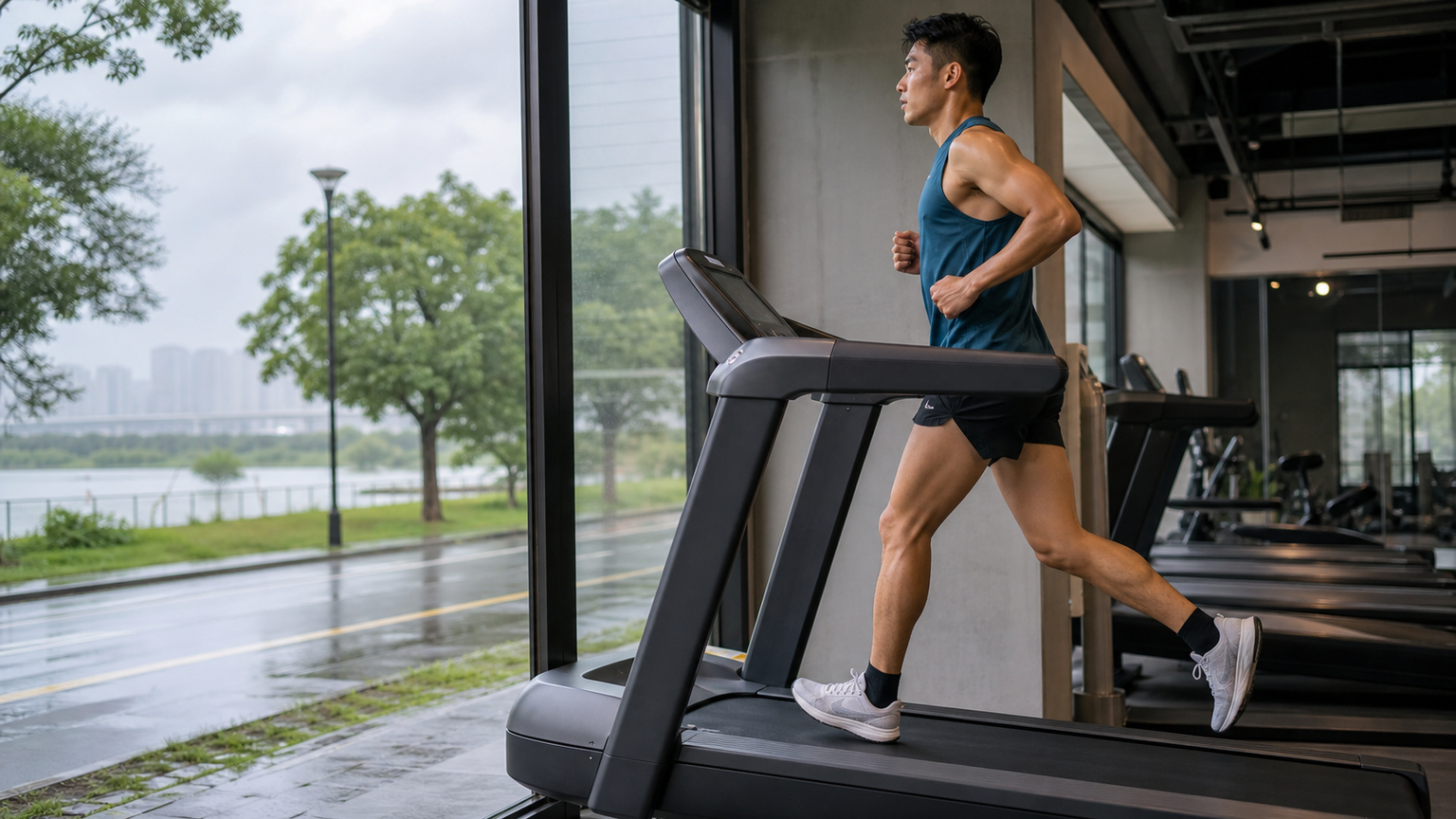
- Treadmill running: The belt actively moves backward beneath you, so the foot only needs to land and “allow” itself to be carried, requiring less push-off force.
Muscle impact: Because the belt assists in moving the leg backward, activation of the hamstrings and gluteus maximus during the push-off phase is lower on a treadmill than outdoors. Studies show that hamstring EMG (electromyography) activity during treadmill running is roughly 10–15% lower than during outdoor running.
Difference 2: Absence of Air Resistance
Outdoor running requires extra energy expenditure to overcome air resistance:
| Speed | Energy Cost from Wind Resistance (% of total energy expenditure) |
|---|---|
| 4:00/km (steady pace) | About 8% |
| 3:30/km (marathon pace) | About 10% |
| 3:00/km (5K pace) | About 12% |
Compensation method: Setting the treadmill incline to 1–2% roughly compensates for the energy expenditure gap caused by the absence of wind resistance (Treadmill Study, Jones & Doust, 1996). This remains the most widely accepted recommendation for treadmill incline compensation.
Difference 3: Differences in Stride and Landing Pattern
The treadmill’s fixed rhythm and reduced visual feedback affect stride and landing in the following ways:
- Stride length on a treadmill tends to be slightly shorter than outdoors (about 3–5%)
- The landing point is relatively closer to the center of mass (since the belt is moving, a large forward stride isn’t needed)
- Some runners show a greater tendency toward heel-striking on the treadmill
Unique Training Advantages of the Treadmill
Despite the differences above, the treadmill offers unique advantages for certain training goals:
Precise Incline Climbing Training
One of the treadmill’s biggest advantages is the ability to precisely set and maintain an incline — something that is nearly impossible to do outdoors:
- Long incline intervals: Set a 5–8% incline, run hard for 3 minutes, rest for 3 minutes, repeat for 6–8 sets
- Incline progression training: Increase the incline by 1% every 5 minutes, from 1% up to 8%, simulating the muscular fatigue of off-road climbing
- Steep hill walk training: Race-walk at an extreme 12–15% incline to strengthen the glutes and calf muscles
Training benefits of high-incline walking: Walking at race-walking speed on a 10–15% incline can reach a heart rate zone comparable to running, while strengthening the posterior chain muscles with almost no impact on the knees — ideal during injury recovery.
Precise Pace Control
The treadmill lets you lock in a pace, forcing you to maintain a set speed. This is especially useful for:
- Tempo runs: Maintain a fixed pace for 20–40 minutes; intensity is easier to control than outdoors
- Negative split training: Gradually accelerate in the second half — the treadmill allows for completely precise speed increases
How to Make Treadmill Training Closer to Outdoor Benefits
- 1–1.5% incline: The standard setting for everyday base runs, compensating for the lack of wind resistance
- 2–4% incline: Used for tempo runs and interval training to further strengthen the posterior chain and cardiovascular load
- Never hold the handrails: Holding the handrails while running on a treadmill is strongly discouraged, as it significantly reduces core engagement and natural gait
- Add supplementary hamstring training: Add one dedicated hamstring session per week (such as Nordic curls or Swiss ball leg curls) to make up for the training deficit caused by belt assistance
- Keep running outdoors regularly: Even if you train mainly on the treadmill, keep 1–2 outdoor runs per week to maintain push-off strength and proprioception
Treadmill vs. Outdoor Training: Recommended Use Cases
| Training Type | Recommended Setting | Reason |
|---|---|---|
| Easy recovery run | Either | Low intensity, minimal difference in impact |
| Tempo run | Treadmill | Precise pace control |
| Interval training | Either | Treadmill offers precise pacing; outdoors offers wind resistance benefits |
| Long run | Outdoor preferred | Outdoor terrain variation provides more comprehensive muscle training |
| Hill/incline training | Treadmill (precise incline) | Outdoor gradients are hard to keep consistent |
| Bad weather training | Treadmill | Safe and stable |
Practical Recommendations
- Always set at least a 1% incline on the treadmill: Whenever you run on a treadmill, set at least a 1% incline as the baseline standard
- Do a pure outdoor long run every other week: Maintain outdoor push-off strength and proprioception, and avoid relying entirely on the treadmill
- The treadmill is the best tool for incline training: Take advantage of the treadmill’s precise incline settings to perform more systematic incline training than is possible outdoors
- Watch for the perceived-speed gap on the treadmill: When switching from treadmill to outdoors, your subjective sense of speed may feel slower, and it can take 1–2 weeks to recalibrate your pace perception
- Race-walking with incline is a low-impact, high-benefit option: If you have knee issues or are in a recovery period, high-incline race-walking can substitute for running while still strengthening the same muscle groups
Conclusion
The treadmill and outdoor running are not an either-or choice — they are complementary training tools. By understanding their differences and adjusting your training strategy accordingly, you can maintain high-quality training in Taiwan regardless of weather or season, while fully leveraging the treadmill’s unique advantages in incline training and pace control.
Related Reading
- Treadmill vs. Outdoor Running: Biomechanical Differences Between the Two Training Environments and Strategies for Taiwanese Runners
- Treadmill vs. Outdoor: Mechanical Differences, Incline Compensation, and Proper Usage
- The Science of Treadmills: A Guide to Speed Calibration and Transitioning to Outdoor Running
- Treadmill vs. Outdoor Running: A Scientific Comparison and Optimal Training Combination Strategy
風櫃嘴! 現實與虛擬騎乘 會有誤差嗎? 背著iPad邊騎一趟風櫃嘴實際測試一次 | 公路車 | CT Yeh
3 年前
#公路車 #Fitting 靠人工智慧APP 幫你調整單車
6 年前
風櫃嘴時間 預測西進武嶺時間?13000名車友統計數據分析告訴你 !
5 年前
元宇宙運動 ! RouvyAR 虛擬實境約騎! 台灣路段開箱 帶你日月潭環潭一圈 | 團騎競賽參加教學 | 常見小問題整理 三人共享一年不用一千 | 公路車 | 訓練台 | CTYeh
5 年前
Zwift 元宇宙單車世界 如何與全世界同步騎車運動
6 年前
大家都在開箱的...單車用藍芽對講耳機真的有幫助嗎? SENA BiKom 20 長距離旅遊 & 海鷗繞圈賽 實際體驗心得 / 公路車 / CT Yeh
9 個月前
3D 列印車褲墊 / 舒適改善? / 無痕 x 分區壓縮 / ATK & Decider系列 / JE22黑科技 / #公路車 #CTYEH
11 個月前
靠單車減肥35公斤 心得分享與整理
7 年前