Trail Running Shoes vs. Road Running Shoes: A Comprehensive Comparison of Traction, Protection, and Cushioning
Introduction
The training environments for runners in Taiwan are extremely diverse: on weekdays, they run in city parks or along riverside paths, and on weekends, they head to Yangming Mountain or Lala Mountain. This mixed-terrain training pattern makes the choice between “trail shoes or road shoes” particularly complex. Some runners choose one pair that does it all, while others keep dedicated shoes for each purpose. How should you decide? Understanding the design differences between the two is the first step.
Outsole Design: The Core Difference in Grip
Trail Running Shoe Outsoles
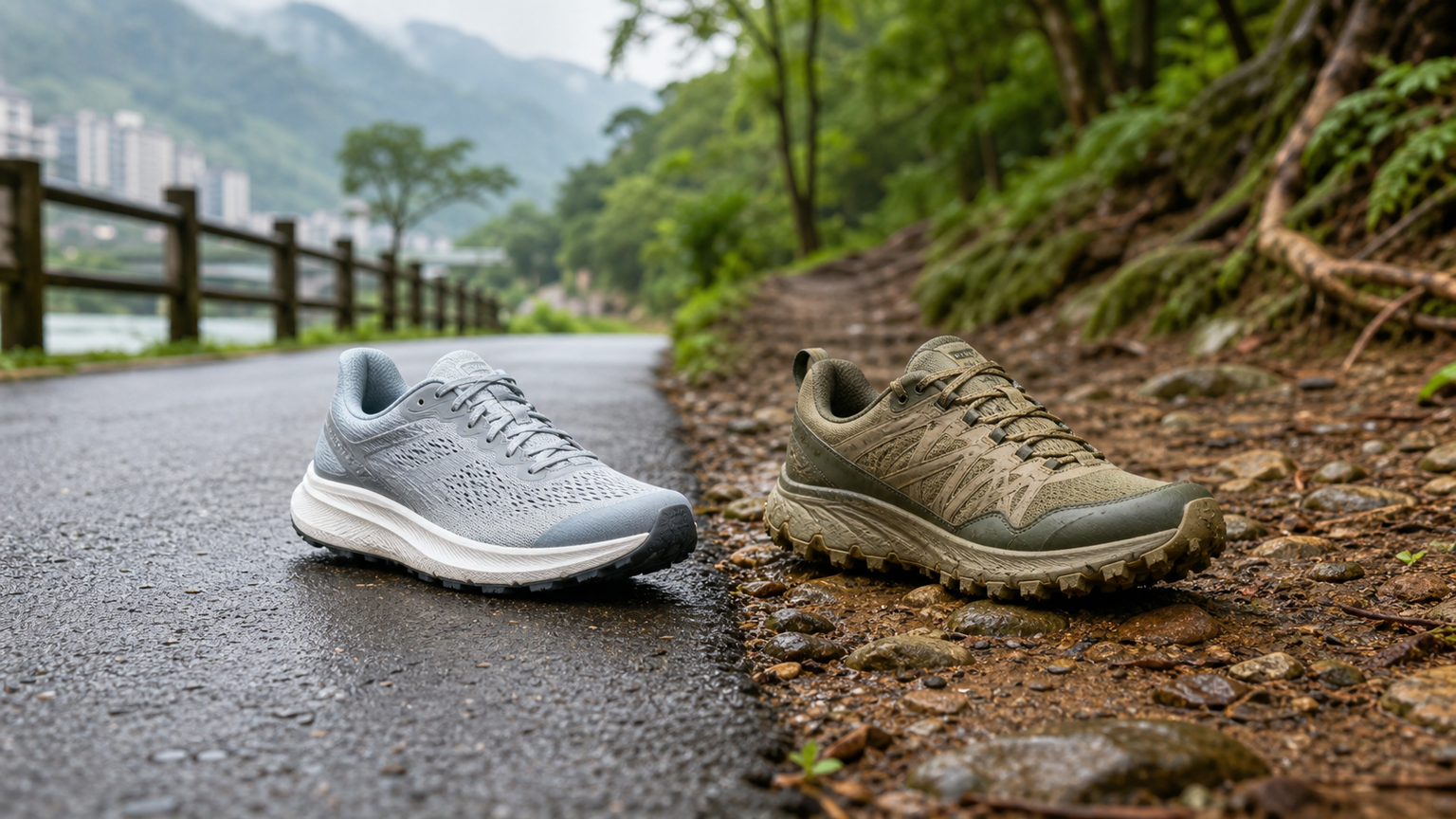
Trail running shoe outsoles feature a raised lug pattern, with lug depth graded according to terrain:
- Shallow lugs (3–4mm): Suitable for compacted dirt trails or low-to-mid-elevation mountain paths in Taiwan, providing adequate grip on lightly technical trails without excessive wear on the occasional paved road sections
- Medium lugs (4–6mm): The most common specification for trail races in Taiwan, an all-around design that adapts to mountain paths and muddy terrain
- Deep lugs (6mm+): Designed specifically for soft, muddy ground, such as mountain trails after the rainy season or wet grassy slopes; running on hard ground will make you noticeably feel the lugs “elevating” you
The rubber compound is also crucial. Vibram rubber holds an excellent reputation among trail runners, with its Megagrip formula performing particularly well on wet, slippery rocks—highly practical for Taiwan’s rainy mountain environment.
Road Running Shoe Outsoles
Road running shoe outsoles feature a smooth or lightly textured design, maximizing contact area with the asphalt to provide stable propulsion. Some brands use wear-resistant rubber (such as Continental tire rubber licensed to Adidas) to reinforce high-wear zones and extend the shoe’s lifespan. Road outsoles perform very poorly on trail surfaces: once you step on a wet rock or a dirt slope, it’s almost like ice skating.
Midsole: Cushioning vs. Protection
| Feature | Trail Running Shoes | Road Running Shoes |
|---|---|---|
| Midsole thickness | Usually thinner (ground feel prioritized) | Thicker (maximum cushioning) |
| Rock plate protection | Most have one (TPU or carbon fiber) | None |
| Lateral stability | Higher | Lower |
| Energy return | Secondary consideration | Primary design goal |
The most distinctive midsole feature of trail running shoes is the rock plate. When your foot lands on a sharp stone, the rock plate disperses the impact force, protecting the sole from puncture-type pain. Taiwan’s mountain trails are dense with loose rocks, making this feature especially important.
Upper Materials and Durability
Trail running shoe uppers typically feature:
- Thicker woven or polyester materials: To resist scratches from branches and rocks
- Overlaid rubber toe caps: To protect the front from impacts
- Reinforced heel counters: To prevent heel slippage from unstable foot strikes on descents
Road running shoes prioritize breathability, using highly breathable thin mesh that performs better at dissipating heat on Taiwan’s hot summer asphalt.
Shoe Recommendations for Common Races in Taiwan
- Taipei Marathon, Fubon Marathon, Kaohsiung Marathon: Entirely on asphalt, road shoes are the only choice; trail shoes are heavier and noticeably less efficient at propulsion than road shoes
- Taroko Gorge Marathon: Primarily asphalt, but with loose gravel and occasional muddy sections along the route; lightweight trail shoes or road shoes with an active stride are both viable options
- OTTR Trail Races (trail series across Taiwan): Fully on trail surfaces, trail running shoes are a necessary choice
- Taipei Grand Trail race-format routes: Mixed terrain, shallow-lug trail shoes with stronger grip are recommended
Hybrid Shoes (Trail-Road Hybrid)
In recent years, a category of shoes designed specifically for mixed surfaces has emerged, such as the Nike Terra Kiger and Salomon Pulsar Trail. These shoes use medium-depth lugs that sit between trail and road designs, along with slightly more midsole cushioning than trail shoes, making them suitable as daily training shoes for runners whose “training happens in the city, racing happens on the trails.”
Practical Advice
- Prepare separate shoes by purpose: If more than 30% of your weekly mileage is on trail surfaces, it’s recommended to have both road shoes and trail shoes and rotate between them—this protects your joints and extends the lifespan of both pairs
- Key try-on indicator: When trying on trail shoes, test ankle stability on uneven ground, not on the smooth floor of the store
- Choosing shoes for Taiwan’s rainy season: Mountain trails are extremely slippery during the plum rain season (May–June) and typhoon season (July–September); during this time, grip takes priority over cushioning—opt for deep-lug trail shoes rather than hybrid models
- Cleaning and maintenance: Mud easily accumulates in the lug gaps of trail shoes; clean them with a stiff-bristled brush after each use, stuff them with newspaper to absorb moisture before air-drying, and avoid direct sunlight exposure which can cause the rubber to age
Conclusion
Trail running shoes and road running shoes are tools designed for fundamentally different surfaces. In Taiwan’s rich and varied terrain, understanding the differences between the two is the foundation for choosing the right equipment. For Taiwanese runners seeking a diverse running experience, owning two pairs of running shoes for different purposes is not a luxury—it’s a responsible investment in your own safety and performance.
Related Reading
- Trail Running Shoe Buying Guide: Grip and Protection for Mountain Terrain
- Trail Running Shoes vs. Road Running Shoes: Outsole Grip Requirements for Taiwan’s Mountain Trails
- Trail Running Shoe Buying Guide: Evaluating Outsole Grip, Waterproofing, and Protection
- The Complete Trail Running Shoe Buying Guide: From Terrain Analysis to Shoe Recommendations, Everything You Need to Know About Choosing Trail Running Shoes
Unaas X50 全碳纖幅條輪 數據實測對比PK | Lun Hyper 的高階版 | 板輪爬坡也可以很厲害? ! 武嶺2小時大師一起親測! CP值超高 | 公路車 | CT Yeh
4 年前
大禹嶺 到 武嶺牌樓 全程前後實況錄影 | 北進武嶺 | 東進武嶺 | KOM | 訓練台 | 坡度分析 | Taiwan KOM Last 10 km HARD | 公路車
6 年前
公路車 BB培林大升級! / 備戰海鷗繞圈賽 Canyon Aerod & TIME 一起改 / MIT大廠 CEMA對鎖式陶瓷培林BB & 導輪 / 公路車 / CT Yeh
2 年前
單車 一日北高 ( 雙城 ) 肥宅雙人瘋狂行 紀錄片 REACTO
10 年前
CT 喇低賽) 武嶺牽車 才是王道 西進牽車四小時內秘訣 攝手位置 如何判斷 防抽筋小秘訣
7 年前
再一組! 全碳幅條 碟煞/無內胎輪組 開箱! 到底好騎嗎? UNAAS X40 | 公路車 | CT Yeh
4 年前
崇越盃武嶺冠軍高手 賽前JJSC 群峰會精華!對應大數據分析,會有落差嗎?/ feat. JJSC中部公路車約騎 /公路車 / CT Yeh
2 年前
96聯賽 桃園市長盃 歷屆各路段大數據攻略 從菁英組到新手組的平均瓦數、均速、平均時間 x 賽前探路
5 年前