Introduction
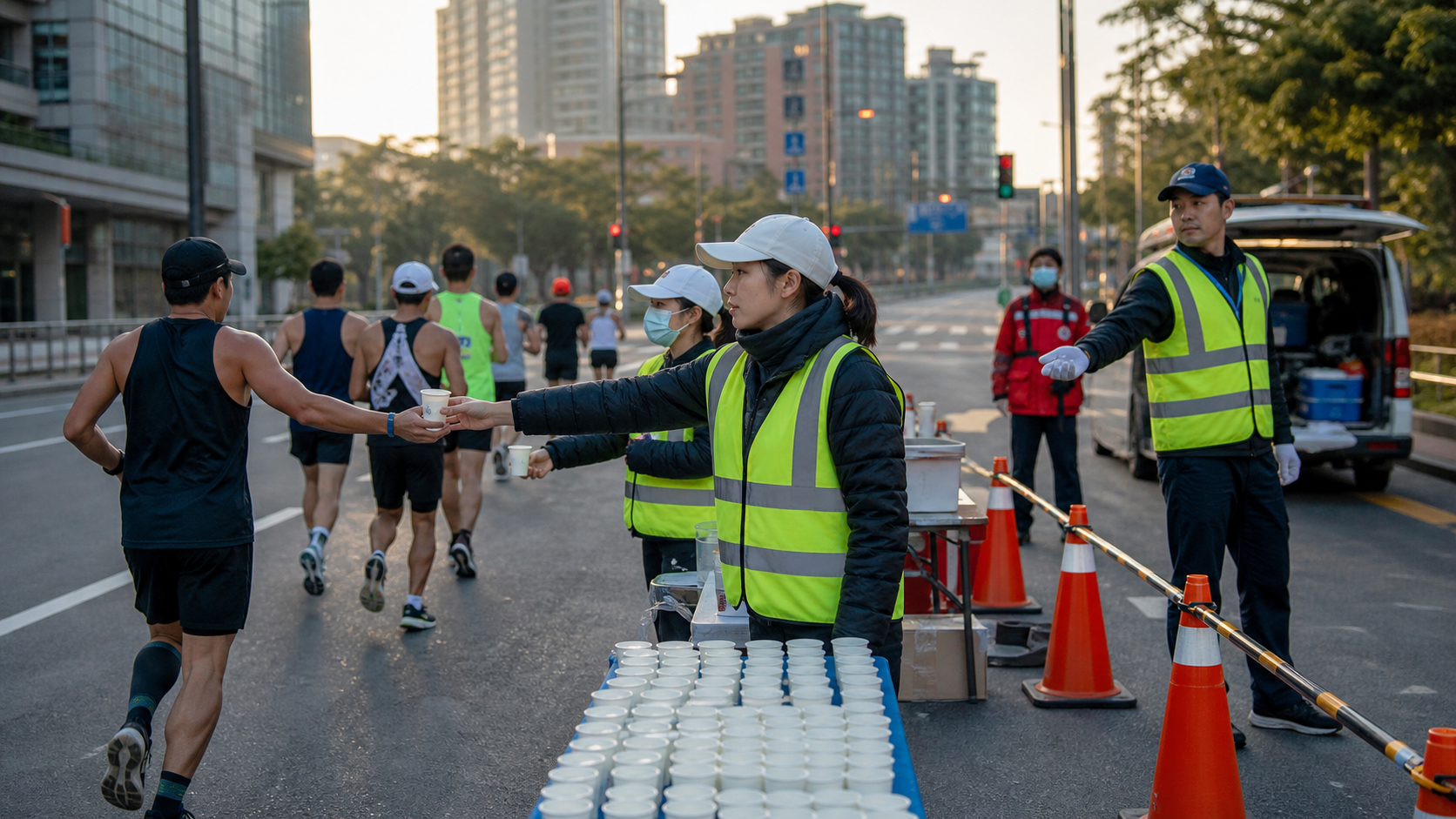
Behind every successful road race, hundreds or even thousands of volunteers and officials work quietly in anonymous roles. For runners, that cup of water at an aid station, the directional gestures at an intersection, and the finisher medal at the finish line are all the fruits of hours or even longer of volunteer service. This article aims to provide a comprehensive understanding of how Taiwan road races operate for those aspiring to serve as race staff.
Taiwan Road Race Organizational Structure
A medium-to-large road race typically operates through the coordination of the following departments:
| Department | Core Responsibilities | Staff Size |
|---|---|---|
| Race Director | Overall coordination, emergency decision-making | 1–2 people |
| Competition Team | Timing, categorization, results | 5–10 people |
| Course Team | Course planning, signage setup | 10–20 people |
| Aid Station Team | Aid station setup, supply management | 30–100 people |
| Medical Team | First aid, medical stations, ambulance coordination | 10–30 people |
| Traffic Control Team | Intersection control, vehicle guidance | 20–50 people |
| Runner Services Team | Check-in, bag drop, finish services | 20–40 people |
| Sweep Team | Tail-end cleanup, post-event tidying | 10–20 people |
Detailed Description of Each Volunteer Role
Aid Station Volunteers
Aid stations are the service points runners encounter most frequently on the course and require the most efficient operation:
Basic Responsibilities:
- Arrive 1.5 hours early to confirm table setup and supplies are in place
- Be familiar with the types of supplies (water, electrolyte drinks, and the placement of solid food)
- Proactively offer supplies to runners rather than waiting for runners to reach out
- Keep the aid station tables tidy and replenish supplies at all times
Technical Details:
- Pouring water: Fill paper cups to about 70% full; cups that are too full tend to spill when runners grab them
- Proactively call out “Water!” or “Sports drink!” to help runners choose quickly
- Stand in two rows (one in the middle of the road, one on the roadside) to widen the service area
- After the last group of runners passes, help clean the ground and collect items
Intersection Traffic Control Volunteers
Traffic control volunteers directly affect runner safety and carry the greatest responsibility:
Core Responsibilities:
- Coordinate with police to control vehicles at designated intersections
- Keep the runner corridor clear at intersections and prevent vehicles from entering early
- In emergencies (e.g., an injured runner), immediately contact the medical team and mark the incident location
Notes:
- Do not leave your post without authorization, even when the flow of runners thins out
- Do not withdraw until the final cleanup is complete; wait for notification from the organizer
- When encountering uncooperative vehicles, prioritize communication, avoid conflict with drivers, and call the organizer for assistance
Timing Officials
Timing officials need to possess certain technical skills:
- Be familiar with timing systems (commonly used in Taiwan: ChronoTrack, bib timing, and other systems)
- Confirm the placement of timing mats and network connectivity
- Monitor runner crossing records in real time and address any omissions promptly
- After the race, assist in exporting results and verifying the data for the leading finishers
Race Day Schedule (Volunteer Version)
Using a full marathon starting at 7:00 AM as an example:
- 4:30 AM: Race command center begins operations; course team departs to set up signage
- 5:00 AM: Runner check-in team and aid station volunteers take their positions
- 6:00 AM: Traffic control volunteers take their positions; final confirmation of timing equipment
- 7:00 AM: Gun goes off; race begins
- During the race: Each post continues operating according to its duties; aid station team replenishes supplies as needed
- 1:00–2:00 PM: Last runner crosses the finish line (depending on the time limit)
- Wrap-up: Clean the venue, collect supplies, and count remaining aid station items
Emergency Response Procedures
The emergency procedures volunteers most need to understand during a race:
Runner collapses or loses consciousness:
- Stop immediately, assess the runner’s condition, and call for help from those nearby
- Notify nearby volunteers (usually a team leader with a two-way radio)
- Record the incident location (kilometer marker or GPS) and maintain order at the scene
- Do not move the runner unless the environment is confirmed to be dangerous (e.g., in the middle of the road)
- Wait for the medical team to arrive, then hand over and assist in explaining the situation
Severe weather response:
- Follow the organizer’s instructions; do not decide on your own whether to stop service
- In thunderstorm conditions, avoid high places and metal equipment
- If temperatures are extremely high, take turns resting to prevent volunteers themselves from suffering heatstroke
Volunteer Recruitment and Training
Recruitment for Taiwan road race volunteers typically begins 1–2 months before the race:
- Recruitment channels: Organizer’s official website, Sports Note platform, Facebook race fan pages
- Training method: Pre-race online or in-person briefing session (1–2 hours)
- Benefits: Most races provide volunteers with a vest or T-shirt, plus a volunteer meal or gift after the race
- Volunteer records: Some volunteer platforms (such as iVolunteer) offer service hour certification
Practical Advice
- First-time volunteers are advised to choose the aid station or runner services team, as they have the lowest entry difficulty
- Wear comfortable standing shoes on race day; you may need to stand for 4–8 hours
- Bring your own personal supplies (water, snacks); do not use the runners’ supplies
- In cold weather, wear an extra layer; the low temperatures while waiting in the early morning are colder than when running
Conclusion
Every volunteer at a road race is a key force that helps runners “achieve what seems impossible.” Whether you are serving as a volunteer for the first time or have already served at multiple races, understanding your role and providing enthusiastic service to runners are the fundamental driving forces that keep Taiwan’s road running culture thriving.
Related Reading
- Road Race Volunteer: The Meaning and Experience of Participating in Race Service
- Road Race Volunteer Culture: Reflections and Community Significance of Participating in Race Service
- Taiwan Road Race Volunteer Culture: The Emotion and Meaning of Serving at Aid Stations
- Road Race Wave Starts and Positioning Strategies
2025 海鷗團體繞圈賽 網路直播 超激烈裁判長視角 / EIPC 李廷威、Waypoint 等眾多高手競爭 / feat. 卡密兒主持 / 海鷗繞圈賽
9 個月前
新屋團體繞圈賽 | 眾多菁英好手賽道奔馳 | 千瓦女子軍團 | 無敵交管狂獲好評 明年你一定不能錯過 | #公路車
5 年前
2023桃園團體繞圈賽/環台賽等級拍攝/賽事精華/ 10人一隊缺一不可!50隊廝殺大場面 / 第三屆 海鷗繞圈賽 /公路車/CT Yeh
2 年前
Live) 備戰2019彰化經典百K 賽前攻略 (已完賽請看新影片
7 年前
第二屆 海鷗繞圈賽 / 桃園團體城市繞圈賽!多視角實況精華版 | | 訪問才是最好笑的 | 公路車 | CT Yeh
3 年前
2023桃園團體繞圈賽 / 海鷗繞圈賽 | 全程空拍數據版 | 公路車 | CT Yeh
2 年前
2024桃園團體自由車邀請賽!4K環台賽等級拍攝 全賽事精華!/ 集團大摔車 / 60隊菁英好手衝線 / 公路車 CT Yeh
1 年前
2025 海鷗團體繞圈賽 / 前八強賽事精華!/ 環台賽等級拍攝 / 國手菁英隊伍較勁 / CT Yeh #公路車
8 個月前