Swimming Resistance Parachutes and Resistance Bands: An Analysis of Professional Assistive Tools for High-Intensity Training
Introduction
When traditional pool training can no longer continuously improve fitness, or when athletes want to achieve higher training intensity in a shorter period, resistance training tools play a key role. The swim drag parachute and resistance band/tether are two of the most common high-intensity swimming aids. Both significantly increase swimming resistance, but each focuses on different training outcomes. In Taiwan’s competitive swimming community—particularly among university swim teams and the triathlon/cycling circle—the use of these resistance tools has noticeably increased in recent years.
Swim Drag Parachute
How It Works
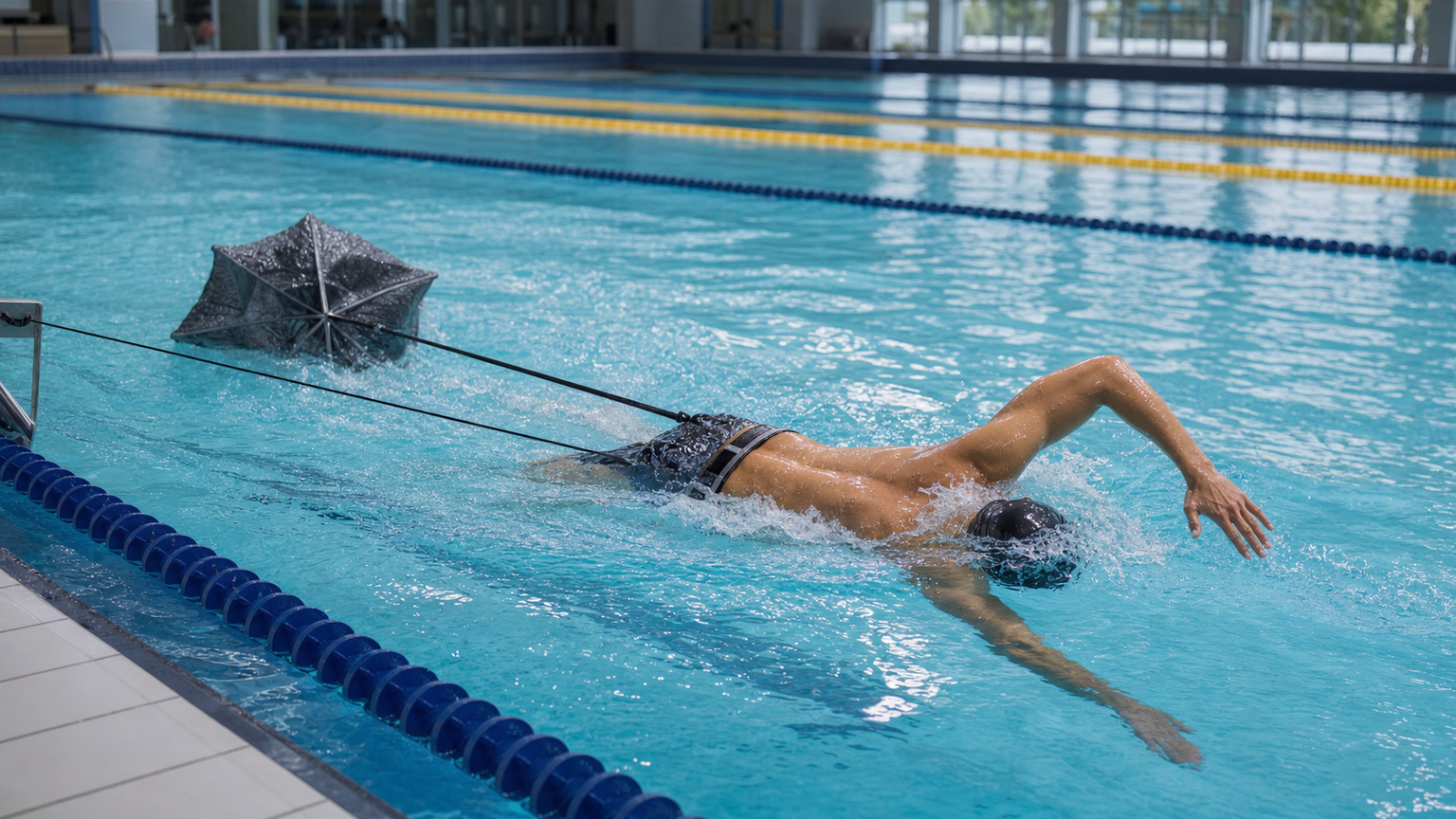
A swim drag parachute is an umbrella-shaped fabric device approximately 15–45 cm in diameter, attached to a belt secured around the swimmer’s waist or thighs. As you swim, water fills the parachute and opens it, creating resistance opposite to your direction of travel. The resistance is proportional to the parachute diameter and the square of swimming speed—the faster you swim, the greater the resistance.
This “speed-linked resistance” design is conceptually similar to sled pulls in land-based training. The training effects primarily target:
- Maximum force output: Each stroke must overcome greater resistance, strengthening the maximum force of the pulling muscles
- Explosive power training: Short-distance high-speed sprints with the parachute, similar to resisted sprint training on land
- Strength endurance: Mid-to-long distances with the parachute, improving lactate tolerance under high resistance
Parachute Size Selection
| Diameter | Resistance Level | Suitable For | Recommended Training Use |
|---|---|---|---|
| 15–20 cm | Light resistance | Youth, first-time users | Technique refinement, warm-up sets |
| 25–30 cm | Moderate resistance | General adult competitive swimmers | Strength endurance main sets |
| 35–45 cm | High resistance | Advanced swimmers, sprint specialists | Maximum strength training |
Swim Tether/Resistance Band
The Training Logic of Fixed Resistance
The resistance band works differently from the drag parachute—it is an elastic band with one end anchored to the pool wall and the other attached to the swimmer’s waist. The swimmer swims “in place” at a fixed position, with the band’s tension serving as the source of forward resistance.
This design is called “stationary swimming” or “tethered swimming,” allowing high-intensity training without occupying an entire lane. It is particularly well-suited to Taiwan’s crowded urban pool environments.
Unique Training Advantages of Resistance Bands
- Easy stroke analysis: Because swimming occurs at a fixed position, coaches can stand at the poolside, observe closely, and correct technique issues in real time
- Extended high-intensity stimulation: As long as the band is long enough, you can swim indefinitely until exhaustion, making it ideal for prolonged stimulation above the anaerobic threshold
- Two-person对抗 training: Two athletes each attach to one end and swim toward each other or pull against each other—a fun, highly effective competitive training method
Drag Parachute vs. Resistance Band Comparison
| Comparison Item | Drag Parachute | Resistance Band |
|---|---|---|
| Resistance type | Speed-linked (faster = greater) | Fixed elastic resistance |
| Movement pattern | Normal swimming movement | Stationary tethered swimming |
| Lane requirement | Full lane | Can be used in 2–3m of space |
| Stroke analysis | Difficult (while moving) | Easy (fixed position) |
| Best use cases | Speed and strength training | Technique correction and endurance building |
| Equipment cost | Moderate (NT$ 600–2,000) | Low (NT$ 300–1,000) |
Scientific Resistance Training Program Design
Sample Drag Parachute Training Set
Main set (drag parachute):
Warm-up: 400m easy freestyle
Main training:
  - 6×50m parachute sprints, 90-second rest intervals
  - 4×100m parachute steady pace, 3-minute rest intervals
  - 2×200m parachute strength endurance, 5-minute rest intervals
Cool-down: 200m easy
Goal: Balance maximum strength and speed endurance
Sample Resistance Band Training Set
Technique correction session (resistance band):
Warm-up: 300m
Technique work:
  - 3×(2-minute tethered swimming in place), 1-minute rest
  - Coach observes and provides real-time stroke path corrections
  - Focus: high-elbow catch, kick rhythm
Finish: 100m normal swimming to feel the technique improvements
Usage Precautions and Safety Guidelines
- Before using a drag parachute, confirm the belt is securely fastened to avoid it slipping off and tangling around the legs mid-swim
- For resistance band training, ensure the anchor point (usually a pool handrail or starting block) can withstand sufficient pulling force
- First-time parachute users should try it in shallow water first to gauge the resistance before moving to deeper water
- Shoulders fatigue easily after high-resistance training; only perform such sessions when fully recovered to avoid injury from accumulated fatigue
- Some pools in Taiwan prohibit the use of drag parachutes; always check with the pool management beforehand
Practical Recommendations
- Recommended drag parachute brands: FINIS and Speedo training parachutes, available for order at Taiwanese swim shops
- Resistance bands can be DIY: use elastic tubing sold at swim shops to make your own—extremely low cost and adjustable in length
- Limit resistance tool training to no more than 2 sessions per week, as a supplement to—not a replacement for—regular training
- Triathletes can intensify parachute training 4–6 weeks before a swim race to improve resistance capacity in open water
Conclusion
Drag parachutes and resistance bands remain relatively underutilized training tools in Taiwan’s swimming community. Properly incorporating these two resistance methods can significantly boost training intensity without adding swimming mileage, making them an effective strategy for maximizing training efficiency. The key lies in understanding the differences between the two tools, selecting the most appropriate one based on training goals, and using them scientifically and safely.
Related Reading
- Swim Drag Parachutes vs. Drag Nets: A Comparison of Resistance Training Equipment
- Drag Parachute Selection and Training Applications: Resistance Settings and the Benefits of In-Water Resistance Training
- Swimming Resistance Training: Training Design with Banded Kicks, Drag Parachutes, and Resistance Bands
- The Complete Guide to Swimming Resistance Tools: Application Strategies for Paddles, Drag Parachutes, and Resistance Cords
西進武嶺 免費訓練分析服務 Intervals | 練不夠還是練過頭?你哪一種類型選手?AI模型告訴你! | 備戰神器 | 公路車 訓練 | CT Yeh
4 年前
一日北高前的西濱集訓 | 跟著11小時軍團 | 300W踩不動的大逆風 | 輪車破風差幾瓦?
6 年前
3D 列印車褲墊 / 舒適改善? / 無痕 x 分區壓縮 / ATK & Decider系列 / JE22黑科技 / #公路車 #CTYEH
11 個月前
訓練台體驗) 2019台北自行車展 三大家 訓練台體驗 Tacx Neo Flux 2 Xepdo Apx Wahoo Kickr
7 年前
洗單車神器 吹水機! 實際洗車用用看 暴力洗鍊條大法 | 公路車 | CT Yeh
4 年前
一日北高前的高裝檢 | 北高 360 | 挑戰11小時的裝備 | 一日雙塔 | 補給
6 年前
鉅齒紋輪組!? ControlTech MEG-T50 EVO 碳纖維幅條輪組/ 功率對比實驗 / 公路車 / CT Yeh
2 年前
一起升級!海鷗盃LSD團練...JJSC Zone2招待 騎到手抖 / 公路車 / CT Yeh
2 天前