Introduction
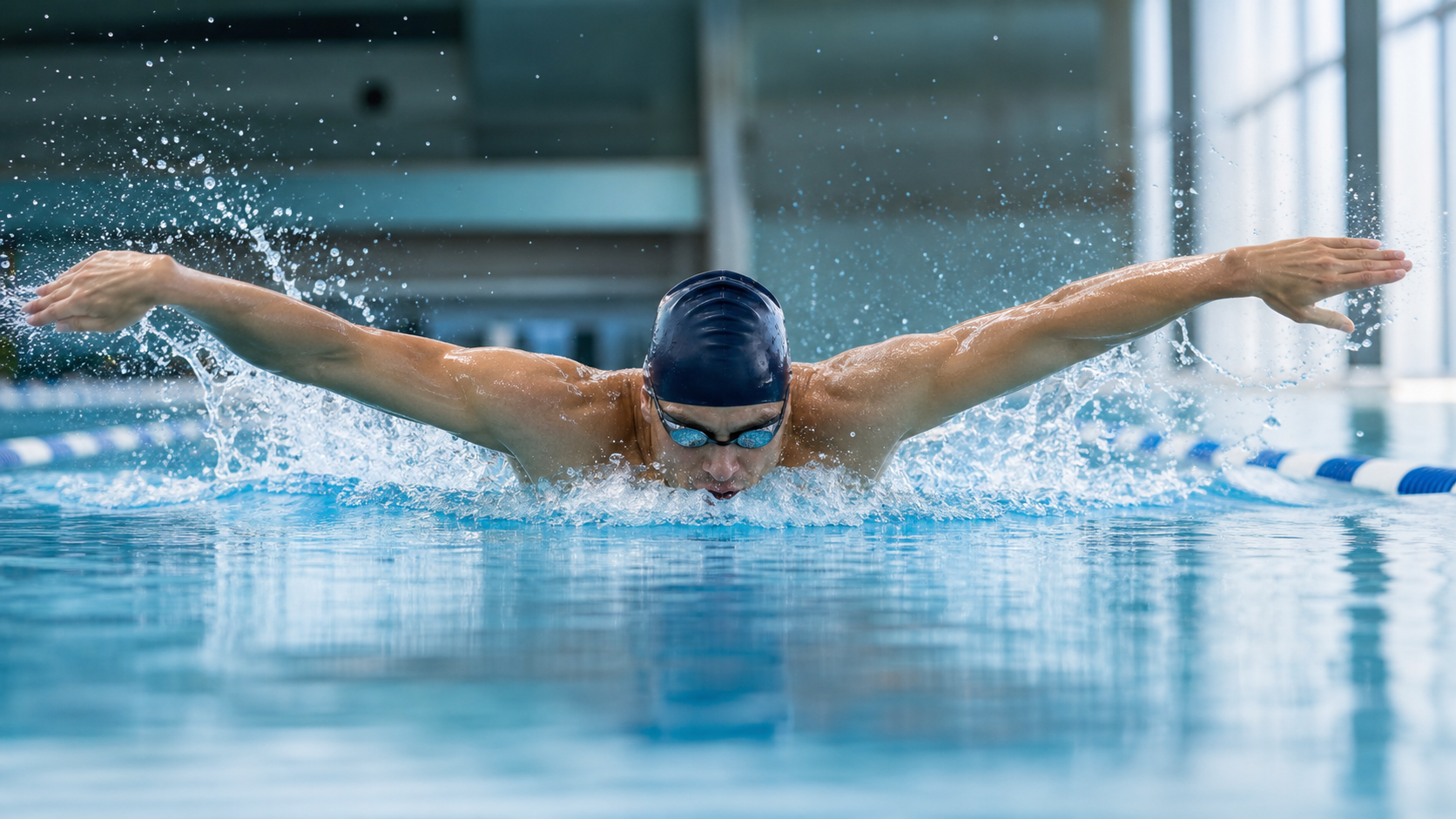
The wave-like undulation of the butterfly stroke is a visual spectacle that is unforgettable at first glance. However, for swimmers learning butterfly, this graceful movement conceals a complex mechanical coordination. The angle of entry, the timing of the exit, and how these two actions synchronize with the body’s undulation collectively determine the efficiency and beauty of the stroke.
Many swimming coaches in Taiwan report that the biggest problem students face when learning butterfly is not a lack of strength, but incorrect rhythm—the movements become disjointed, and the body fails to establish a continuous wave, making swimming both exhausting and slow. This article will delve into the core elements of butterfly rhythm.
The Wave Principle of Butterfly
The Essence of Body Undulation
The fundamental movement of butterfly is a wave motion that travels from head to toe. This wave consists of the following nodes:
- Head press down → Chest press down → Lower back press down → Hips rise up → Thighs drive down → Legs kick
This wave is not achieved through forceful muscle contractions, but through coordinated transmission across the body’s joints. Efficient butterfly swimmers appear to be “carried by the water’s wave,” while inefficient swimmers seem to be “struggling against the water’s resistance.”
The Functional Difference Between the Two Kicks
Each full butterfly cycle includes two kicks, and these two kicks serve distinctly different functions:
| Kick Timing | Name | Primary Function |
|---|---|---|
| When hands enter the water | First kick (propulsion kick) | Maintains forward momentum, compensates for entry resistance |
| When hands push past the hips | Second kick (balance kick) | Balances the upper body’s exit, prevents excessive rising |
A common mistake among beginners is applying equal force to both kicks, or performing only one kick. In proper butterfly, the first kick is typically more powerful than the second, as it needs to compensate for the resistance loss generated during entry.
Detailed Entry Technique
Entry Angle and Body Streamlining
The angle at which the hands enter the water greatly affects body streamlining. Proper entry should be:
- Palms slightly rotated outward: Hands enter slightly wider than shoulder width—not too wide (increases drag) and not too narrow (compromises propulsion)
- Entry angle of approximately 45 degrees: Similar to freestyle, an angled entry reduces surface resistance
- Head presses down immediately: After the hands enter, the head should press down into the water right away, without continuing to lift
- Body forms a streamline: At the moment of entry, the body should assume a streamlined position with minimal resistance
The “Glide Sensation” After Entry
Efficient butterfly swimmers experience a brief “gliding moment” after entry—hands in the water, body extended, first kick engaged—and in that instant, the body should feel the force of gliding forward. Many people miss this gliding moment because they rush to “swim,” which actually reduces efficiency.
Detailed Exit Technique
The Importance of Exit Timing
The most distinctive feature of butterfly is the simultaneous exit of both arms from the water. Incorrect exit timing is the main reason many swimmers find butterfly “particularly exhausting.”
Exit Movement Breakdown:
- When pushing to the hips, the arms accelerate the backward push
- The pinky side exits the water first, with palms rotating outward
- Elbows bend, and the arms recover forward in a low arc (Recovery)
- The recovery arc should be as low and flat as possible to reduce air resistance and preparation time for the next entry
The Energy-Saving Benefits of “Low Recovery”
There are two styles of arm recovery in butterfly:
- High Recovery: Arms swing high over the head—visually impressive but taxing
- Low Recovery: Arms recover forward close to the water surface, conserving energy
Modern competitive butterfly favors low recovery, especially in longer-distance races. For recreational swimmers, low recovery can significantly reduce fatigue and allow you to swim longer distances.
Breathing Timing and Frequency
The Mechanics of Butterfly Breathing
Butterfly breathing must align with the rhythm of the body’s undulation. The correct timing for breathing is at the end of the push, just before the arms exit the water, as the head rises naturally with the body’s wave. Many swimmers mistakenly “actively lift their head” to breathe, which disrupts the continuity of the body’s undulation.
Breathing Rhythm Recommendations:
- Short distance (25–50 meters): Breathe every 2 cycles
- Middle distance (100 meters): Breathe every 2 cycles, with the option to increase frequency toward the end
- Longer distances: Breathe every cycle (breathe on every stroke)
Common Mistakes and Corrections
- Head exiting too early or too late: The head should be carried out naturally by the push, not actively controlled
- Both kicks having the same rhythm: During practice, deliberately emphasize the first kick and soften the second
- Excessive body undulation amplitude: The wave should mainly originate from the hips and legs; the lower back should not over-bend
- Head not pressing down immediately after breathing: After inhaling, the head must return to the water quickly to avoid increased lateral drag
Practical Advice
- Before practicing butterfly, do 10 minutes of “dolphin kicks” (butterfly kick using only the legs, with both arms extended forward) to establish body wave awareness
- When practicing kicking with a kickboard, focus on feeling the rise and fall of the hips, rather than forcing the feet
- If you feel particularly sore in the lower back while swimming butterfly, it is usually because the lower back is dominating too much of the undulation; strengthen your core muscles instead
- Some swimming clubs in Taiwan offer specialized butterfly courses; beginners are advised to seek professional instruction before practicing on their own
Conclusion
The beauty of butterfly comes from the harmony of rhythm, not the accumulation of brute force. When the streamlining of the entry, the wave transmission of the body, and the arcing motion of the exit work together perfectly, butterfly gives you a wonderful sensation of “gliding forward with ease.” This feeling is what many swimming coaches refer to as “finding the rhythm.” It is recommended to feel the rhythm at a slow pace first during each practice session, then gradually increase speed, allowing technique and speed to improve in tandem.
Related Reading
- The Science of Butterfly Undulation: Hip-Driven Rhythm and Coordination Training Guide
- Butterfly Wave Rhythm: Synchronizing Body Undulation and Breathing Timing
- Butterfly Undulation: Coordinated Chest and Hip Rise-and-Fall Training
- Butterfly Undulation: Coordinating Hip Drive and Arm Synchronization
風櫃嘴 衝刺慢動作回放!
8 年前
西進武嶺 自製新版AI配速表產生器 x 賽前攻略 抱佛腳! 沒有功率計也可以產生配速表嗎?有什麼其他眉角賽前要注意的呢? | 西進武嶺 / 東進武嶺 KOM 攻略 | 公路車 | CT Yeh
4 年前
西進武嶺 免費訓練分析服務 Intervals | 練不夠還是練過頭?你哪一種類型選手?AI模型告訴你! | 備戰神器 | 公路車 訓練 | CT Yeh
4 年前
教學) 如何做出專業 慢動作 影片 Slow Motion 120fps GoPro 7 ActionCam AX700 A99II
7 年前
2023桃園團體繞圈賽 / 海鷗繞圈賽 | 全程空拍數據版 | 公路車 | CT Yeh
2 年前
一起升級!海鷗盃LSD團練...JJSC Zone2招待 騎到手抖 / 公路車 / CT Yeh
1 天前
[教學] Premiere 影片 手震 修正 教學 防抖 單眼 影像 GoPro 穩定 Video Stabilization
8 年前
[教學] Dashware 教學 如何製作有 速度 功率 心律的 騎車影片 Guages Video
8 年前