Introduction
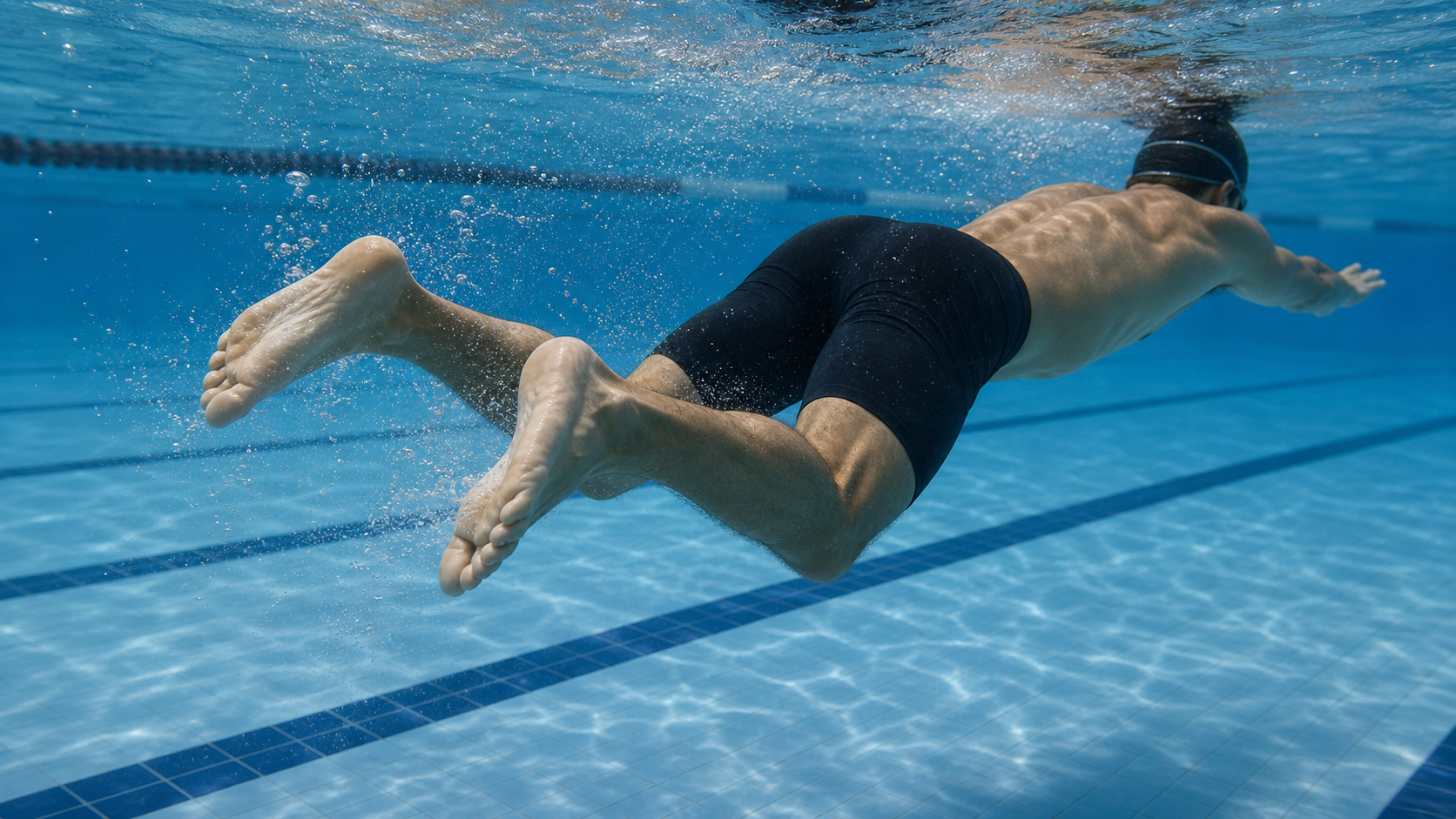
The breaststroke kick is the most joint-demanding technique among the four competitive swimming strokes. Unlike freestyle and butterfly, which primarily rely on the up-and-down flexion and extension of the ankles and knees, breaststroke requires hip external rotation, knee flexion and abduction, and the ankle’s “frog-foot turn”—this complex combination of movements is both the source of breaststroke propulsion and a potential risk for knee injuries.
Many swimming enthusiasts in Taiwan have experienced “knee pain from swimming breaststroke,” commonly known as “Breaststroke Knee.” This is not a problem inherent to breaststroke itself, but rather a compensatory knee injury caused by incorrect technique and insufficient hip flexibility.
Biomechanics of the Breaststroke Kick
Correct Movement Sequence
The complete breaststroke kick consists of four phases:
- Recovery: Draw the legs toward the buttocks, heels approaching the hips, knees spreading outward
- Foot Turn: Turn the toes outward, the tops of the feet facing outward, forming a “paddle surface” for pushing water
- Kick: Drive the legs outward, backward, and downward, forming an elliptical arc
- Glide: After the legs are fully extended, bring them together, and the body enters a streamlined glide
The core of this movement lies in the “direction of the kick”—the ideal breaststroke kick is not purely backward but outward and backward, using the resistance of the soles pushing against the water to generate forward propulsion.
The Importance of Outward Rotation Angle
The hip joint’s external rotation angle determines the degree to which the feet can turn outward, which in turn affects the effective surface area for pushing water. Literature on breaststroke biomechanics indicates that the ideal ankle external rotation angle (the angle of the toes pointing outward) is approximately 40–60 degrees, achieving an optimal balance between propulsion and streamlining.
| Outward Rotation Angle | Pushing Surface Area | Drag | Propulsive Efficiency | Knee Stress |
|---|---|---|---|---|
| Too small (<30°) | Small | Low | Low | Low |
| Moderate (40–60°) | Large | Moderate | High | Low–Moderate |
| Too large (>70°) | Large | High | Moderate | High |
Causes of Knee Injuries
Why Breaststroke Hurts the Knee
Breaststroke knee (medial collateral ligament or medial meniscus injury) primarily occurs due to:
- The knee compensating for hip external rotation: When hip flexibility is insufficient, the knee is forced to twist outward to complete the frog-kick motion, placing stress on the medial ligament
- Excessive knee abduction during recovery: When the recovery angle exceeds hip width, lateral stress on the knee increases
- Incorrect kick direction: Kicking the feet straight backward (rather than outward and backward) causes abnormal loading on the knee joint surfaces
- Excessive movement speed: Pursuing speed before technique is solidified leads to loss of control over details
Technical Points for Knee Protection
During recovery:
- The knee abduction angle should not exceed slightly wider than hip width
- Actively draw the heels toward the buttocks, rather than using knee external rotation to “pull” the heels closer
During the foot turn:
- The outward turn should come from the ankles and feet, not from twisting the knees
- Practice the foot turn while sitting on land first to confirm that it is the ankle joint moving rather than the knee joint
During the kick:
- The kick direction should have a clear sense of “outward and backward,” not purely backward
- Kick symmetrically with both legs; do not let one side generate more force than the other
Improving Hip Flexibility
Hip external rotation flexibility is the physiological foundation for executing a correct breaststroke kick. Here are targeted dry-land stretching recommendations:
- Seated butterfly stretch: Sit on the floor, soles of the feet together, knees opened outward, gently press the knees toward the ground, hold for 30 seconds
- Supine external rotation: Lie on your back, lift one leg, use your hands to assist in rotating the knee and foot outward, feeling the hip external rotation
- Frog stretch: Start on all fours, spread the knees wider than hip width, soles of the feet facing the ceiling, sit the hips back
It is recommended to perform 10 minutes of hip warm-up before each breaststroke training session and static stretching after swimming.
Kick Speed and Timing
The timing of the breaststroke kick must be coordinated with the arm pull. The correct sequence is:
- The arms sweep outward to catch water and recover inward (pull)
- As the pull ends and the arms extend forward, the legs begin the recovery phase
- After the arms are fully extended, the kick is initiated
- The kick ends, and the body enters a streamlined glide
This rhythm of “pull → glide → recovery → kick → glide” is the source of breaststroke’s tempo. A common mistake among beginners is moving arms and legs simultaneously, losing the sense of rhythm in the glide.
Practical Advice
- Those with existing knee injuries: Should not swim breaststroke until fully recovered; hip flexibility training must be strengthened first
- Beginners: Learn the “foot turn” movement (ankle eversion) on land first before practicing the kick in the water
- Advanced swimmers: Try the “Narrow Kick,” keeping the knees close together during recovery and using the ankles to push water during the kick—suitable for swimmers with narrow hips and good hip flexibility
- Regular self-assessment: If you feel discomfort on the inner side of the knee after swimming breaststroke, stop training immediately and evaluate whether the technique is correct
Conclusion
The essence of the breaststroke kick lies in “using the right body parts for the right movements”—the hip joint provides external rotation, the ankles provide the foot turn, and the knees serve only as a relay station for transmitting force, not as an actively engaged point of exertion. When your hip flexibility is sufficient and your technique is correct, the breaststroke kick can generate very powerful propulsion while the knees remain well protected. Investing time in dry-land flexibility training often improves breaststroke technique faster than simply increasing swimming volume.
Related Reading
- The Outward and Inward Sweep in Breaststroke: Balancing Knee Protection and Pushing Power
- Rebuilding Water Feel in the Breaststroke Kick: The Science of Hip External Rotation Angle and Propulsive Efficiency
- Biomechanics of the Breaststroke Leg Action: A Scientific Analysis of External Rotation and Pushing Thrust
- Knee Problems in Swimming: Causes, Prevention, and Rehabilitation of Breaststroke Knee
[教學] Premiere 影片 手震 修正 教學 防抖 單眼 影像 GoPro 穩定 Video Stabilization
8 年前
抖肩舞 台灣x日本交流版 (台灣 vs 前橋) 赤城山登山賽 coincidance
8 年前
大禹嶺 到 武嶺牌樓 全程前後實況錄影 | 北進武嶺 | 東進武嶺 | KOM | 訓練台 | 坡度分析 | Taiwan KOM Last 10 km HARD | 公路車
6 年前
CT 喇低賽) 武嶺牽車 才是王道 西進牽車四小時內秘訣 攝手位置 如何判斷 防抽筋小秘訣
7 年前
如何把 GoPro 影片 翻轉 批次 轉正?
6 年前
一日北高常見問題大集合 | 攻略 | 路線 | 訓練 | 補給 | 自行車 單車 | 一日雙城 | 雙塔 | TWB北高360 | 屁股痛
6 年前
下次拍照前要查清楚啦🤣 #cycling
7 個月前
滑雪新手們慘摔學習全紀錄(請開字幕),滑雪好好玩 | Snowboard + Ski | 岩原 スキー場 | 滑雪APP使用 | GoPro Max
6 年前