Introduction
The saying “half the race is won at the start” applies just as well to swimming. A perfect starting dive not only gives you an edge in the first few seconds of the race but also lays the foundation for the rhythm of the entire event. However, many swimmers never practice their starting technique in training and are unaware that different race distances require different start strategies.
From county and city swimming championships in Taiwan to amateur triathlons, starting technique is one of the most overlooked yet most impactful technical aspects for athletes. This article will systematically introduce the best start strategies for different race distances.
Basic Classifications of Swimming Starts
Grab Start
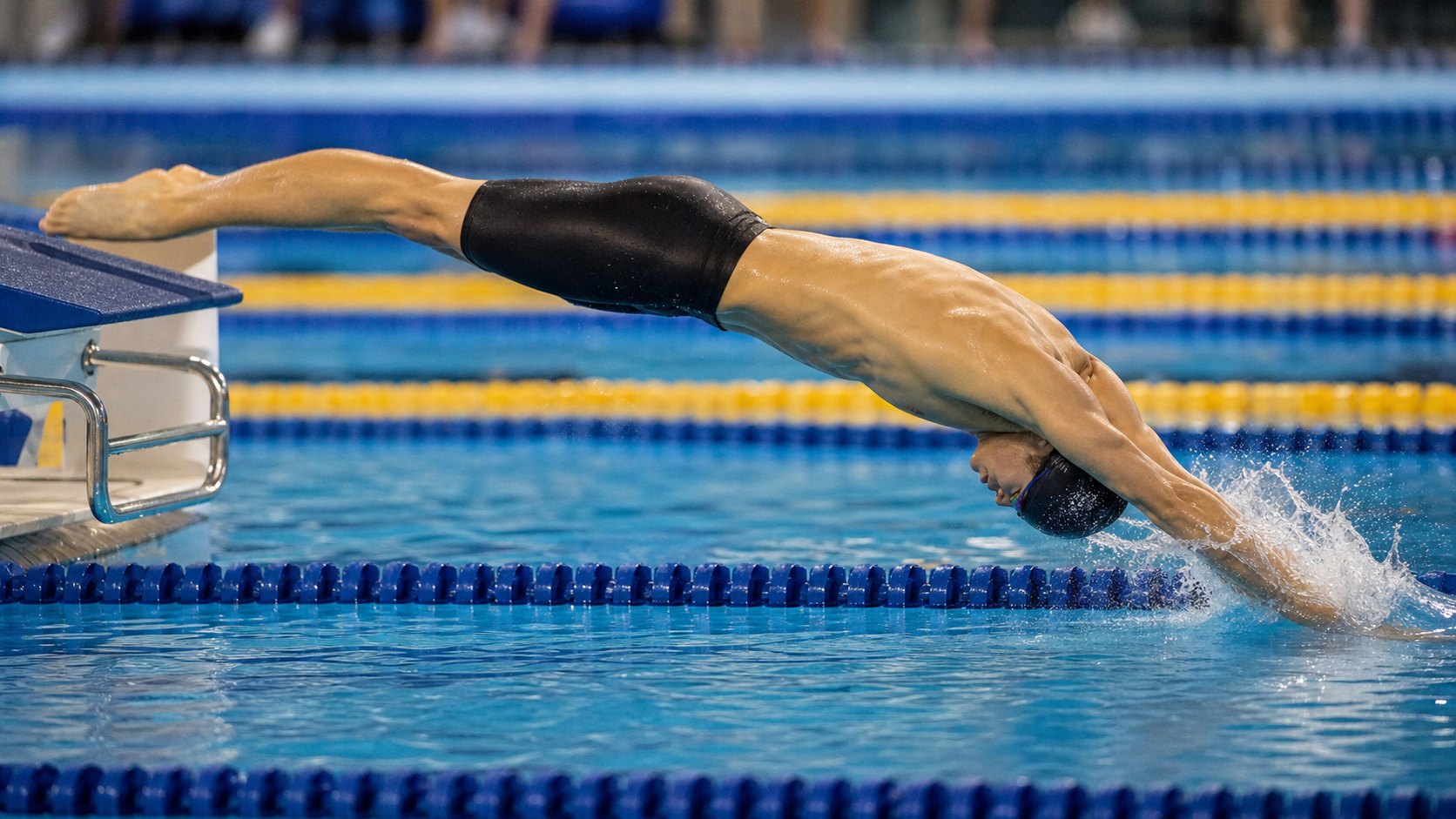
The traditional grab start involves gripping the front edge of the starting block with both hands, leaning the body forward, and launching with explosive power. This start produces a steeper entry angle (approximately 40–50 degrees) and suits sprint-oriented swimmers.
Track Start
The track start is the most mainstream starting technique in modern competitive swimming. With one foot forward and one foot back, the rear leg drives while the front leg springs at takeoff, generating greater horizontal initial velocity.
Triathlon In-Water Start
Open-water swimming in triathlons typically has no starting block; athletes usually start from a standing position in shallow water or from a floating start, requiring a completely different set of technical demands.
Entry Angle Strategies for Different Distances
Sprint Distance (50m): Low Angle, High-Speed Entry
The 50m sprint is the event with the highest demands on the start in swimming. The ideal entry angle is approximately 30–35 degrees (flatter), with the goal of quickly reaching maximum swimming speed.
Advantages of a low entry angle:
- Longer underwater glide distance (up to 7–10 meters)
- Maintains faster initial speed without wasting horizontal momentum
- Suited to sprint distances because there is ample time to fully exploit the glide advantage
Cautions:
- An entry angle that is too low (<20 degrees) can cause a belly flop, which is a serious technical error
- The head should be tucked between the arms and must not enter the water first (which could cause cervical spine injury)
Middle Distance (100–200m): Balanced Medium-Angle Strategy
The 100–200m events require a balance between starting speed and subsequent pacing. A recommended entry angle of approximately 35–45 degrees shortens the glide distance to 5–7 meters, allowing a quicker transition into normal swimming rhythm.
Long Distance (400m and Above): Steeper Angle to Conserve Energy
The goal of the start in long-distance events is not to “enter the water fastest” but to “avoid expending excessive explosive power and quickly settle into cruise pace.” The entry angle can be slightly steeper (45–55 degrees), with a shorter glide distance (approximately 3–5 meters) to transition into normal swimming sooner.
The trap of long-distance starts: an overly aggressive start causes lactate to accumulate rapidly after the first 50 meters, ultimately hurting your performance in the latter part of the race.
Comparison of Start Strategies by Distance
| Distance | Entry Angle | Glide Distance | Start Strategy | Kick Initiation Timing |
|---|---|---|---|---|
| 50m | 30–35 degrees | 7–10 meters | Maximum explosive power | Later (kick only at high speed) |
| 100–200m | 35–45 degrees | 5–7 meters | Balanced start | Moderate |
| 400m and above | 45–55 degrees | 3–5 meters | Energy-conserving start | Earlier (establish rhythm as soon as possible) |
| Triathlon | Standing start | Depends on conditions | Energy-conserving and stable | Immediate |
Underwater Technique After the Start
The Key to Streamlined Gliding
After entering the water, the body should immediately assume an optimal streamlined position (arms pressed against the ears, hands stacked, core engaged). During the high-speed glide phase, even slight drag is amplified and depletes momentum.
Using the Dolphin Kick
In freestyle and butterfly races, the underwater dolphin kick after the start is a highly important technique in modern competitive swimming. Research shows that underwater dolphin kicking speed often exceeds normal surface swimming speed, so maximizing underwater distance (within the 15-meter limit allowed by the rules) is a key strategy for competitive swimmers.
Timing the Surface Break
Surfacing too early loses high-speed momentum; surfacing too late (beyond the 15-meter rule limit) results in disqualification. The ideal time to surface is just before your speed drops to normal swimming speed.
Mental Preparation for the Start
Beyond technical factors, mental preparation at the start is also critical:
- Reaction time: Competitive swimming allows reacting after the gun, but a false start (negative reaction time) results in disqualification
- Focus on the signal: Avoid being influenced by other swimmers’ movements when judging the start
- Repetitive motor memory: The start is a muscle-memory movement, making repeated practice in training essential
Practical Recommendations
- Schedule at least 5–10 full start practices in every training session, treating the start as part of technical training
- Video-analyze your own entry angle; simply place your phone at the side of the pool to film
- Practice “blind distance estimation”: without looking at the wall, feel whether your surfacing position is at the optimal point
- Triathletes especially need to practice the transition from a stationary water entry (not from a starting block) to quickly establishing swimming rhythm; you can simulate the in-water race start during training
Conclusion
Swimming start technique is one of the few aspects of a race where the outcome can be influenced before the race even begins. Whether at swimming competitions across Taiwan’s cities and counties or at the open-water start of a triathlon, a high-quality start builds confidence mentally and secures valuable leading advantages physically. Starting today, make start practice a regular item on your swimming training schedule.
Related Reading
CT 喇低賽) 武嶺牽車 才是王道 西進牽車四小時內秘訣 攝手位置 如何判斷 防抽筋小秘訣
7 年前
滑雪新手們慘摔學習全紀錄(請開字幕),滑雪好好玩 | Snowboard + Ski | 岩原 スキー場 | 滑雪APP使用 | GoPro Max
6 年前
戰略) Zwift Race 如何咬在第一集團 如何評估自己要開多少推力 (請開1.5倍速看)
7 年前
2025 乘鞍岳登山賽 比賽全紀錄篇 / 完整路線攻略介紹 / 日本版武嶺 公路最高點 / 高山空拍絕景 / 明年會開團! / 公路車 / CT Yeh
10 個月前
#PUSHBIKE 原來這麼好玩! 小朋友 滑步車 初體驗 超可愛
6 年前
Live) 備戰2019彰化經典百K 賽前攻略 (已完賽請看新影片
7 年前
戀戀197 競賽組 | 50頁投影片心得報告 | 賽後檢討 攻略 #公路車
6 年前
多機位拍片神器 DJI Action 2 拍出速度張力感 | 類空拍機視角 4陣列麥克風超強降風噪 實測! | 公路車 | CT Yeh
3 年前