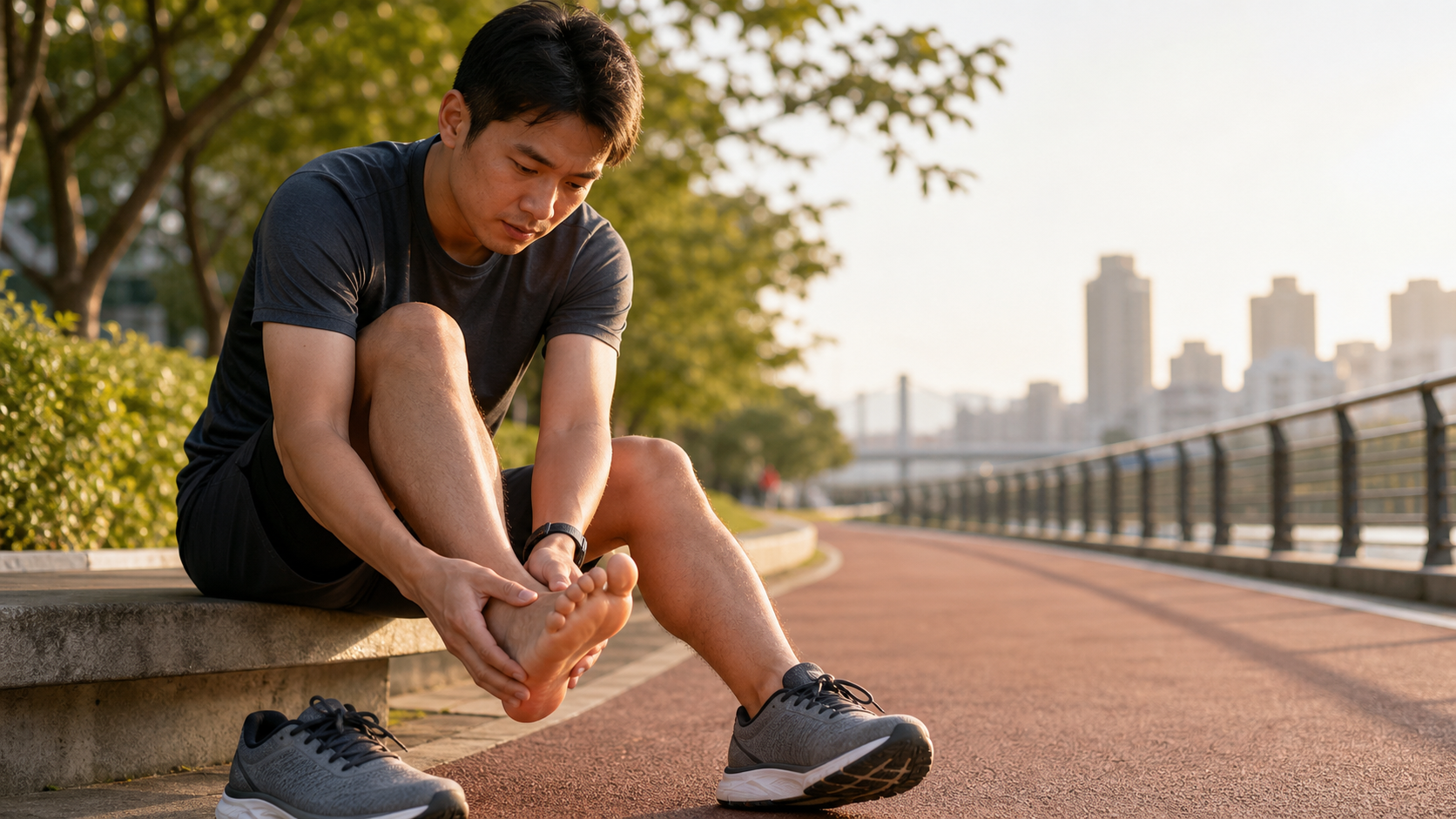
Introduction
“The moment my foot hits the ground every morning, my heel feels like I’m stepping on shards of glass.” This is the most common description given by patients with plantar fasciitis. In Taiwan, plantar fasciitis is arguably the most common foot problem seen in orthopedic and rehabilitation outpatient clinics, with an estimated incidence rate of over 10% among runners, particularly prevalent among middle- and long-distance running enthusiasts.
Although this injury is painful, understanding its nature and taking the right approach allows most people to recover within weeks to months.
Anatomy and Causes of Plantar Fasciitis
The plantar fascia is a band of fibrous connective tissue approximately 2–3 cm wide, extending from the calcaneus (heel bone) to the base of the five metatarsals. Its primary function is to support the arch of the foot and absorb the impact of landing while running.
During running, the plantar fascia endures a tensile force equivalent to 110–150% of body weight with each foot strike. When repeated microtrauma exceeds the tissue’s repair rate, tiny tears develop at the fascial attachment point on the heel bone, leading to chronic degenerative changes (modern research suggests this is primarily a “fasciopathy” rather than simple inflammation).
Major Risk Factors
| Category | Risk Factors |
|---|---|
| Training-related | Sudden increase in mileage, starting to run after prolonged standing work |
| Biomechanics | High arch (cavus foot) or low arch (flat foot), insufficient ankle dorsiflexion range of motion |
| Body composition | Higher BMI (not weight itself, but increased load on the plantar surface) |
| Footwear | Excessively stiff soles, insufficient heel cushioning, walking barefoot on hard surfaces |
| Age | Decreased tissue elasticity and reduced recovery capacity in the 40–60 age group |
Symptom Recognition and Differential Diagnosis
Typical Symptoms
- Severe pain upon weight-bearing in the morning: The fascia shortens during sleep, and the first step causes the most intense pain from stretching, usually easing slightly after a few steps
- Pain worsens again after prolonged standing or walking
- Pain is located at the medial anterior aspect of the heel (anterior edge of the calcaneus), and the tender point can be confirmed by pressing with the thumb
- Pain increases after running and is more pronounced the following morning
Other conditions to rule out: atrophy of the heel fat pad (pain located more posteriorly), tarsal tunnel syndrome (accompanied by numbness), and calcaneal stress fracture (localized tenderness on percussion).
Non-Surgical Treatment: A Three-Tiered Strategy
Research shows that over 90% of patients with plantar fasciitis achieve full recovery through conservative treatment within 6–18 months.
Tier 1: Reducing Load
- Temporarily reduce running volume: When pain exceeds 4 out of 10, reduce volume by more than 50%
- Avoid walking barefoot: Wear slippers with arch support even at home to provide basic support for the fascia
- Night Splint: Keeps the ankle in 5° of dorsiflexion during sleep to prevent fascial shortening; highly effective for improving morning pain
Tier 2: Stretching and Strengthening
Three essential stretches:
- Plantar fascia self-stretch: Seated, pull the toes back toward the shin, hold for 30 seconds × 3 reps. Perform this before getting out of bed each morning (most effective when done before stepping out of bed)
- Calf stretch (gastrocnemius + soleus): Facing a wall in a lunge position, stretch each leg for 30 seconds; note that the back knee must be slightly bent when stretching the soleus
- Ankle mobility training (Knee-to-Wall Test): Place toes 10 cm from the wall, attempt to touch the knee to the wall without lifting the heel, gradually increasing the distance
Intrinsic foot muscle strengthening (the most scientifically supported treatment):
- Towel toe curls: Seated with the foot on a towel, curl the toes to pull the towel toward you
- Short Foot Exercise: Keep the toes straight while contracting to shorten the arch, hold for 5 seconds × 10 reps
- Single-leg heel raises (eccentric calf strengthening): On the edge of a step, lower the heel slowly to strengthen eccentric control of the plantar fascia
Tier 3: Adjunctive Tools
- Custom orthotics or arch supports: Most effective for high-arch or flat-foot conditions, reducing fascial tension
- Low-energy extracorporeal shock wave therapy (ESWT): Consider if conservative treatment fails after 3–6 months; this equipment is widely available in rehabilitation departments at major hospitals in Taiwan
- Corticosteroid injections: Provide short-term relief but carry a risk of fat pad atrophy; not the first choice
Practical Advice
Shoe selection tips: Choose running shoes with adequate heel cushioning and mild arch support; avoid zero-drop models, and wait until plantar fasciitis has fully resolved before considering a transition. Among the major brands commonly used by runners in Taiwan, models with a heel-to-toe drop of 8–12 mm are more forgiving on plantar fascia strain.
Training surfaces: Practice on rubber tracks or grass whenever possible to reduce impact from concrete surfaces. The rubber path at Dadaocheng Riverside Park in Taipei is an excellent option.
Seek medical attention if symptoms persist beyond 6 weeks: To determine whether an MRI is needed to rule out calcaneal stress fracture or nerve entrapment.
Conclusion
Although plantar fasciitis is stubborn, it tells us something important: the feet need to be trained, not just protected. Short foot exercises and intrinsic foot muscle strengthening are the fundamental way to keep runners free from this injury over the long term. Combined with proper shoe selection and progressive mileage planning, your heels can continue to land lightly on every race course.
Related Reading
- Analysis of Plantar Fasciitis Causes and Runner Recovery Plans
- Runner’s Plantar Fasciitis: A Complete Guide to Causes, Treatment, and Prevention
- The Complete Guide to Plantar Fasciitis: Treatment Strategies and Training Adjustments for Runners’ Most Common Foot Injury
- Runner’s Therapy for Plantar Fasciitis: An 8-Week Conservative Treatment Plan for Morning Heel Pain
一日北高常見問題大集合 | 攻略 | 路線 | 訓練 | 補給 | 自行車 單車 | 一日雙城 | 雙塔 | TWB北高360 | 屁股痛
6 年前
單車 一日北高 ( 雙城 ) 肥宅雙人瘋狂行 紀錄片 REACTO
10 年前
Never Stop 西進武嶺 前後雙機 完整全程錄影 訓練台 實境
8 年前
一日北高/長距離團騎 常見問題補充篇 / 組團或跟團的眉角 / 壯車友容易被瘦車友慢性拉爆 / 原來屁股痛可能是這個原因...? / 風場配速法 / 公路車 / CT Yeh
2 年前
摔車後補裝備: 好市多新款單車安全帽& Specialized Romin 北高整路屁股都不痛的坐墊 | 一千元居然有MIPS | CT Yeh | 公路車
4 年前
[教學] Premiere 影片 手震 修正 教學 防抖 單眼 影像 GoPro 穩定 Video Stabilization
8 年前
CT 喇低賽) 武嶺牽車 才是王道 西進牽車四小時內秘訣 攝手位置 如何判斷 防抽筋小秘訣
7 年前
高雄綠園道鐵路自行車道 / 外地人能輕鬆駕馭 還是整路崩潰? / 2025 全線開通 春節實地探索一次!(附GPS連結)/ 公路車 / CT Yeh
1 年前