Introduction
At Taiwan’s trail races such as the Yuanshan Trail Race, the Taroko Marathon trail section, and even the root-strewn paths of Daan Forest Park, countless runners sprain their ankles every year from missteps. Lateral ankle sprains are the most common acute injury in sports, accounting for 15–20% of all sports injuries.
More importantly, research shows that without proper rehabilitation after an initial sprain, there is up to a 40% chance of developing “Chronic Ankle Instability,” creating a vicious cycle of recurrent sprains.
Anatomy and Classification of Ankle Sprains
The lateral ankle is protected by three ligaments: the anterior talofibular ligament (ATFL), the calcaneofibular ligament (CFL), and the posterior talofibular ligament (PTFL). Inversion sprains (the foot rolling inward) are the most common mechanism, and are classified into three grades by severity:
| Grade | Injury Severity | Symptoms | Estimated Return-to-Running Time |
|---|---|---|---|
| Grade 1 | Mild ligament stretch, no tearing | Mild swelling, tenderness, can walk normally | 1–2 weeks |
| Grade 2 | Partial ligament tear | Noticeable swelling, bruising, painful walking | 3–6 weeks |
| Grade 3 | Complete ligament rupture | Severe swelling, feeling of instability, unable to bear weight | 6–12 weeks (surgery may be required) |
Note: If you cannot bear weight, or there are specific tender points over the ankle bones or the dorsum of the foot (Ottawa Ankle Rules), an X-ray is needed to rule out a fracture.
Acute Phase Management: From RICE to POLICE
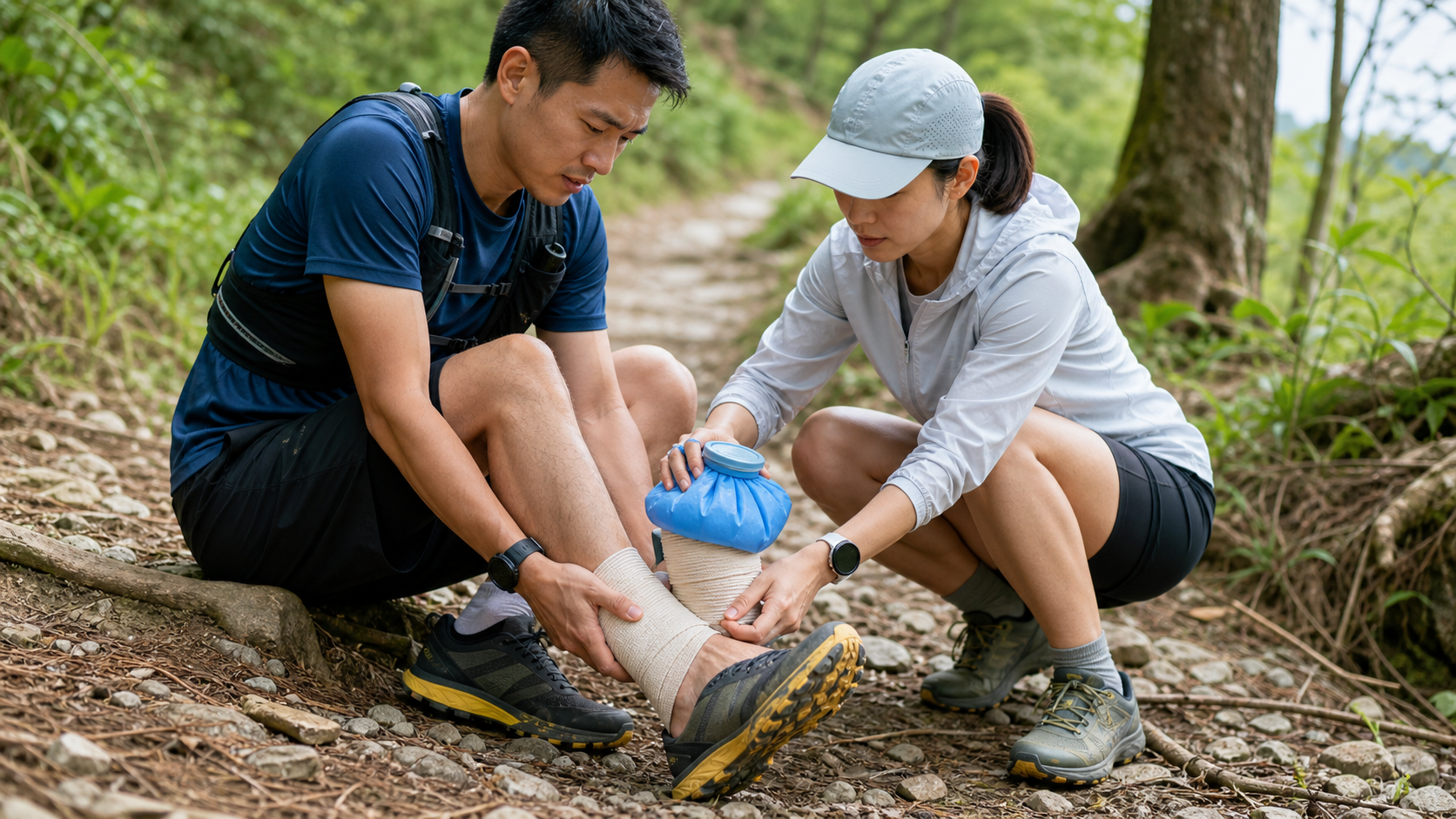
The former “RICE” principle (Rest, Ice, Compression, Elevation) has been updated to “POLICE”:
- P (Protection): Protect the injured area to avoid re-injury; an ankle support brace can be used in the early stage
- OL (Optimal Loading): Begin early, gentle weight-bearing (such as short-distance walking) within a pain-free range. This promotes ligament healing and is superior to complete bed rest
- I (Ice): Within 48–72 hours after injury, apply ice for 10–20 minutes per session, every 2 hours, to effectively control swelling
- C (Compression): Wrap with an elastic bandage or ankle compression sleeve to reduce swelling
- E (Elevation): Elevate the injured limb above heart level when resting to promote venous return
What NOT to do: Heat application (within the first 72 hours of the acute phase), massaging the injured area (may worsen bleeding), and forcibly testing range of motion (may worsen the tear).
Staged Rehabilitation Plan
Phase 1: Acute Control (Days 1–3 Post-Injury)
- Follow the POLICE principles
- Gentle ankle circling movements (within a pain-free range)
- Active toe movements to maintain circulation
- If pain allows, use a support brace or ankle guard to assist with short-distance walking
Phase 2: Range of Motion Restoration (Days 4–14)
Once swelling subsides, the focus shifts to restoring normal range of motion:
- Ankle alphabet: Trace the letters A–Z in the air with your toes to improve range of motion in all directions
- Ankle dorsiflexion stretch: Facing a wall, drive the knee forward while keeping the heel on the ground, 30 seconds × 5 sets
- Calf muscle stretches: Gastrocnemius and soleus, 30 seconds each
- Swimming or water walking can be attempted (water buoyancy reduces joint load)
Phase 3: Strength and Proprioception (Weeks 2–6)
Proprioceptive training is the cornerstone of preventing recurrence. Research shows that proprioceptive receptors in the ankle are damaged after a sprain, and neurological control deficits persist even after pain subsides:
- Single-leg stance: Once you can hold 30 seconds on the healthy leg, practice on the affected leg, gradually increasing difficulty (eyes closed, on a soft surface)
- Balance board training: Progress from static balance to dynamic perturbations
- Resistance band ankle strengthening in four directions: Dorsiflexion, plantarflexion, inversion, and eversion resistance exercises, 3 sets × 15 reps each
- Single-leg calf raises: Calf strength building
Phase 4: Dynamic Training and Return to Running (Weeks 4–8, adjusted by grade)
- Straight-line jogging, observing ankle stability
- S-curve weaving around poles, figure-8 running
- Lateral movements and cutting drills
- Gradually introduce training on uneven surfaces
Managing Chronic Ankle Instability
If you have a history of multiple sprains, or your ankle frequently feels like it is “about to give way,” this constitutes chronic ankle instability, which requires:
- A long-term proprioceptive training program (recommended to maintain for 6 months or more)
- Wearing trail running shoes with lateral support when running trail races
- Using preventive taping when necessary
- If conservative treatment fails after 6–12 months, evaluate ligament reconstruction surgery (such as the Brostrom-Gould procedure)
Practical Advice
Pre-trail race preparation: Before signing up for a trail race, ensure you have completed at least 8 weeks of ankle proprioceptive training. Taiwan’s trail race terrain is complex, and adequate ankle training is more important than any brace.
Choosing an ankle brace: Runners with a history of sprains are advised to use a semi-rigid ankle brace (such as the ASO style) when running on hard surfaces, which can reduce recurrence risk by 50%. However, this should not be an excuse to skip strengthening training.
Conclusion
Although ankle sprains are common, they are not a minor issue to simply “tough out.” Complete POLICE first aid combined with a systematic rehabilitation program can make your ankle stronger than it was before the injury. Every bit of rehab effort is an investment in countless future miles of trail running.
Related Reading
- Runner’s Ankle Sprain Recovery Guide: From Acute Management to Safe Return to Running
- Sprains Caused by Running Form Deviations: A Complete Guide to Ankle Stability Training
- Running Rehabilitation After Ankle Sprains: Four Stages of Proprioceptive Training and a Safe Return-to-Run Protocol
- Trail Running First Aid Essentials: Emergency Management of Trail Sprains, Getting Lost, and Hypothermia
爬陡坡被爆胎的車友跑步超車 #cycling #里佳部落
9 個月前
Never Stop 西進武嶺 前後雙機 完整全程錄影 訓練台 實境
8 年前
摔車後補裝備: 好市多新款單車安全帽& Specialized Romin 北高整路屁股都不痛的坐墊 | 一千元居然有MIPS | CT Yeh | 公路車
4 年前
大禹嶺 到 武嶺牌樓 全程前後實況錄影 | 北進武嶺 | 東進武嶺 | KOM | 訓練台 | 坡度分析 | Taiwan KOM Last 10 km HARD | 公路車
6 年前
CT 喇低賽) 武嶺牽車 才是王道 西進牽車四小時內秘訣 攝手位置 如何判斷 防抽筋小秘訣
7 年前
[教學] Premiere 影片 手震 修正 教學 防抖 單眼 影像 GoPro 穩定 Video Stabilization
8 年前
一日北高/長距離團騎 常見問題補充篇 / 組團或跟團的眉角 / 壯車友容易被瘦車友慢性拉爆 / 原來屁股痛可能是這個原因...? / 風場配速法 / 公路車 / CT Yeh
2 年前
再一組! 全碳幅條 碟煞/無內胎輪組 開箱! 到底好騎嗎? UNAAS X40 | 公路車 | CT Yeh
4 年前