Introduction
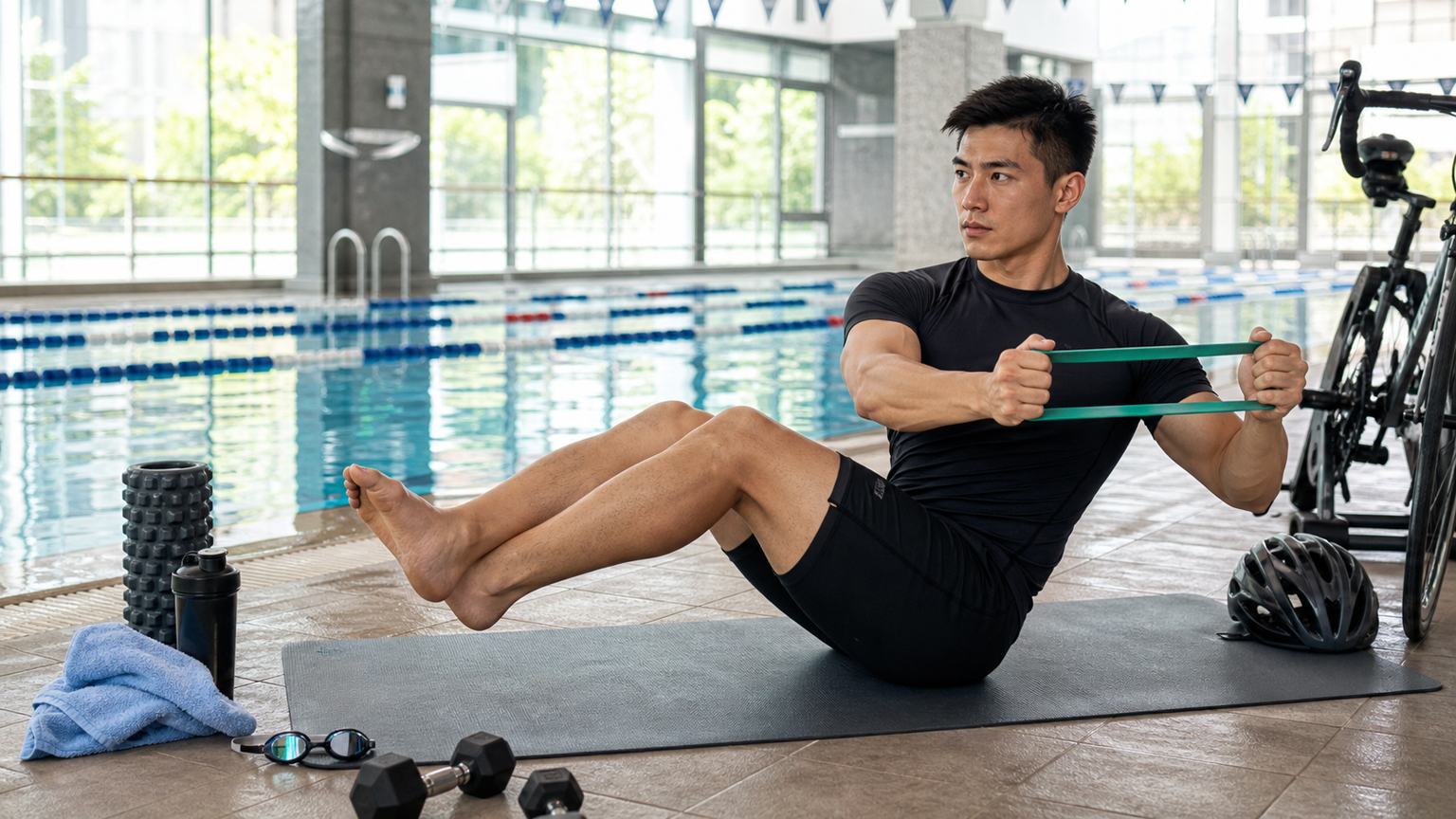
Many dedicated swimmers devote all their time to the water, overlooking the importance of land training for improving swimming performance. In fact, swimming propulsion comes primarily from muscular strength and coordination, both of which can be effectively enhanced through land training. Take freestyle, for example: the latissimus dorsi (the primary pulling muscle), core stabilizers (maintaining body line), and the rotator cuff (injury prevention)—all of these can be strengthened through targeted land training.
Additionally, public pools in Taiwan are typically very crowded during peak hours (6–8 AM, 5–8 PM), and sometimes there simply aren’t enough lanes available for training. In such cases, land training can serve as an effective supplement to water training, allowing you to conduct meaningful sessions even on days when the pool is crowded.
This article presents a 7-day cross-training plan built around 4 water sessions, 2 land sessions, and 1 complete rest day per week, suitable for amateur swimmers who are seriously preparing for competition or pursuing overall improvement.
What Land-Based Qualities Does Swimming Require?
Before designing land training, it’s important to understand swimming’s land-based demands:
| Ability Category | Impact on Swimming | Representative Exercises |
|---|---|---|
| Latissimus dorsi strength | Primary pulling muscle, relied upon with every stroke | Pull-ups, rowing machine |
| Core stability | Maintains horizontal body line, reduces drag | Planks, dead bugs, suspension training |
| Rotator cuff | Protects the shoulder joint, prevents swimmer’s shoulder | Band external rotation, Y-T-W |
| Flexibility (shoulder/chest) | Reach on entry, butterfly range | Pectoralis stretch, posterior shoulder stretch |
| Ankle flexibility | Freestyle kick efficiency | Ankle mobility exercises |
| Aerobic base | Supplements in-water aerobic training | Running, cycling (low-impact) |
7-Day Cross-Training Plan
Monday: Aerobic Swim + Evening Core Session
Morning (Swimming): Aerobic base session, 2500–3000 meters total, primarily Zone 2
Evening (Land, 30 minutes):
- Plank 3×60 seconds
- Dead bug 3×10 reps/side
- Single-leg Romanian deadlift 3×10 reps (light weight)
- Bird dog 3×12 reps
Core training is scheduled in the evening after the aerobic swim to avoid core fatigue compromising technical stroke quality in the water.
Tuesday: Land Strength Training (Weightlifting Focus)
This is the most important land training day of the week, 30–45 minutes:
- Pull-ups (or band-assisted): 4×6–8 reps (primary latissimus dorsi training)
- Band rows: 3×12 reps (mid-back and rhomboids)
- Dumbbell shoulder rotation (band external rotation): 3×15 reps/side (rotator cuff injury prevention)
- Y-T-W: 2×10 reps (posterior shoulder stability)
- Pectoralis stretch + ankle mobility: 5 minutes each
Wednesday: Technique Swim
Total volume 1600–2000 meters, low intensity with high focus:
- Technique focus: dedicate the week to correcting one technical weakness (e.g., high-elbow catch, sighting)
Thursday: Complete Rest
No structured training. Light stretching or walking is acceptable, but it doesn’t count as training. Rest days are essential for supercompensation to occur.
Friday: Interval Swim
The highest-intensity water session of the week:
- Warm-up: 500 meters
- Main set: 6×200 meters at target pace, 45 seconds rest between reps
- Cool-down: 300 meters
- Total: approximately 2600 meters
Saturday: Land Aerobic + Flexibility
If weekly water volume is already sufficient, an easy land aerobic session on Saturday can increase overall aerobic base without accumulating swim-specific shoulder fatigue:
- Jog or cycle 30–45 minutes (Zone 2)
- Full-body stretching 20 minutes (focus: shoulder/chest, glutes/hips, ankles)
Sunday: Long Swim
The longest water session of the week, easy Zone 1–2 swimming:
- Warm-up: 300 meters
- Main set: 1×2000 meters aerobic swim (advanced amateur) or 1×1500 meters (beginner amateur)
- Cool-down: 200 meters backstroke
- Total: approximately 2500–2800 meters
Cross-Training Considerations
- Fatigue management: Muscle soreness from land strength training may affect the quality of water training on the same or following day; it’s recommended to schedule strength training after water sessions or on non-swim days
- Movement pattern transfer: Land exercises (such as pull-ups) are not identical to swimming movements, but strengthening the same muscle groups provides training transfer effects
- Don’t over-increase total training load: When adding land training, there’s no need to increase water volume; instead, replace a low-value easy swim with a land session
Practical Advice
- Many gyms in Taiwan (such as Fitness Factory, World Gym) have attached swimming pools, allowing you to complete both water and land training at the same venue, saving commute time
- Swimmers new to land-based weight training should first learn proper pull-up and rowing technique from a coach; incorrect strength training form may increase the risk of shoulder injury
Conclusion
Integrating swimming with land training is one of the most underrated strategies for improving swimming performance. Through a systematic 7-day plan that allows water training and land-based strength, core, and flexibility work to support each other, your swimming improvement will far exceed what you’d achieve by simply adding more swimming distance.
Related Reading
- Swimming’s Cross-Disciplinary Strength: Transfer of Land-Based Power Training to Swimming Speed
- Cross-Scheduling Swimming and Land Training: Weekly Schedule Design for the All-Around Athlete
- Land-Based Supplementary Training for Swimmers: Swim-Specific Exercises with Bands, Core Boards, and Yoga Balls
- Complete Land Training Program for Swimmers: A Shore-Based Guide to Bands, Core, and Flexibility