Introduction
The 24-hour ultramarathon is one of the most extreme challenges in road running—runners continuously circle a fixed loop course, accumulating the greatest distance possible. In recent years, Taiwan has also hosted several ultramarathon events, such as 24-hour ultras and 100-kilometer ultras, attracting more and more runners to push their limits.
Compared to marathon nutrition strategies, energy replenishment in an ultramarathon is not as simple as “just packing a few more energy gels.” After 24 hours, taste fatigue (aversion to sweet foods), declining gastrointestinal function, and electrolyte imbalance become the biggest obstacles to finishing. A proper nutrition strategy can help you run farther, recover faster, and even maintain your willpower during the nighttime low point.
Energy Demands of an Ultramarathon
Caloric expenditure in a 24-hour ultramarathon varies greatly depending on pace and body size. For a runner weighing 65 kg at an average pace of 7–8 min/km:
- Calories burned per hour: approximately 500–700 kcal
- Total expenditure over 24 hours: approximately 12,000–16,000 kcal
- Actual replenishable amount (gastrointestinal absorption limit): approximately 200–400 kcal per hour
- Replenishment deficit: the body must make up the difference from fat stores, making energy reserves and fat metabolism capacity crucial
Phased Nutrition Strategy for an Ultramarathon
Phase 1 (0–6 hours): Establishing a Rhythm
During this phase, running intensity is relatively high, and the digestive system is still functioning normally.
- Consume 30–60 g of carbohydrates every 30–45 minutes (energy gels, bananas, dates)
- Replenish electrolytes every hour (sports drinks containing sodium or salt tablets)
- Avoid: high-fiber, high-fat foods to keep the stomach light
Phase 2 (6–12 hours): Maintaining Stability
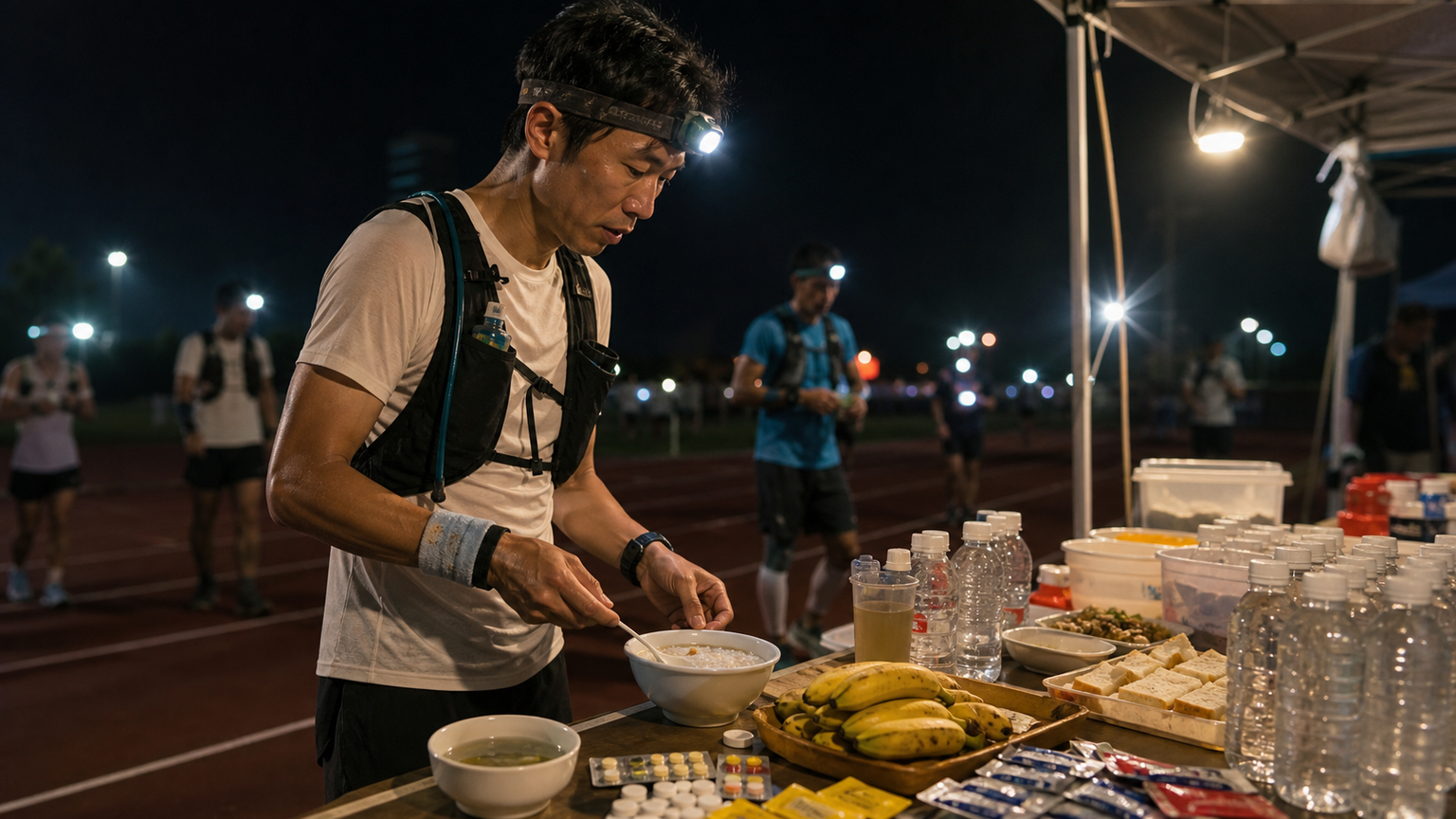
At this point, your palate may begin to tire of sweet foods, so it’s time to introduce savory options.
- Introduce solid foods: sandwiches, steamed buns, congee, salty crackers
- Mix sweet and savory replenishment: alternate between energy gels and savory foods to stimulate appetite
- Increase protein intake: small portions of eggs, tofu, and cheese to help maintain muscle and prevent breakdown
Phase 3 (12–18 hours): The Nighttime Challenge
The deep night is the most difficult period of an ultramarathon; fatigue and low temperatures cause many runners to give up here.
- Psychological benefits of warm food: congee, hot noodle soup, and hot cocoa can significantly boost morale
- Caffeine strategy: consume caffeine (energy gels or coffee) between midnight and 2 a.m. to combat drowsiness
- Small, frequent meals: take small amounts every 20–30 minutes to avoid gastrointestinal discomfort from large intakes
Phase 4 (18–24 hours): The Final Push
In the last 6 hours, the body enters a state of extreme fatigue but heightened mental arousal.
- Fast carbohydrates: energy gels, sports drinks, and bananas provide immediate energy
- Use caffeine again (if first used in the deep night, can be replenished after a 5–6 hour interval)
- Hydrate: after prolonged running, kidney strain increases, making adequate fluid intake especially important
24-Hour Ultramarathon Food Checklist
Below are common replenishment foods used by ultramarathon runners, arranged by phase suitability:
| Food | Suitable Phase | Advantages | Notes |
|---|---|---|---|
| Energy gels | Entire race | Rapid absorption | Taste fatigue later on; pair with savory foods |
| Bananas | Entire race | Natural carbs + potassium | May become hard to swallow in the latter half |
| Dates | Entire race | Dense carbohydrates | Very sweet; use in small amounts |
| Salty crackers | Mid-to-late race | Sodium + carbs | Requires water intake |
| Plain congee | Mid-to-late race | Easy to digest, warms the stomach | Prepare in advance before the race |
| Sandwiches | 6–18 hr | Carbs + protein | Avoid high-fat fillings |
| Chicken noodle soup | Deep night | Warms the stomach, replenishes sodium | Significant psychological support effect |
| Plum candies | Entire race | Sodium + appetite stimulant | A traditional Taiwan ultramarathon staple |
Gastrointestinal Management: The Hardest Challenge in an Ultramarathon
The biggest nutritional challenge in an ultramarathon is not what to eat, but keeping your gut working under prolonged running stress. The following strategies can help maintain gastrointestinal function:
- Train your gut: during long training runs in the preparation period, deliberately practice eating while running so your gut adapts to this state
- Slow down to aid digestion: if gastrointestinal discomfort occurs, briefly reduce pace to allow visceral blood flow to recover
- Avoid high-fiber and high-fat foods: these digest most slowly during a race and are most likely to cause discomfort
- Probiotic preparation: supplement with probiotics 2–4 weeks before the race; some studies suggest it may help reduce gastrointestinal symptoms during exercise
Practical Tips
- Do a simulation training one week before the race: a 12-hour long run to test your replenishment foods and strategy.
- Prepare a personal drop bag: ultramarathons usually allow self-supplied provisions; place familiar foods in a drop bag at designated points.
- Stock up on traditional Taiwanese provisions: plums, ginger candies, and pickled foods are common staples in Taiwan ultramarathons; their salty-sour flavors are especially effective when you’re tired of sweets.
- Have someone assist with replenishment: arrange for family or fellow runners to help at aid stations, reducing stop time and providing psychological support.
Conclusion
The nutrition strategy for a 24-hour ultramarathon is a discipline that requires personal testing and individualized adjustment. From carbohydrate replenishment to gastrointestinal management, from taste fatigue to nighttime fueling, every detail can determine how far you can run. Before race day, take the time to rehearse your nutrition strategy during long training runs, so that your body and gut become your most reliable partners in the longest and toughest race.
Related Reading
- Ultramarathon Nutrition Strategy: A Comprehensive Fueling Plan from Training to Race
- 24-Hour Cycling Race Nutrition Plan: Fuel Management for Nonstop Riding
- Ultramarathon Fueling Strategy: Energy and Electrolyte Rhythm from 50K to 100K
- Ultramarathon Fueling Strategy: The Ratio of Solid Food vs. Liquid Fuel for 100km Races
CT暗黑廚房) 車友必備 宇宙無敵鮮蚵湯 幫助訓練恢復 天然食補 好市多 超肥鮮蚵 破PR
7 年前
一日北高前的高裝檢 | 北高 360 | 挑戰11小時的裝備 | 一日雙塔 | 補給
6 年前
西進武嶺 免費訓練分析服務 Intervals | 練不夠還是練過頭?你哪一種類型選手?AI模型告訴你! | 備戰神器 | 公路車 訓練 | CT Yeh
4 年前
單車 一日北高 ( 雙城 ) 肥宅雙人瘋狂行 紀錄片 REACTO
10 年前
半日 小台灣 極限單車路線挑戰實錄
7 年前
一日北高 11小時 賽後心得分享篇 | TWB北高360 | 一日雙城 | 單車 | 公路車
6 年前
Live) 備戰2019彰化經典百K 賽前攻略 (已完賽請看新影片
7 年前
2019 夏季KOM 5小 完賽心得 準備攻略 東進武嶺 夏季登山王之路 Taiwan KOM Challenge
7 年前