Introduction
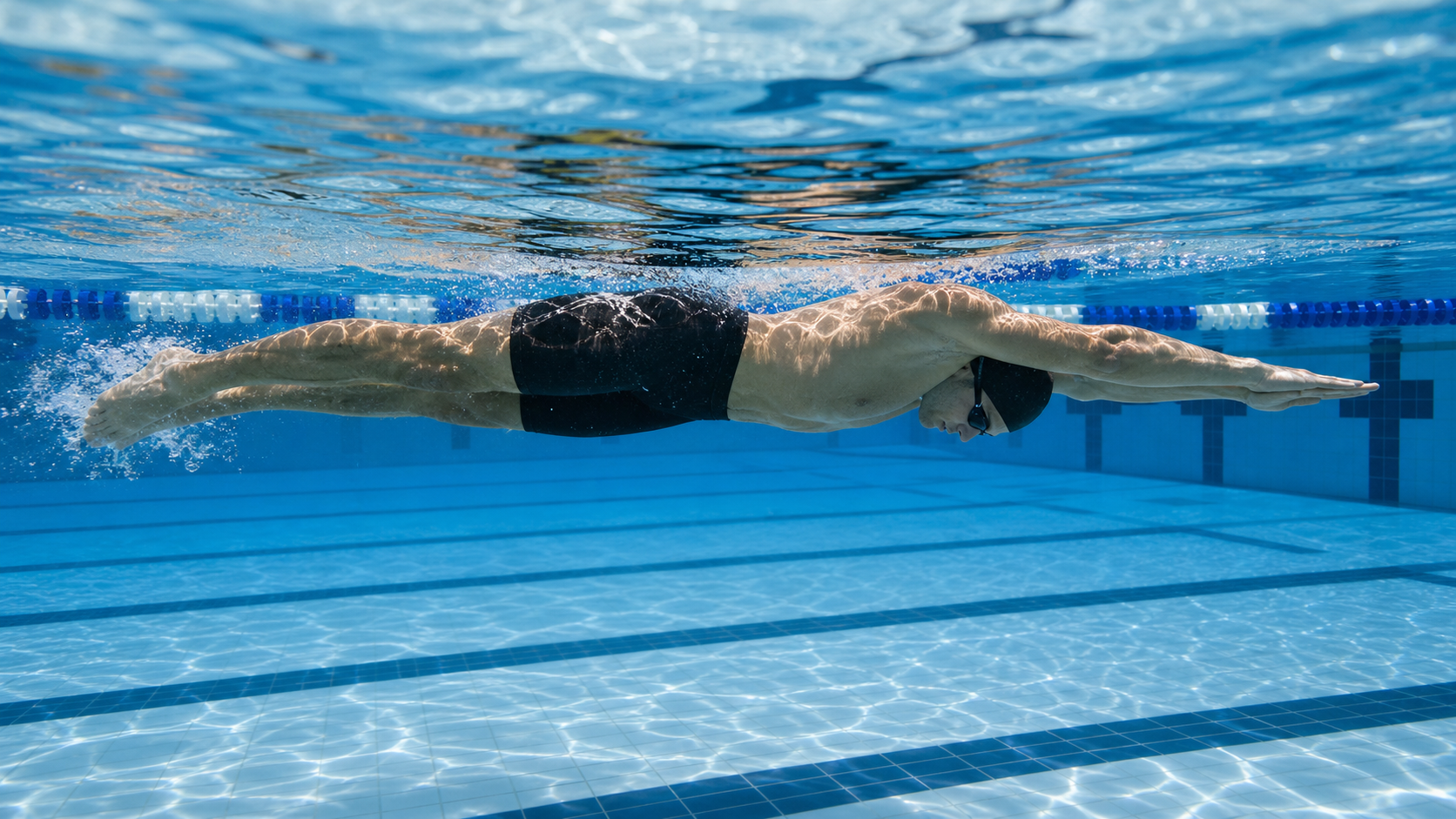
At public pools across Taiwan, the most common inefficient swimming posture is the “drooping hips”—where the swimmer’s hips and legs sink into the water, creating a downward-angled body position, much like a sailboat with its bow raised high and its stern dragging behind. This posture forces the swimmer to fight against the extra drag they create while moving forward, significantly reducing swimming efficiency.
Body position is the foundation of swimming technique. All stroke, kick, and breathing techniques are built upon a solid body position. This article will delve into the fluid dynamics principles of horizontal posture and how to systematically improve body position.
Types of Drag in Water
To understand the importance of body position, one must first understand the types of drag a swimmer faces in the water:
Form Drag
Form drag is the resistance of the body’s frontal cross-sectional area against the water flow. The more “upright” the body (the lower the hips), the larger the cross-sectional area, and the higher the form drag. This is the most direct mechanism by which body position affects swimming speed.
Research shows that for every 5-degree increase in body posture angle (i.e., hips sinking lower), form drag can increase by 15–25%. When swimming at a speed of 1 meter per minute, such an increase in drag requires significantly more energy expenditure.
Skin Friction
This is the friction between the water flow and the skin. Competitive swimmers wear special-material swimsuits and shave their body hair to reduce this type of drag. Its impact on recreational swimmers is relatively small.
Wave Drag
The waves generated by a swimmer at the water’s surface also consume energy. Swimmers with good body position who maintain a streamlined profile below the surface can effectively reduce wave drag.
Factors Affecting Body Position
| Factor | Effect on Body Position | Improvement Method |
|---|---|---|
| Core muscle strength | Weak core causes the lower back to sink | Land-based core training |
| Breathing posture | Lifting the head too high causes the hips to sink | Side-breathing technique training |
| Kicking technique | Incorrect kick direction increases downward pressure | Training for correct kick direction |
| Lung buoyancy | Lungs are at the top, so the hips naturally sit lower | Adjust lung capacity and breathing rhythm |
| Leg muscle density | Legs with higher muscle density sink more easily | Add buoyancy aids, optimize kicking |
The Body’s Natural Buoyancy Distribution
Interestingly, a sinking body is not entirely a technical issue—the human body’s buoyancy distribution is inherently structured so that the upper body (lungs) is more buoyant, while the lower body (denser leg muscles) is less buoyant. This explains why almost all swimmers’ legs naturally sink when they are stationary.
The real technical challenge is: how to actively maintain a horizontal body position through correct movements, counteracting this natural buoyancy imbalance.
Technical Methods to Improve Body Position
The Critical Role of Head Position
The head position affects body position more than many people realize. According to the “seesaw principle”: when the head lifts, the hips sink; when the head presses down, the hips rise.
Correct head position:
- Freestyle: The top of the head is at the water’s surface, eyes looking diagonally toward the pool bottom (at about a 45-degree angle), neck naturally relaxed
- Breaststroke: When breathing, only the chin reaches the water’s surface, then immediately press down
- Backstroke: The head rests on the water’s surface, ears below the waterline
The Supporting Role of the Core Muscles
A strong core is the primary source of strength for maintaining a horizontal posture. Specifically, it is the sustained isometric contraction of the transversus abdominis that keeps the body rigid in the water, preventing the lower back from bending and sinking.
Recommended land-based exercises:
- Plank: Hold for 30–60 seconds each time, perform 3–4 sets before each swim session to build core endurance
- Superman: Lie face down, lift all four limbs off the ground simultaneously to train the back extensors
- Yoga Boat Pose: Lie on your back, lift your upper body and legs off the ground simultaneously to strengthen the entire core
The Effect of Kicking on Body Position
Correct kicking technique (driven from the hips, with relaxed ankles) maintains a horizontal body position; incorrect kicking (using only the lower legs, with stiff ankles) actually increases the tendency for the body to sink. During practice, pay special attention to the position of the hips—the sensation of the hips near the water’s surface is the most direct indicator of good body position.
Testing and Monitoring Body Position
The following methods can be used to assess and monitor your body position:
- Surface Shadow Observation: On a sunny day at an outdoor pool, observe your shadow on the pool bottom. A nearly horizontal shadow represents good body position; a slanted shadow indicates sinking hips
- Underwater Video Recording: Having someone film you from the side underwater is the most intuitive way to assess your position
- Pull Buoy Test: Place a pull buoy between your thighs. If you find it extremely difficult to swim straight, it means your kick is providing significant buoyancy compensation during normal swimming, and your body position relies on kicking rather than your core
Practical Advice
- Before each swim session, spend 5 minutes doing floating drills in the water to feel your body’s natural posture, then begin training
- The fastest way to improve body position is often not by swimming more, but by strengthening your core on land
- Different strokes have slightly different body position requirements, but “stay as horizontal as possible” is the universal principle
- Beginners are advised to have underwater video taken under a coach’s supervision—one clear visual feedback session is often more effective than verbal instruction
- Body composition also affects buoyancy: those with higher body fat percentages generally have better buoyancy, while lean, muscular athletes (such as triathletes) need to pay more attention to maintaining posture through kicking
Conclusion
Body position is the foundation of swimming technique—the effectiveness of all other techniques is built upon a solid body position. Investing time in improving your horizontal posture often yields more immediate speed gains than improving your stroke technique. When your body becomes more horizontal and streamlined in the water, you’ll feel that “swimming feels lighter”—that sensation is the real experience of significantly reduced drag.
Related Reading
- Improving Posture Against Drag: The Relationship Between Streamlined Body Position and Head Position
- The Science of Water Drag in Swimming: How Streamlined Posture Reduces Drag
- Backstroke Body Balance: Why Backstroke Swimmers’ Hips Cannot Sink
- Freestyle Body Posture and Core: Turning Yourself into a Shallow-Draft Speedboat
風櫃嘴 | 全台最多大砲的單車路線 | 尋寶網攝影師告訴你怎麼擺拍起來才好看 | 熱門攝影地點巡禮
6 年前
CT 喇低賽) 武嶺牽車 才是王道 西進牽車四小時內秘訣 攝手位置 如何判斷 防抽筋小秘訣
7 年前
一日北高/長距離團騎 常見問題補充篇 / 組團或跟團的眉角 / 壯車友容易被瘦車友慢性拉爆 / 原來屁股痛可能是這個原因...? / 風場配速法 / 公路車 / CT Yeh
2 年前
CT 喇低賽) 單車 比賽總是沒照片? 攝影師的觀點大公開 姿勢就是力量! 請加速1.25倍收看
7 年前
一日北高常見問題大集合 | 攻略 | 路線 | 訓練 | 補給 | 自行車 單車 | 一日雙城 | 雙塔 | TWB北高360 | 屁股痛
6 年前
[教學] Premiere 影片 手震 修正 教學 防抖 單眼 影像 GoPro 穩定 Video Stabilization
8 年前
2016/05/13 單車 冷水坑下滑
10 年前
大禹嶺 到 武嶺牌樓 全程前後實況錄影 | 北進武嶺 | 東進武嶺 | KOM | 訓練台 | 坡度分析 | Taiwan KOM Last 10 km HARD | 公路車
6 年前