Introduction
Taiwan’s road-running community places increasing emphasis on post-training recovery, and it’s common to see runners in sports center locker rooms diligently pressing with foam rollers or massage guns. However, the notion that “the more massage, the better” is incorrect—massaging the wrong areas at the wrong time not only fails to help but may even worsen injuries.
This article will analyze the three primary post-training massage tools from a sports science perspective and provide a scientific usage protocol.
The Mechanism of Massage: Current Scientific Evidence
The benefits of post-run massage have been extensively studied in recent years. Currently, the scientifically supported mechanisms include:
- Promoting waste metabolite clearance: Massage stimulates lymphatic return, aiding in the removal of metabolic waste such as lactate (though the effect is smaller than active cool-down exercise)
- Reducing delayed onset muscle soreness (DOMS): Particularly for the “second-day soreness” occurring 24–48 hours after training, massage can reduce its severity
- Improving psychological relaxation: Through parasympathetic nervous system activation, lowering post-training cortisol (stress hormone)
- Increasing tissue temperature and mobility: Briefly improving muscle flexibility
Note: Evidence that massage directly “eliminates” fatigue or enhances athletic performance remains insufficient; it is more of a tool for comfort and assisted recovery, not a magic solution.
Comparison of the Three Tools
| Tool | Best Time for Use | Main Advantages | Contraindicated Situations |
|---|---|---|---|
| Foam Roller | Post-training + pre-training warm-up | Large muscle group relaxation, improved fascial mobility | Acute injuries (fractures, acute strains), areas with severe varicose veins |
| Massage Gun | Post-training recovery, deep pressure on specific muscles | Portable, adjustable depth, targets small muscle groups | Direct use on bones, acute bruises, tendons and ligaments |
| Manual Massage | Any time (performed by professionals) | Most precise, can sense tissue condition | Affected areas during the acute inflammatory phase |
Proper Use of the Foam Roller
Target Muscle Groups and Techniques
The most commonly used areas for runners:
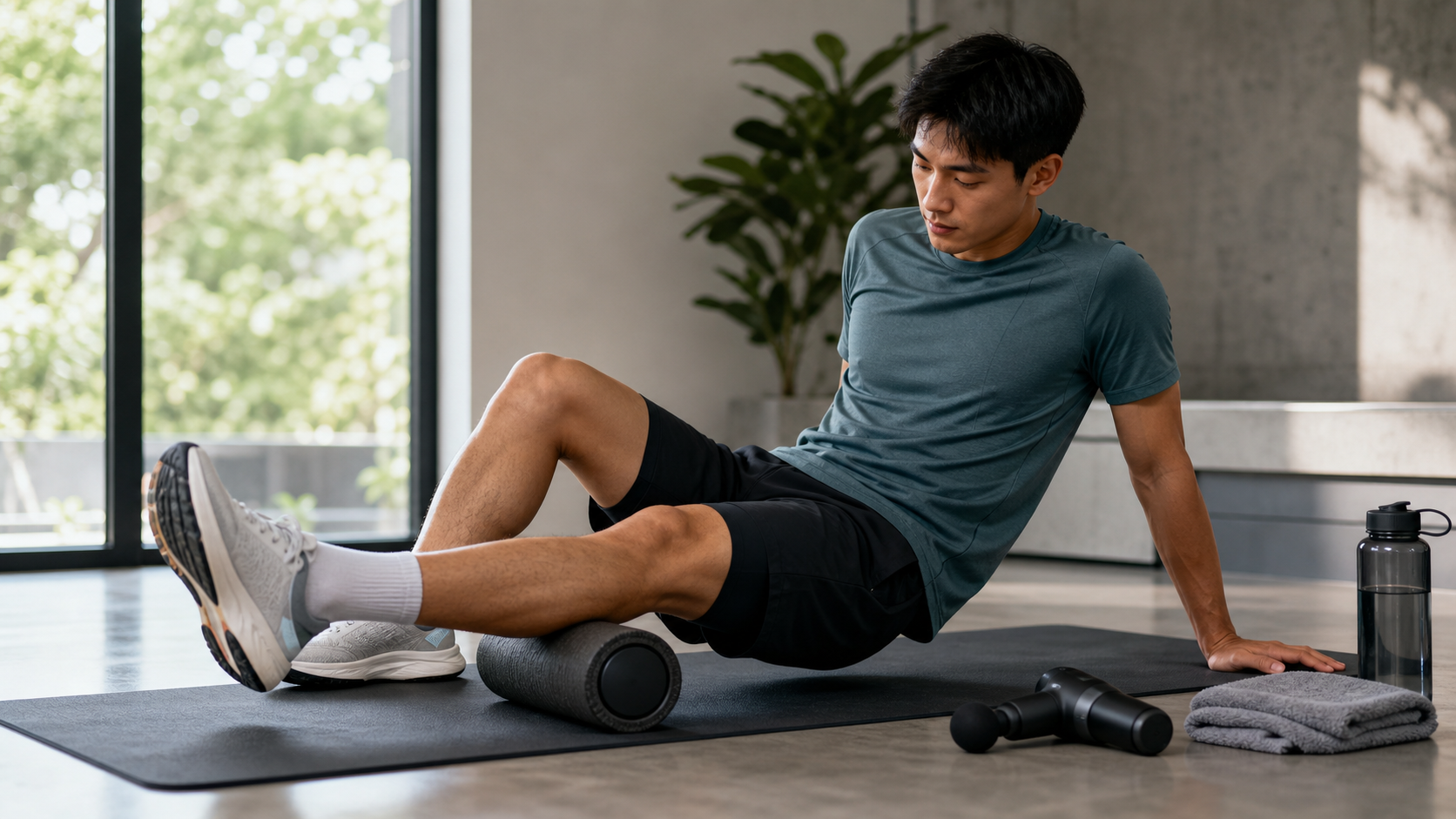
- Calf muscles: Seated position, place the roller under the calf belly (avoiding the Achilles tendon). Roll back and forth with rotation; when you find a tight spot, hold for 20–30 seconds—this is called “trigger point release”
- Hamstrings (posterior thigh): Sit on the roller with hands supporting you, roll the posterior thigh back and forth
- Iliotibial band (outer thigh): Side-lying, place the roller under the outer thigh. Note: pausing on pressure points is more effective than repeated rolling
- Gluteus maximus: Sit on the roller, cross one ankle over the opposite knee in a figure-4 position, shifting your weight toward the hip on the crossed side
- Thoracic spine (upper back): Place the roller horizontally under the upper back, cross your arms over your chest, and gently extend
Precautions
- Do not exceed 90–120 seconds per area (excessive time can overstimulate the tissue)
- Pressure should be “comfortably painful” (around 6–7 out of 10, no more than 8)
- Do not roll directly over the middle of the iliotibial band: The IT band is dense connective tissue that cannot be “stretched”; excessive pressure can cause irritation
- Do not roll the lumbar lower back: Lacking rib protection, it can easily become hypermobile
Proper Use of the Massage Gun
The massage gun uses high-frequency vibration to penetrate muscle tissue, making it suitable for targeting small, localized areas of muscle tightness.
Usage Techniques
- Speed selection: Use high frequency (2400 RPM) for warm-up or large muscle groups; use low frequency (1200 RPM) for recovery or sensitive areas
- 30–60 seconds per area, moving slowly across the muscle belly, not sweeping quickly
- Maintain moderate pressure: No need to press hard; let the vibration penetrate naturally
Contraindicated Areas (Absolutely Avoid)
- Front of the neck (carotid artery)
- Directly on bones or joints
- Areas with skin wounds, bruises, or varicose veins
- Tendon attachment points (such as the Achilles tendon or patellar tendon)—vibration may worsen degenerative conditions
Complete Post-Training Recovery Massage Protocol (20 Minutes)
It is recommended to perform this after cooling down from your run and once your heart rate has returned to normal:
- Easy walking for 5 minutes (most important—allows blood circulation to naturally metabolize lactate)
- Foam roller: calves → hamstrings → outer thighs → glutes (60 seconds each)
- Massage gun: deep stimulation of key tight areas (such as one-sided calf or gluteus medius, 30 seconds each)
- Static stretching: calves, hip flexors, hamstrings, 30–45 seconds each
When to Use Manual Massage
If you can regularly see a sports massage therapist or physical therapist for manual massage, the results are superior to self-massage tools. Recommendations:
- 2–3 days before a race: Light maintenance massage (avoid deep massage that could cause micro-damage and affect race performance)
- 24–48 hours after a race: Recovery-oriented deep massage (using Effleurage + Petrissage techniques)
- After peak training weeks: Systematic full-body massage once every 2–4 weeks
Practical Advice
Massage combined with contrast water therapy: After training, take a cold shower for 1 minute followed by hot water for 2 minutes, alternating 3–4 times, ending with cold water. This stimulates vasoconstriction and vasodilation, accelerating metabolic waste clearance—an effect comparable to massage tools.
Sleep is the best recovery: No massage tool can replace adequate sleep (7–9 hours). If sleep quality is poor, no amount of massage will lead to effective recovery.
Conclusion
Foam rollers, massage guns, and manual massage are all good tools, but they are “supplements” to the recovery system, not the core. Scientific training programming, sufficient sleep, and balanced nutrition are the true foundations of running recovery. Use the right tool, at the right time, on the right area—this is the wisdom that allows your body to quickly reset after each training session and prepare for the next journey.
Related Reading
- Comparison of Running Recovery Tools: When to Use Foam Rollers, Massage Guns, and Compression Socks
- Post-Run Fascial Release: The Correct Order for Using Foam Rollers, Balls, and Stretching
- Post-Run Massage: Sports Massage vs. Self-Myofascial Release with Foam Rollers
- The Real Benefits of Massage for Sports Recovery: Which Claims Are Supported, Which Are Exaggerated, and How to Properly Use Foam Rollers and Massage Guns
西進武嶺 免費訓練分析服務 Intervals | 練不夠還是練過頭?你哪一種類型選手?AI模型告訴你! | 備戰神器 | 公路車 訓練 | CT Yeh
4 年前
[教學] Premiere 影片 手震 修正 教學 防抖 單眼 影像 GoPro 穩定 Video Stabilization
8 年前
摔車後補裝備: 好市多新款單車安全帽& Specialized Romin 北高整路屁股都不痛的坐墊 | 一千元居然有MIPS | CT Yeh | 公路車
4 年前
如何把 GoPro 影片 翻轉 批次 轉正?
6 年前
洗單車神器 吹水機! 實際洗車用用看 暴力洗鍊條大法 | 公路車 | CT Yeh
4 年前
Insta 360 One 超級防手震技術實測
7 年前
一日北高/長距離團騎 常見問題補充篇 / 組團或跟團的眉角 / 壯車友容易被瘦車友慢性拉爆 / 原來屁股痛可能是這個原因...? / 風場配速法 / 公路車 / CT Yeh
2 年前
#公路車 #Fitting 靠人工智慧APP 幫你調整單車
6 年前