Introduction
In a 25-meter or 50-meter pool, the black line on the bottom is every swimmer’s best navigator. But in open water, with no visible reference lines, beginners often drift dozens of meters off course within just a few hundred meters. Statistics show that in triathlon races, about 30% of athletes swim more than 10% extra distance due to navigation errors. This article provides a complete introduction to the core techniques of open-water navigation—head-up sighting and target-point selection strategies.
Why Is It Easy to Drift Off Course in Open Water?
The human body is inherently asymmetrical—the dominant arm pulls slightly harder, causing the body to naturally veer toward the non-dominant side while swimming. In a pool, the black line and the wall constantly correct this deviation; but in open water, with no external correction mechanism, the deviation accumulates continuously over distance.
In addition, the following factors can also disrupt direction:
| Disruptive Factor | Impact Level | Description |
|---|---|---|
| Lateral current | High | A current of 0.3 m/s can cause a 15-meter drift over 500 meters |
| Wave direction | Medium | Diagonal waves cause the body to unconsciously turn with the swell |
| Sun glare | Medium | If you are swimming directly into the sun, sighting becomes much harder |
| Breathing-side preference | Medium | Swimmers who only breathe to one side show noticeable veering |
The Standard Technique of Sighting
Basic Movement Breakdown
The goal of sighting is to complete visual navigation with minimal disruption to your swimming rhythm. The standard process is as follows:
- Timing: When the pulling arm extends forward and the other arm finishes its pull and push phase
- Head lift: Use the backward thrust of the stroke to let the head rise naturally; only the chin needs to clear the water (no need to lift the entire face out)
- Scan duration: After lifting, quickly lock onto the target (0.5–1 second), without lingering
- Breathing integration: After sighting, lower the head back into the water and take a side breath following your normal breathing rhythm
- Correction action: If you confirm you are off course, use slightly stronger strokes on one side for the next 4–6 strokes to correct direction
Recommended Sighting Frequency
- Beginners: Sight every 4–6 strokes
- Intermediate swimmers: Sight every 8–10 strokes
- Advanced swimmers: Sight every 12–16 strokes, adjusting flexibly based on water conditions
Sighting too frequently will: raise your body’s center of gravity, increase water resistance, and consume more energy; therefore, improving sighting efficiency is more important than increasing frequency.
Target Selection Strategies
Principles for Choosing a Good Target
- Tall and vertical: Bridges, towers, mountain peaks, and building tops are easier to spot than low-lying buoys
- Aligned with your route: Choose a fixed landmark directly ahead of your intended swimming line
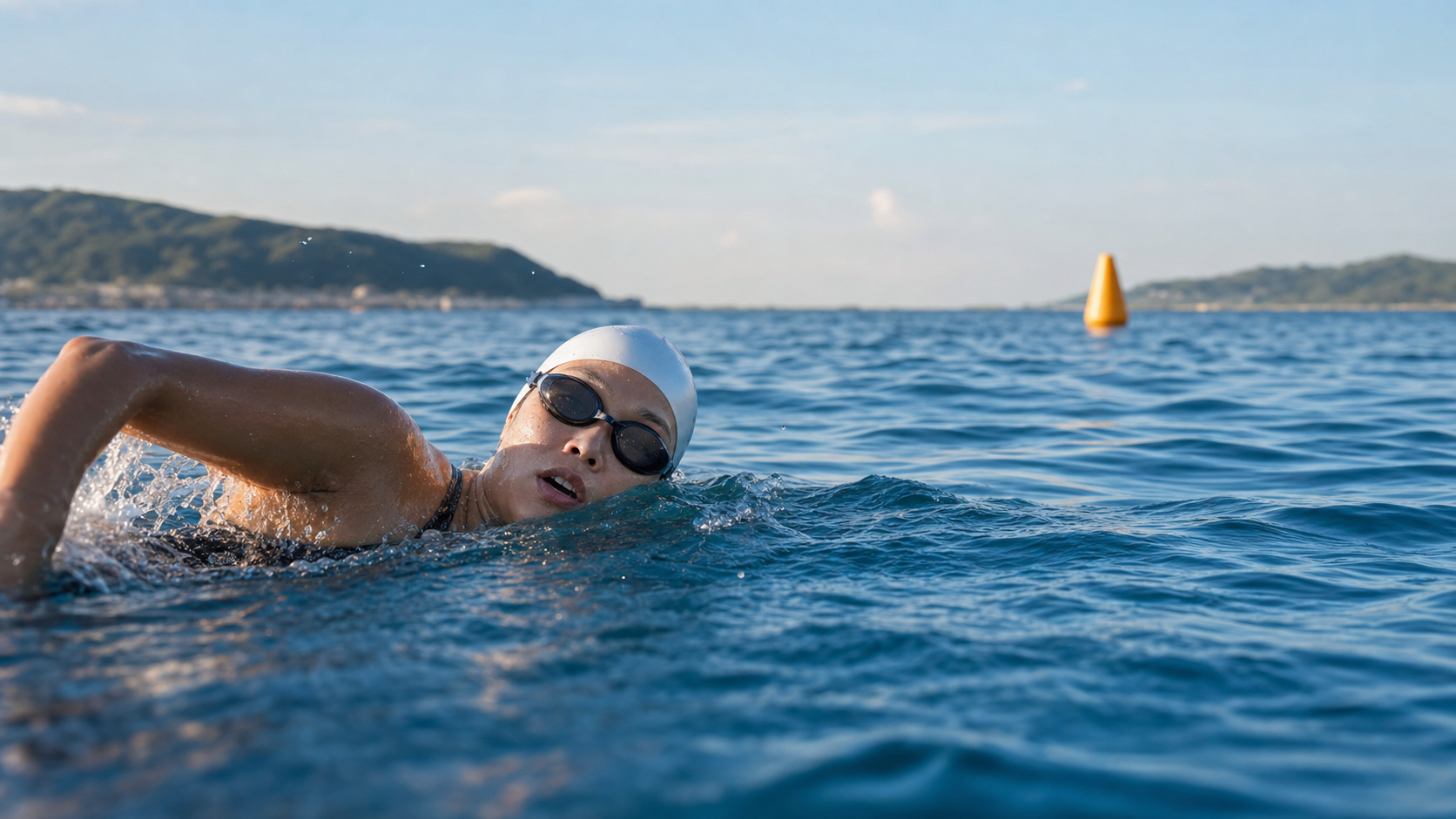
- Strong color contrast: Orange buoys are easy to spot on a blue sea, but become harder to see against a sunset backlight
- Backup target: Your primary target may disappear momentarily in the waves; prepare a more distant backup landmark
Target Setting for Common Races in Taiwan
In Taiwan’s open-water swimming races, orange or yellow inflatable buoys are commonly used to mark turning points. Recommended pre-race strategy:
- Scout the location from shore and memorize the correspondence between buoy positions and landmarks behind them
- Confirm the sun’s direction for each leg of the course (avoid swimming into the sun the entire way)
- Memorize the color and shape of the turning buoys (some races use different colors to distinguish straight-ahead vs. turning points)
Correction Techniques in Currents
Angle Compensation Method
When there is a noticeable lateral current, you should not aim directly at the target. Instead, choose a point upstream of the target as your visual reference, allowing the current to naturally carry you toward the actual target.
Calculation formula (approximate):
- Current speed = 0.5 knots (about 0.25 m/s)
- Swimming speed = 1.5 m/s (moderate level)
- Required upstream angle ≈ arcsin(0.25/1.5) ≈ 10 degrees
In actual races, it is recommended to observe floating objects on the water surface (foam, seaweed) before entering the water to determine current direction and strength.
Bilateral Breathing Training
Improving bilateral breathing ability can significantly reduce veering problems:
- Training method 1: During every pool session, force yourself to breathe on your non-dominant side for 30 minutes
- Training method 2: 3-stroke breathing drill (breathe left → left → right → breathe right → left → right cycle)
- Training method 3: Closed-eye swimming drill (in the shallow end of the pool, swim 25 meters without sighting, then check your drift)
Practical Tips
- Pre-race water check: On race day, enter the water early to warm up and perform 2–3 sighting attempts to confirm target positions
- Use tinted goggles: Dark lenses (gray/blue) suit sunny days; yellow/orange lenses suit overcast days or early morning
- Surface landmark method: If the buoy is completely invisible, choose a building on shore as an alternative target
- Practice water awareness: Through regular feel-based swimming (less sighting, more focus on body balance), develop a natural sense of direction
Conclusion
Navigation technique is one of the most practice-intensive skills in open-water swimming. Unlike technical movements that can be quickly built through muscle memory, it requires continuously accumulating judgment experience in real sea and lake environments. During each practice session, deliberately include several segments where you rely entirely on sighting for navigation. You will find yourself swimming fewer wasted meters in races and gaining more confidence in facing the uncertainties of open water.
Related Reading
- Open-Water Swimming Navigation Technique: Head-Up Sighting and Target Locking
- Open-Water Positioning and Navigation: Visual Correction and Energy-Saving Strategies for Swimming in a Straight Line
- Complete Guide to Open-Water Positioning: The Sighting Head-Up Method Every Triathlete Must Learn
- Directional Technique (Sighting): The Key Training for Maintaining a Straight Line in Open Water
CT 喇低賽) 武嶺牽車 才是王道 西進牽車四小時內秘訣 攝手位置 如何判斷 防抽筋小秘訣
7 年前
西進武嶺 自製新版AI配速表產生器 x 賽前攻略 抱佛腳! 沒有功率計也可以產生配速表嗎?有什麼其他眉角賽前要注意的呢? | 西進武嶺 / 東進武嶺 KOM 攻略 | 公路車 | CT Yeh
4 年前
2016/05/13 單車 冷水坑下滑
10 年前
備戰 戀戀197 賽前關門點分析 西濱團練 #公路車 4K高畫質
6 年前
戰略) Zwift Race 如何咬在第一集團 如何評估自己要開多少推力 (請開1.5倍速看)
7 年前
風櫃嘴 | 全台最多大砲的單車路線 | 尋寶網攝影師告訴你怎麼擺拍起來才好看 | 熱門攝影地點巡禮
6 年前
一日北高/長距離團騎 常見問題補充篇 / 組團或跟團的眉角 / 壯車友容易被瘦車友慢性拉爆 / 原來屁股痛可能是這個原因...? / 風場配速法 / 公路車 / CT Yeh
2 年前
#公路車 #西進武嶺 配速配瓦實驗 坡度分析 四小時內攻略 建大盃 NeverStop #西進武嶺攻略
6 年前