Introduction
Taiwan’s coastline stretches approximately 1,600 kilometers, offering a rich and diverse swimming environment, but not all waters are suitable or permitted for swimming. Drowning accidents still occur every year, with most cases happening in waters that are not open to the public or lack lifeguards. This article compiles safety guidelines for open water swimming in Taiwan, the characteristics of various legal swimming areas, and the correct ways to call for help in emergencies, for the reference of all sea swimming enthusiasts.
Taiwan’s Regulatory Framework for Open Water
The main regulations currently governing swimming areas in Taiwan come from:
- Regulations for Water Recreation Activities (Ministry of Transportation and Communications): Governs the management of marine recreational activities
- Municipal Bathing Beach Management Self-Government Ordinances: Each city and county sets its own opening regulations
- Coast Guard Administration Announcements: Prohibitions for specific sensitive or dangerous sea areas
In short, Taiwan does not have a unified national “sea swimming permit list”; each region manages its own affairs based on actual conditions. The basic principle is: Swimming is only legal in waters where lifeguards are stationed and the area has been officially announced as open.
Major Legal Swimming Areas
Northern Region
| Name | City/County | Open Season | Features |
|---|---|---|---|
| Baishawan Beach | Shimen, New Taipei City | June–September (lifeguards on duty) | Gentle sandy beach, suitable for beginners |
| Emerald Bay | Wanli, New Taipei City | June–September | Quieter, pebble beach |
| Fulong Beach | Gongliao, New Taipei City | May–October | Long sandy beach, frequently hosts events |
| Daxi Beach | Daxi, Taoyuan City | May–October | Northeast coast, larger swells |
Southern Region
| Name | City/County | Open Season | Features |
|---|---|---|---|
| South Bay Water Activities Area | Kenting, Pingtung | Year-round (depending on surf conditions) | One of Taiwan’s most important sea swimming venues |
| Houbihu | Hengchun, Pingtung | Year-round | Surrounded by coral reefs, colorful fish |
| Little Bay | Kenting, Pingtung | Year-round | Small waves, suitable for families |
| Chengcing Lake (freshwater lake) | Kaohsiung | Year-round | Artificial lake, relatively safer |
Eastern Region
| Name | City/County | Open Season | Features |
|---|---|---|---|
| Qixingtan | Hualien | Swimming prohibited | Pebble beach, strong currents, viewing only |
| Jialulan | Taitung | Limited opening | Complex currents, requires thorough understanding of water conditions |
Note: Due to the Pacific’s strong waves and complex currents in the east, most beaches do not allow swimming. Be sure to confirm local regulations.
Taiwan Beach Flag System
Legally open bathing beaches display flags indicating the day’s water conditions and safety status:
| Flag Color | Meaning | Swimmer’s Action |
|---|---|---|
| Green flag | Safe, swimming allowed | Normal entry into the water permitted |
| Yellow flag | Caution, unstable water conditions | Assess carefully; avoid entering unless necessary |
| Red flag | Dangerous, swimming prohibited | Entry into the water prohibited, including wading |
| Double red flags | Closed, entry strictly forbidden | Beach closed; no one may enter the water |
| Purple flag | Dangerous marine life present | Jellyfish, venomous fish, etc.; assess carefully |
| Black and white flag (checkered) | Surfing/water sports area | Swimmers should avoid this area |
Risks of Swimming in Unsupervised Waters
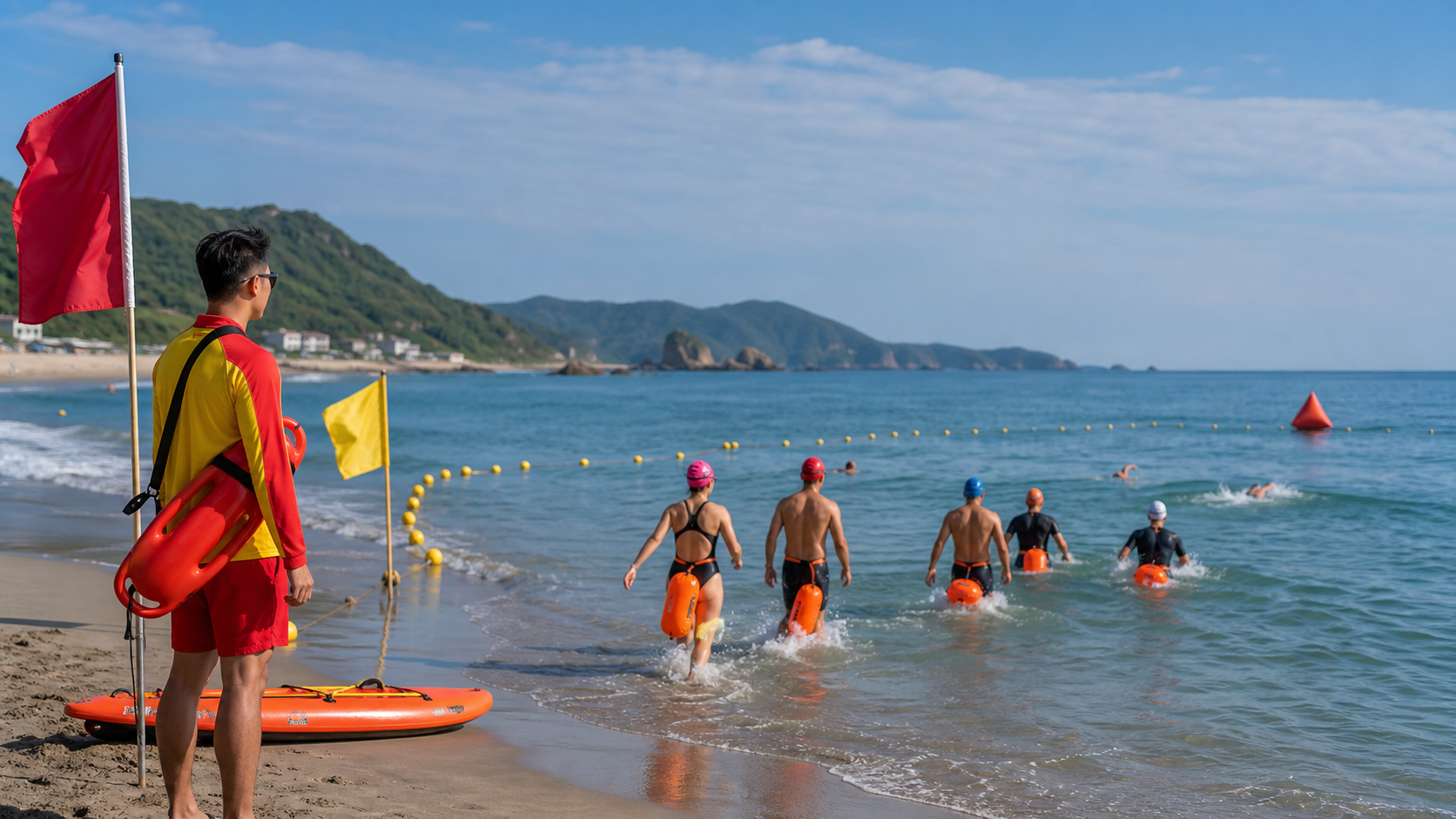
Some sea swimming enthusiasts and open water competitive athletes train at locations without lifeguards. This is not entirely impossible, but the following principles must be strictly followed:
Solo swimming is absolutely prohibited
- At least one shore-based observer who can clearly see the swimmer at all times is required
- It is strongly recommended to have a kayak, SUP, or jet ski accompany the swimmer
Essential safety equipment:
- Orange or bright yellow tow float, so fishing boats and yacht operators can see you
- Waterproof rescue whistle (can be blown while in the water)
- Rechargeable waterproof flashing light (for early morning or dusk training sessions)
Environmental assessment checklist:
- [ ] Confirm the area is not a fishery closure zone or military control zone
- [ ] Check that the day’s wave height is < 0.8 meters and wind speed is < force 4
- [ ] Confirm there is no rip current (observe the direction of foam lines on the water surface)
- [ ] Inform family and friends of the swimming location and estimated time
Emergency Distress Methods
In-Water Distress Signals
- Raise one arm vertically and wave it: International standard in-water distress signal
- Blow a whistle: Use a waterproof whistle in the water; three short blasts signal distress
- Inflate the tow float: Some tow float models have visual warning features
Shore-Based Distress
- Call 118: Taiwan Coast Guard Administration emergency hotline (24 hours)
- Call 119: Fire Department water rescue
- GPSLogger: Share your real-time location with a shore-based contact
Practical Advice
- Check the “Water Safety Map” before entering the water: The water safety information platform (established by the Water Resources Agency) provides hazard levels and historical accident data for various waters
- Never swim alone: This is the most fundamental and important principle of open water safety
- Follow lifeguard instructions: Even if you are a seasoned athlete, lifeguard instructions carry legal authority
- Watch out for boat traffic: Many sea swimming accidents are caused by collisions with speedboats or jet skis, especially in waters without clear demarcation
Conclusion
Enjoying the freedom of open water swimming requires a thorough understanding of and respect for the relevant regulations and natural risks. Taiwan’s oceans are beautiful and vast, and with proper safety knowledge as your foundation, every entry into the water can become an anticipated and wonderful experience. By continuously building skills and experience in legal, protected environments, you will be better equipped to safely take on more diverse water environments in the future.
Related Reading
- Open Water Safety Regulations: Venues, Lifeguard Deployment, and Escort Rules in Taiwan
- Taiwan Open Water Swimming Regulations: Which Waters Are Legal for Swimming
- Open Water Swimming Safety Guidelines: Buddy System, Current Reading, and Emergency Response
- Taiwan Beach Culture and Swimming Safety: Understanding Wave Conditions and Rip Currents
備戰 戀戀197 賽前關門點分析 西濱團練 #公路車 4K高畫質
6 年前
半日 小台灣 極限單車路線挑戰實錄
7 年前
2023桃園團體繞圈賽 / 海鷗繞圈賽 | 全程空拍數據版 | 公路車 | CT Yeh
2 年前
2025 海鷗團體繞圈賽 網路直播 超激烈裁判長視角 / EIPC 李廷威、Waypoint 等眾多高手競爭 / feat. 卡密兒主持 / 海鷗繞圈賽
9 個月前
一起升級!海鷗盃LSD團練...JJSC Zone2招待 騎到手抖 / 公路車 / CT Yeh
2 天前
虎豹潭!日本老師來台一日約騎 台灣車友熱情招待私房路線 / CT Yeh
21 天前
嘉義大埔、阿婆灣挑戰賽,美到以為在日本!ft. 環騎5 Cool 西拉雅188 / 公路車 / CT Yeh
7 個月前
4K單車實境) 嘉義 梅山36灣 訓練台 爬坡 輕鬆騎
6 年前