Special Techniques for the Swim Leg of Triathlon: Transition Area Preparation and Exit Techniques
Introduction
For triathletes, swimming is not a standalone sport but the first link in the chain of three disciplines. The quality of the swim leg is measured not only by time, but also by cardiorespiratory recovery speed after exiting the water, energy conservation, and the efficiency of the transition area (T1, Transition 1). Many athletes fail to train specifically for the demands of the “swim-to-bike” transition; even with a decent swim time, they waste unnecessary seconds in T1 or start the bike leg with an elevated heart rate that compromises their cycling performance. This article systematically introduces the special techniques of the triathlon swim leg, from pacing strategy in the middle of the race to time-saving T1 skills.
Key Differences Between the Swim Leg and Open-Water Swimming
| Item | Open-Water Swim Race | Triathlon Swim Leg |
|---|---|---|
| Goal | Swim the designated distance as fast as possible | Swim the distance with maximum efficiency, preserving energy for the next two legs |
| Pacing Strategy | Full-out sprint possible | Usually controlled at 75–80% of max heart rate |
| After Exiting Water | Can rest immediately | Must immediately transition to cycling |
| Nutrition | Can refuel | Usually no refueling (shorter distance) |
| Mental Preparation | Race ends after swimming | Swimming is just the beginning of the most exciting part of the race |
Pacing Strategy for the Swim Leg
Energy Distribution Principles
The triathlon swim leg should not be a “full-out sprint” but rather an “efficient cruise.” Core principles:
- First segment (first 200 meters): Due to the chaotic start, heart rate runs high and is hard to control, but avoid unnecessary fighting and jostling
- Middle segment (remaining 300–last 200 meters): Find your target pace, maintain steady output, reduce sighting frequency to every 10 strokes
- Last 200 meters: Begin to accelerate, increase stroke rate, and start preparing to exit the water
Heart Rate Control Recommendations
| Race Type | Recommended Swim Heart Rate (% of Max HR) |
|---|---|
| Sprint Distance (1.5km) | 80–85% (can be slightly higher) |
| Half Distance (1.9km) | 76–82% |
| Full Distance (3.8km) | 72–78% |
Exit Preparation in the Final 100 Meters
This distance is the critical period where “thought precedes action”:
- Shorten sighting intervals: Check the exit point every 4–6 strokes to avoid losing direction near the shore
- Feel the water depth change: When your feet can touch the bottom, begin preparing to stand (water depth approximately above the knees)
- Mental transition preparation: Remind yourself to “switch from horizontal to vertical movement,” activating the leg muscles in advance
Technical Details for Exiting and Standing
When the water is approximately mid-thigh depth, stop swimming and begin standing. Points to note:
- Don’t stand up too early: Attempting to stand and walk in deep water creates enormous resistance and wastes energy
- Run after standing: Running in water is faster than walking; in water below waist depth, run with high knees
- Anti-slip steps: On reef or slippery stone bottoms, shorten your stride to ensure stability rather than taking long running strides
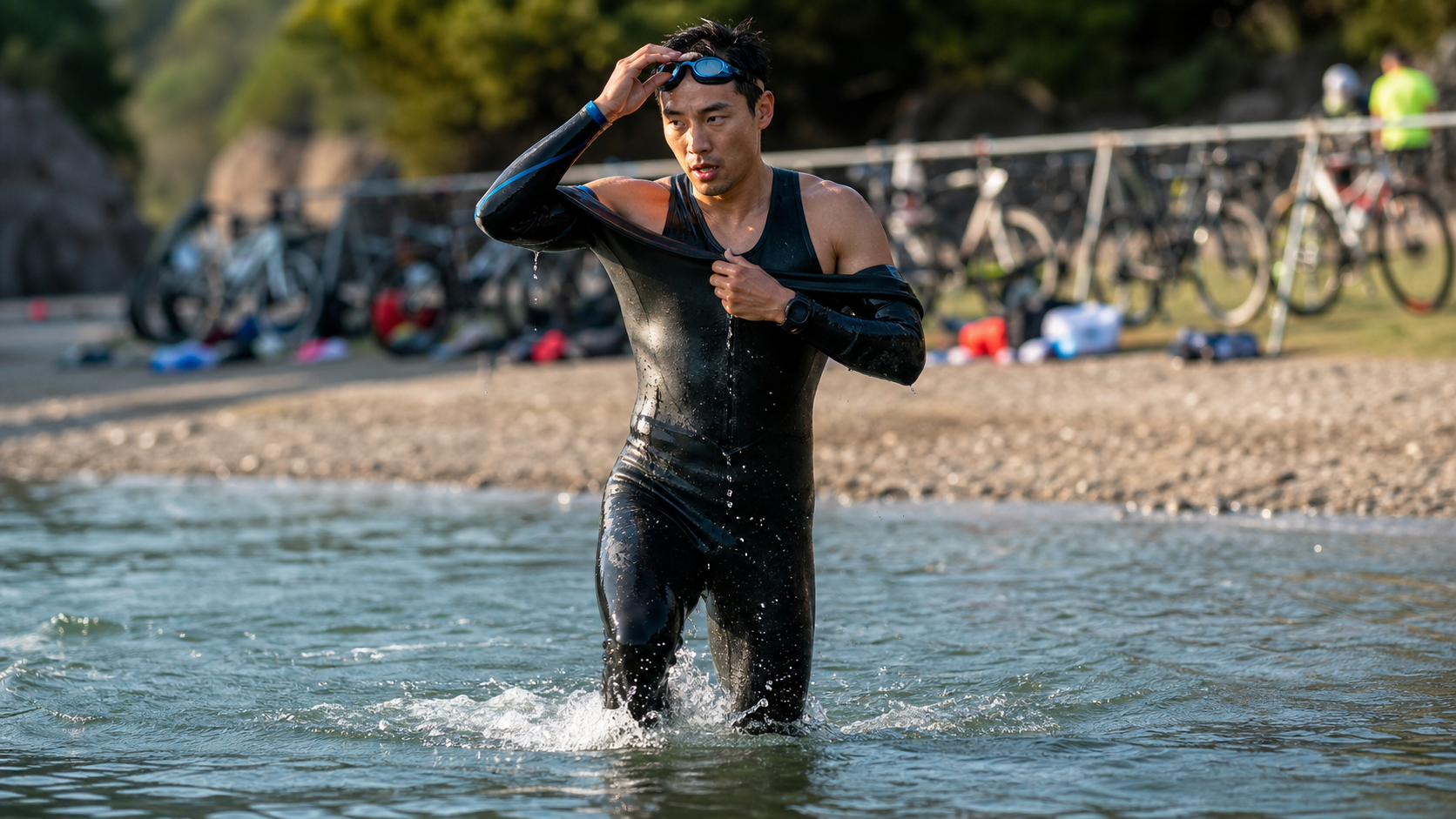
Quick Wetsuit Removal
In races requiring wetsuits, quick removal after exiting the water is the most time-consuming step in T1. Training points:
Advance Preparation (Before Entering the Water)
- Apply Vaseline or Body Glide on wrists and ankles to reduce wetsuit friction
- Confirm the zipper pull cord location; feel for it once with your hand before entering the water
- Confirm the wetsuit zipper direction (to avoid fumbling under stress)
Post-Exit Removal Steps
- Unzip while walking: Pull open the back zipper immediately upon exiting the water
- Remove shoulders: Push down forcefully with both hands to peel the wetsuit off the shoulders down to the waist
- Run forward to T1: With the wetsuit still on below the waist, pull the sleeves off your wrists while running
- Sit down in T1 to remove the legs: Sit on the mat and remove one leg at a time; do not remove while standing (risk of falling)
Target Times (T1 wetsuit removal only):
- Beginner: 2–3 minutes
- Intermediate: 60–90 seconds
- Advanced: 30–45 seconds
Systematic Transition Area Setup in T1
Transition Area Setup Principles
Flow planning from entrance to exit:
- Helmet (must be put on first; violations incur penalties)
- Race number (pre-folded and attached to belt, clip on quickly)
- Cycling shoes/Running shoes (depending on race type)
- Nutrition (put energy gels into pockets)
- Sunglasses (put on last)
Ground layout recommendations:
- Use a brightly colored towel to mark your spot (transition areas are crowded and easy to misidentify)
- Arrange all items in order of use, with the first-used items placed on the outside
- Pre-loosen cycling shoes and clip them onto the pedals to save time on buckling in T1
Heart Rate Recovery After Mounting the Bike
After exiting the swim, the heart must adapt to the redistribution of blood from horizontal to vertical position, along with adjustments in blood pressure and heart rhythm, resulting in a 30–60 second “dizzy phase.” In the early stage of riding:
- For the first 3–5 minutes on the bike, maintain an easy cadence (80–90rpm) and wait for heart rate to stabilize
- Do not push a big gear immediately after mounting
- Use this time to regulate breathing, converting the T1 adrenaline spike into steady aerobic output
Practical Advice
- Practice T1 after every training session: Even after a regular swim workout, simulate the wetsuit removal → shoe change sequence to build muscle memory
- Brick Training: After swimming, immediately switch to a stationary trainer or easy run to help the body adapt to the transition between states
- Scout T1 before race day: Walk through the transition area the day before the race, memorizing your spot location and the exit route from T1
- Check the rules: Some races have specific T1 regulations (e.g., when you may put on your helmet); read the athlete guide carefully before race day
Conclusion
In triathlon, the goal of the swim leg is not to “swim the fastest” but to “create the best possible starting point for the next two legs.” From pacing control in the middle of the swim, to smooth exit movements, to systematic T1 transitions, refining every detail allows you to maintain a higher level of competitive performance in the latter two legs. These skills require repeated practice, and every session is an investment—on race day, everything will flow smoothly, completing your triathlon journey with effortless grace.
Related Reading
- Optimizing Triathlon Swim Exit and T1 Transition Speed: The Critical 120 Seconds from Water to Bike
- The Final 100 Meters of the Triathlon Swim Leg: Key Strategies Before the T1 Transition
- Triathlon Transition Area Strategies: How to Save Every Second in T1 and T2
- Triathlon Swim Leg Finish Strategy: Full Planning from Start to T1
西進武嶺 免費訓練分析服務 Intervals | 練不夠還是練過頭?你哪一種類型選手?AI模型告訴你! | 備戰神器 | 公路車 訓練 | CT Yeh
4 年前
FTL 與 SYB 車隊專訪 西進武嶺 實用攻略分享! 2小時 如何練?!你不知道的眉角!新手準備武嶺必看 EP1 | 實力派女車友 | 精華版 | 公路車 | CTYeh
4 年前
福隆鐵人團練隨拍
8 年前
CT 喇低賽) 武嶺牽車 才是王道 西進牽車四小時內秘訣 攝手位置 如何判斷 防抽筋小秘訣
7 年前
#東進武嶺 全程實況錄影 5小時半 #夏季KOM #太魯閣 Taiwan KOM Challenge Reality Video Taroko scenery
7 年前
Live) 備戰2019彰化經典百K 賽前攻略 (已完賽請看新影片
7 年前
2023桃園團體繞圈賽 / 海鷗繞圈賽 | 全程空拍數據版 | 公路車 | CT Yeh
2 年前
2019 夏季KOM 5小 完賽心得 準備攻略 東進武嶺 夏季登山王之路 Taiwan KOM Challenge
7 年前