The Optimal Timing for Specialization in Youth Swimming: Risks and Benefits of Early Specialized Training
Introduction
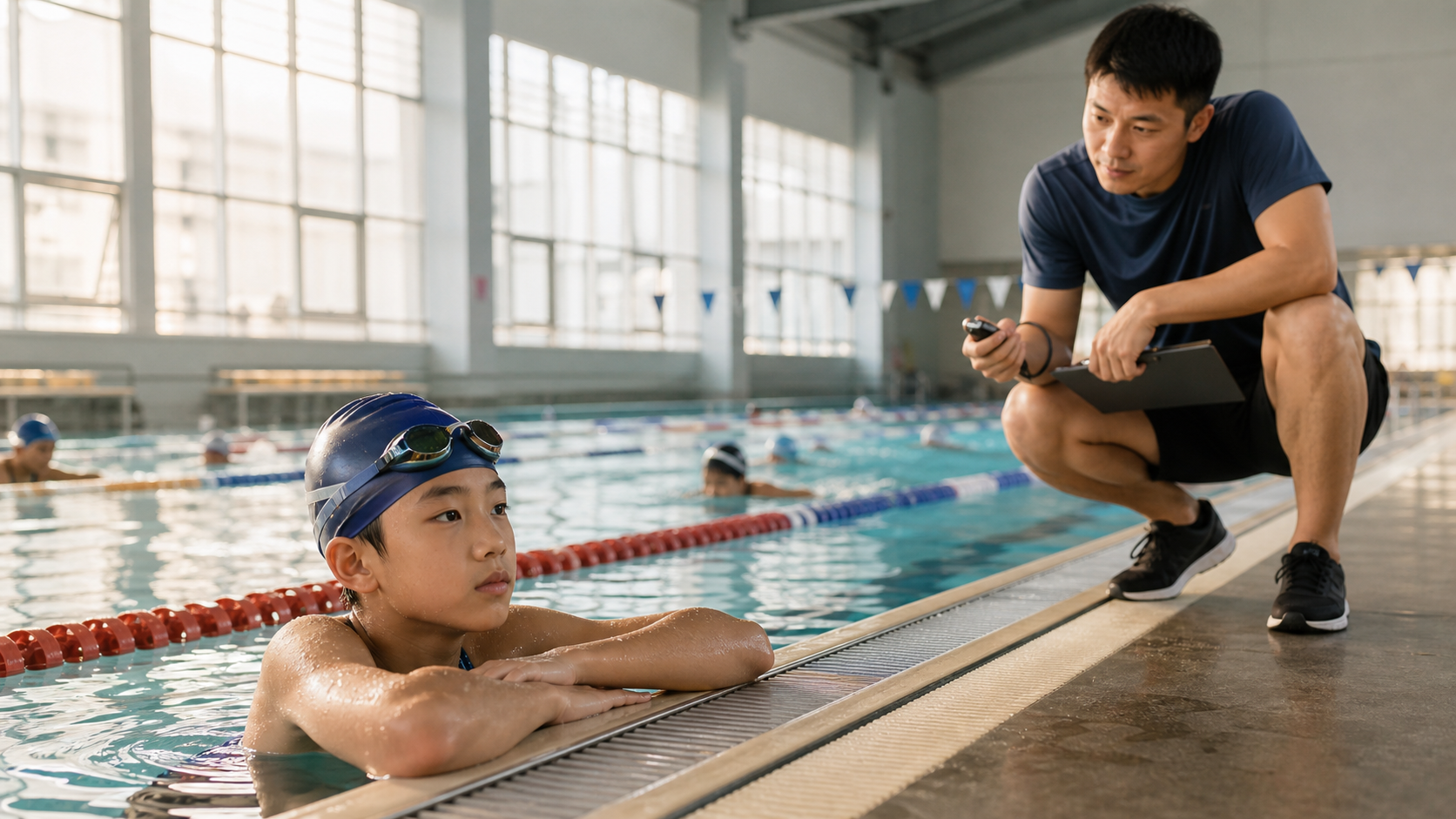
In Taiwan’s youth swimming community, the belief that “starting early leads to early success” is quite common. Many parents enroll their children in clubs for daily training at age 8 or 9, hoping they will stand out at the National High School Athletic Games or the Youth Cup. However, sports science research on “early specialization” has accumulated substantial evidence, reminding us that this path is not without its downsides.
What Is Early Specialization?
Early specialization refers to concentrating training resources on a single sport before the musculoskeletal system matures, with weekly training hours exceeding the athlete’s age (e.g., a 10-year-old training more than 10 hours per week).
In contrast, the “early diversification” strategy encourages children to engage in a wide range of sports before puberty, then gradually focus on a specific discipline after ages 14–16.
Potential Risks of Early Specialization
Overuse Injuries
Swimming is a full-body aerobic sport, but repetitive stroke movements place continuous stress on the shoulder and knee joints (in breaststroke). Research shows that swimmers who undergo high-intensity specialized training before age 12 have an overuse injury rate 2–3 times higher than their peers.
Common early overtraining injuries:
- Rotator cuff wear (swimmer’s shoulder)
- Breaststroker’s knee (quadriceps tendinitis)
- Growth plate stress fractures
- Lumbar hyperextension injuries (butterfly)
Athletic Burnout and Dropout Rates
Long-term follow-up studies by the U.S. Olympic Committee found that more than 35% of athletes who specialized before age 10 dropped out before age 16 due to burnout or psychological stress. A similar phenomenon exists in Taiwan—many outstanding elementary school swimmers on school teams gradually quit after entering junior high due to academic pressure combined with training fatigue.
Limited Development of Overall Athletic Ability
Multi-sport training develops a broad movement vocabulary, which remains beneficial later in an athletic career. Swimmers who specialize early often lag behind peers with diverse sports backgrounds in areas such as explosive power and agility.
The Limited Benefits of Early Specialization
Of course, not all research opposes early specialization. As a technique-intensive sport, swimming does offer certain advantages from early exposure:
| Benefit | Description |
|---|---|
| Early water feel development | Water feel established before age 6 is harder to compensate for later in adolescence |
| Solidified technical movements | Certain techniques (e.g., turns, starts) create deeper neural memory the earlier they are learned |
| Aerobic foundation | An aerobic engine built in early years does yield long-term benefits |
| Competition adaptability | Early exposure to competitive environments aids psychological adaptation |
However, most of these benefits require only “moderate participation” rather than “high-intensity specialized training.”
Current Status and Recommendations for Taiwan’s Youth Training
Youth swimming training in Taiwan currently shows a polarized landscape: some counties and cities (e.g., Kaohsiung, Tainan) have complete multi-age club systems, while other regions rely heavily on the school system and lack a structured long-term development pathway.
Recommended specialization timeline:
| Age Group | Recommended Strategy | Weekly Training Volume |
|---|---|---|
| 6–10 years | Multi-sport + swimming fundamentals | 3–5 hours/week of swimming |
| 10–13 years | Progressive focus on swimming | 6–10 hours/week |
| 13–16 years | Full specialization training | 12–18 hours/week |
| After 16 | High-performance training | Adjusted to individual needs |
Practical Recommendations
For parents:
- Before age 12, encourage children to also engage in other sports (e.g., basketball, gymnastics, track and field)—don’t focus solely on swimming.
- Observe your child’s training motivation—if they show resistance before every practice, reassess the training intensity.
- Communicate long-term goals with the coach and ensure the training plan prioritizes “sustainable development” over “short-term results.”
For coaches:
- For athletes under 10, adopt a “training as play” approach to session design.
- Establish long-term tracking mechanisms to monitor athletes’ growth curves and injury records.
- Avoid prematurely exhausting athletes’ long-term potential for the sake of this year’s competition results.
Conclusion
Early specialization is not a black-and-white issue. Swimming does require early exposure and technical foundation-building, but there is a critical difference between “appropriately early” and “excessively early.” If Taiwan’s youth swimming development can draw on the Long-Term Athlete Development (LTAD) models of swimming powerhouses like Australia and the Netherlands—ensuring athletes train at the right intensity at the right time—we can truly cultivate swimmers with long-term competitiveness.
Related Reading
- Multi-Sport Participation for Youth: The Long-Term Benefits of Early Specialization vs. Diversified Development
- Multi-Sport Development for Youth: Why Early Specialization Should Be Avoided
- The Risks of Early Specialization: Why Focusing on a Single Sport Too Early May Shorten Athletic Careers
- Youth Swimming Training: Training Volume Recommendations and Technical Development Priorities by Age Group
一日北高/長距離團騎 常見問題補充篇 / 組團或跟團的眉角 / 壯車友容易被瘦車友慢性拉爆 / 原來屁股痛可能是這個原因...? / 風場配速法 / 公路車 / CT Yeh
2 年前
一日北高常見問題大集合 | 攻略 | 路線 | 訓練 | 補給 | 自行車 單車 | 一日雙城 | 雙塔 | TWB北高360 | 屁股痛
6 年前
滑雪新手們慘摔學習全紀錄(請開字幕),滑雪好好玩 | Snowboard + Ski | 岩原 スキー場 | 滑雪APP使用 | GoPro Max
6 年前
西進武嶺 免費訓練分析服務 Intervals | 練不夠還是練過頭?你哪一種類型選手?AI模型告訴你! | 備戰神器 | 公路車 訓練 | CT Yeh
4 年前
[教學] Premiere 影片 手震 修正 教學 防抖 單眼 影像 GoPro 穩定 Video Stabilization
8 年前
live) 超越北高 之一日北高12小時 策略
7 年前
CT 喇低賽) 武嶺牽車 才是王道 西進牽車四小時內秘訣 攝手位置 如何判斷 防抽筋小秘訣
7 年前
備戰 戀戀197 賽前關門點分析 西濱團練 #公路車 4K高畫質
6 年前