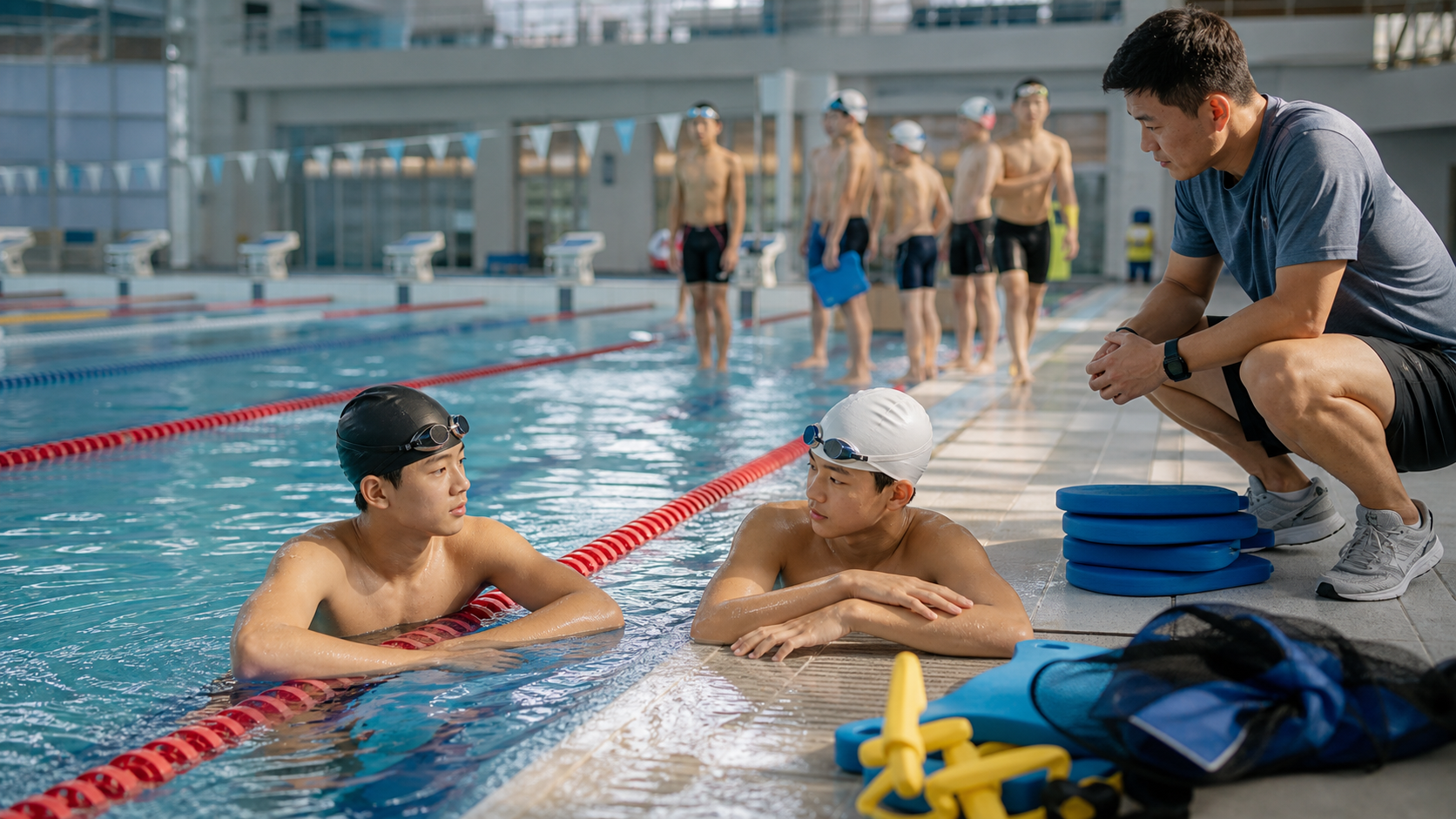
Introduction
Youth swimming training in Taiwan operates primarily through two systems: school swim teams (affiliated with junior high and senior high school athletic programs) and private swimming clubs (including association-affiliated teams). These two systems differ significantly in training culture, resource allocation, competition goals, and athlete development pathways. Understanding these differences is crucial for parents choosing a training environment for their children.
Taiwan’s School Swim Team System
Institutional Framework
School swim teams in Taiwan typically operate as athletic programs, where athletes must pass sports aptitude entrance exams and use competition results as the basis for academic advancement. From elementary school athletic programs (established in some counties/cities) → junior high athletic programs → senior high athletic programs, a complete academic progression system is formed.
Key Features:
- Training hours: Typically 6:00–7:30 AM daily + 4:00–6:00 PM after school (double sessions)
- Coach status: Mostly full-time school faculty with physical education teacher certification
- Training goals: Primarily targeting student sports competitions such as the National High School Games and county/city games
- Funding sources: School budget + subsidies from the Sports Administration of the Ministry of Education
- Athlete recruitment: Selection through sports aptitude entrance exams
Advantages
- Academic and training schedules are coordinated, reducing conflicts with schoolwork
- Integrated academic advancement resources (sports merit admissions, special recruitment)
- Relatively low (or free) training costs
- More stable peer support culture among athletes
Limitations
- Wide variation in coaching quality (some schools lack high-level professional swimming coaches)
- Limited facility conditions (some schools use borrowed pools, leading to unstable training schedules)
- Lower flexibility in training volume and program design
- Highly dependent on the school administrative calendar; training intensity generally drops during winter and summer breaks
Taiwan’s Swimming Club System
Institutional Framework
Swimming clubs in Taiwan exist in two forms: private swimming clubs (such as county/city swimming association affiliate teams and private swim schools) and athlete training programs run by county/city aquatics promotion associations.
Key Features:
- Training hours: Varies by club schedule, typically Monday to Saturday, 1–2 hours per day
- Coach status: Professional coaches, mostly holding swimming coach certifications (certified by the Chinese Taipei Swimming Association)
- Training goals: National Swimming Championships, age-group competitions, and international junior events
- Funding sources: Student tuition + parental sponsorship + limited corporate sponsorship
- Athlete recruitment: Open enrollment, grouped by training level
Advantages
- Higher coaching expertise, with many coaches having competitive swimming backgrounds
- Greater flexibility in individualized training (groups adjusted by ability)
- Diverse competition opportunities, including international age-group events
- Well-established winter and summer training camp systems
- Some clubs have access to scientific training tools (lactate testing, video analysis)
Limitations
- Higher costs (monthly fees ranging from NT$3,000–8,000, plus competition travel and accommodation expenses)
- Difficult to coordinate academic and training schedules
- No guaranteed academic advancement benefits (must seek competition qualifications separately)
- Training intensity management quality varies by club
Comparison of the Two Systems
| Comparison Aspect | School Swim Team | Swimming Club |
|---|---|---|
| Training cost | Low (or free) | Medium–High |
| Coaching expertise | Medium (varies widely) | Medium–High |
| Individualized training | Low | Medium–High |
| Academic advancement integration | High | Low |
| Diversity of competition opportunities | Medium | High |
| Facility conditions | Medium (depends on school) | Medium–High |
| Cross-county competitive exposure | Low–Medium | High |
| Academic support resources | High | Low |
Selection Recommendations: Choose Based on Goals
Goal: Secure academic advancement while maintaining swimming interest
→ Prioritize school swim athletic programs, as the academic pathway is clear and training pressure is relatively manageable.
Goal: Pursue national-level or international junior competitive results
→ Prioritize high-level clubs, or adopt a dual-track strategy of “club primary training + school swim team representation.”
Goal: Pathway to university physical education departments
→ It is recommended to secure competition records from the National High School Games or National Championships before senior high school; club training helps elevate competitive standards.
Directions for Improving Taiwan’s Youth Development System
Drawing on the youth development experience of swimming powerhouses such as Japan and Australia, potential improvements for Taiwan’s youth development system include:
- Integration of school and club resources: Allow school swimmers to simultaneously participate in club training to enhance training quality.
- Continuing education system for coaches: Establish a systematic mechanism for regular certification renewal for swimming coaches.
- Cross-county youth leagues: Increase national age-group competition opportunities to provide more competitive evaluation platforms.
- Sports science support: Introduce basic sports science services (sports injury prevention, sports nutrition counseling) at county/city swimming training centers.
Practical Recommendations
- Before choosing a system for your child, arrange trial training sessions to personally experience the coach’s style and training environment.
- Communicate directly with the coach about your child’s long-term goals to ensure the coach’s training philosophy aligns with family expectations.
- If finances allow, the “dual-track model” of club training combined with school team representation is a viable strategy in competitive cities (such as Taipei and Taichung).
- Reassess annually whether the current system still meets your child’s developmental needs at that stage, and remain flexible.
Conclusion
School swim teams and swimming clubs each have irreplaceable advantages and structural limitations. For swimming families in Taiwan, the most important thing is to understand their child’s goals, personality, and resource conditions before making the most suitable system choice. Regardless of which system is chosen, a dedicated, competent coach who understands child development often determines an athlete’s long-term development outcomes more than the system itself.
Related Reading
- Junior High Swimming Athlete Development Pathways: A Systematic Training Blueprint from Amateur to Elite
- Taiwan University Swim Team Training Ecosystem: The Development Path from Student Athlete to National Team Member
- Youth Swimming Competitions: The Impact of Team Training Volume on Academics and Balance Strategies
- Private Coach vs. Swimming Class: A Complete Selection Guide for Taiwanese Parents
Live) 備戰2019彰化經典百K 賽前攻略 (已完賽請看新影片
7 年前
live) 超越北高 之一日北高12小時 策略
7 年前
備戰 戀戀197 賽前關門點分析 西濱團練 #公路車 4K高畫質
6 年前
崇越盃武嶺冠軍高手 賽前JJSC 群峰會精華!對應大數據分析,會有落差嗎?/ feat. JJSC中部公路車約騎 /公路車 / CT Yeh
2 年前
一日北高/長距離團騎 常見問題補充篇 / 組團或跟團的眉角 / 壯車友容易被瘦車友慢性拉爆 / 原來屁股痛可能是這個原因...? / 風場配速法 / 公路車 / CT Yeh
2 年前
Zwift跨國線上追逐賽 第二站 台灣 TTR vs. 日本 JETT 第二場 (台灣追日本) | 數百位國內外公路車高手,同場較勁 | 多視角賽事直播
4 年前
2025 海鷗團體繞圈賽 網路直播 超激烈裁判長視角 / EIPC 李廷威、Waypoint 等眾多高手競爭 / feat. 卡密兒主持 / 海鷗繞圈賽
9 個月前
2023桃園團體繞圈賽/環台賽等級拍攝/賽事精華/ 10人一隊缺一不可!50隊廝殺大場面 / 第三屆 海鷗繞圈賽 /公路車/CT Yeh
2 年前