Introduction
For runners, the quality of recovery after training depends largely on sleep quality, which in turn is deeply influenced by behaviors in the hours before falling asleep. Many runners are meticulous about their training but still scroll through their phones, consume caffeinated drinks, and stay in high-intensity lighting before bed—unwittingly sabotaging the very sleep that should bring full recovery.
This article provides a pre-sleep routine grounded in behavioral science and sleep medicine to help runners systematically improve their sleep quality.
90 Minutes Before Bed: Start Activating “Sleep Mode”
The process of falling asleep is a gradual physiological transition, not a switch. Core body temperature needs to drop by about 0.5–1°C before the brain decides “now is the right time to sleep.” Melatonin secretion requires a darkened environment to be triggered. These processes typically require a 60–90 minute preparation period.
Treat the 90 minutes before bed as a “transition zone,” gradually shifting from active mode to sleep mode.
Six Key Elements of a Pre-Sleep Routine
1. Light Management (Starting 90 Minutes Before Bed)
Light is the strongest signal regulating the circadian clock. Blue light (from phones, computer screens, LED lights) directly suppresses melatonin secretion from the pineal gland.
Specific practices:
- Starting 90 minutes before bed, switch all screens to warm color mode (Night Shift / eye-care mode)
- 60 minutes before bed, switch the main lighting to warm yellow or dim lights to reduce overall ambient illumination
- 30 minutes before bed, stop using any screens (this step is the most important)
- Keep the bedroom completely dark (use blackout curtains or an eye mask)
2. Body Temperature Regulation (60 Minutes Before Bed)
The drop in core body temperature is the key trigger for sleepiness. Paradoxically, a warm shower or bath can actually help you fall asleep faster, because after stepping out of hot water, vasodilation carries heat to the skin’s surface where it dissipates, causing core body temperature to drop rapidly.
Specific practices:
- 60–90 minutes before bed, take a bath or shower (38–40°C) for 10–15 minutes
- Set the bedroom temperature to 18–22°C (in Taiwan’s summer, it’s recommended to set the air conditioner to 26°C with a fan)
- Choose breathable natural materials (cotton or bamboo fiber) for bedding
3. Diet and Hydration Management (2–3 Hours Before Bed)
Runners often have a strong appetite after training, but the timing and content of dinner have a profound impact on sleep:
What to avoid:
- Eating a large meal within 2 hours of bedtime (the digestive process raises core body temperature, affecting sleep onset)
- Caffeine (half-life of 5–7 hours; caffeine consumed after 2 PM still lingers at midnight)
- High-fat or spicy foods (prolong digestion time and increase the risk of acid reflux)
- Alcohol (although it helps you fall asleep, it severely disrupts REM sleep and deep sleep)
Recommended foods:
- Foods rich in tryptophan: nuts, pumpkin seeds, yogurt, bananas
- Low glycemic index carbohydrates: oatmeal, whole wheat bread (in moderation)
- Magnesium glycinate: supplementing 200–400 mg before bed helps muscle relaxation and sleep depth
- Warm chamomile tea or lavender tea
4. Physical Relaxation Rituals (30–45 Minutes Before Bed)
High-volume runners’ sympathetic nervous systems are chronically activated, so they need to actively “switch” to parasympathetic-dominant mode before bed.
Effective relaxation methods:
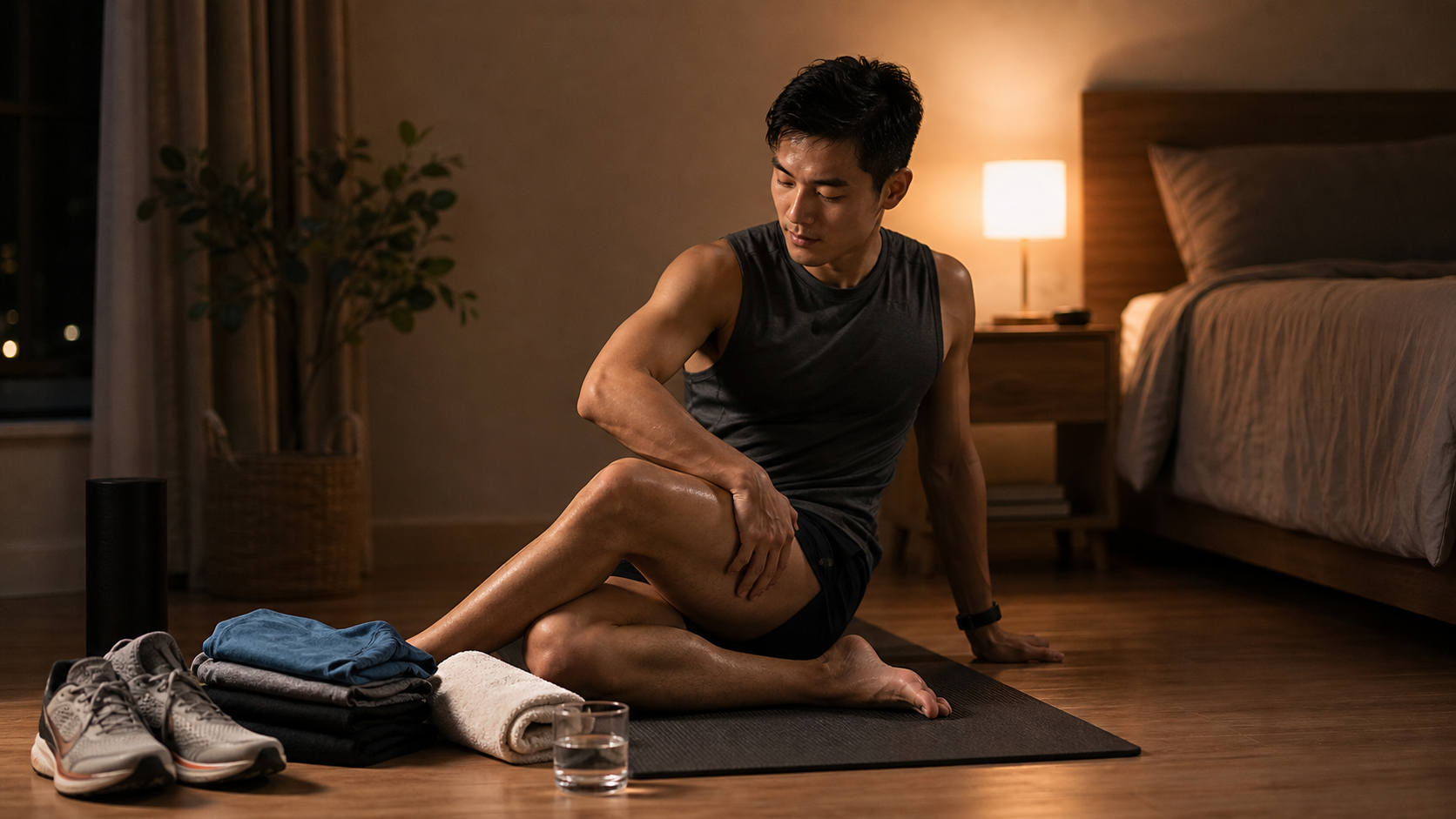
- Yoga stretching (10–15 minutes): Target common post-run tight areas—hip flexors, calves, thoracic spine. Emphasize slow breathing, holding each pose for 60–90 seconds
- 4-7-8 breathing technique: Inhale for 4 seconds → hold for 7 seconds → exhale for 8 seconds, repeat for 4–8 cycles. This effectively lowers heart rate and anxiety
- Foam rolling (5–10 minutes): Gently roll the quadriceps and glutes without aggressive deep pressure; the goal is relaxation, not treatment
- Mindfulness meditation: Use guided meditation apps (such as Headspace, Calm) for 5–10 minutes of guided meditation
5. Mental Transition (45 Minutes Before Bed)
Runners’ training plans often come with anxiety about performance, and this “mind won’t shut off” state is a major obstacle to falling asleep.
Cognitive relaxation strategies:
- Write down tomorrow’s plan: Write what needs to be done tomorrow in a notebook. Research shows that writing a “to-do list” (rather than a journal) before bed shortens sleep onset time
- Training log review: Briefly record three positive things from today’s training; ending on a positive note helps with emotional transition
- Information cutoff time: Set a fixed time (e.g., 9 PM) as the cutoff for checking training-related information (such as Strava, group discussions)
6. Sleep Environment Optimization
| Environmental Factor | Recommended Setting | Reason |
|---|---|---|
| Temperature | 18–22°C | Core body temperature drop requires a cool environment |
| Light | Completely dark | Blocks light’s suppression of melatonin |
| Noise | <40 decibels | Above this level affects deep sleep |
| Humidity | 50–60% | Prevents airway dryness from affecting sleep |
| Bedding | Breathable natural materials | Aids heat dissipation and maintains proper body temperature |
A Complete Pre-Sleep Schedule for Runners
Using an 11 PM sleep target as an example:
- 21:30 – Stop high-intensity training (if training in the evening)
- 21:30 – Switch screens to warm color mode
- 22:00 – Dinner (if not yet eaten) or a light snack
- 22:00 – Take a bath or warm shower for 15 minutes
- 22:20 – Write in training log or plan for tomorrow
- 22:30 – Stop all screen use
- 22:30 – Gentle yoga stretching / foam rolling
- 22:45 – Breathing meditation practice
- 23:00 – Go to bed
Practical Tips
- Consistency matters more than perfection: Even if you can’t complete the full pre-sleep routine, prioritize a fixed bedtime and wake-up time
- Don’t suddenly change your routine the night before a race: Stick to your usual pre-sleep routine; save new experiments for after the race
- Use a two-week evaluation cycle: Changing sleep habits takes time to show results; don’t give up after just one week
- Avoid doing non-sleep activities in bed: The bed is for sleeping; working or watching shows in bed weakens the brain’s conditioned response that “bed = sleep”
Conclusion
A pre-sleep routine is not a luxurious form of self-care—it’s an extension of a runner’s training plan. Treat the 90 minutes before bed as “recovery training.” By systematically adjusting light, temperature, diet, and relaxation activities, your proportion of deep sleep will significantly improve, and training adaptations will show up in your performance at a faster rate.
Related Reading
- Sleep and Running Recovery: The Scientific Impact of Sleep Quality on Repair
- Napping Strategies in Running Training: The Effect of Short Naps on Training Outcomes
- The Week Before a Running Race: Tapering, Carb Loading, and Sleep Adjustments
- Sleep Optimization for Runners: Scientific Research on Sleep Quality and Running Recovery/Performance
西進武嶺 免費訓練分析服務 Intervals | 練不夠還是練過頭?你哪一種類型選手?AI模型告訴你! | 備戰神器 | 公路車 訓練 | CT Yeh
4 年前
FTL 與 SYB 車隊專訪 西進武嶺 實用攻略分享! 2小時 如何練?!你不知道的眉角!新手準備武嶺必看 EP1 | 實力派女車友 | 精華版 | 公路車 | CTYeh
4 年前
[教學] Premiere 影片 手震 修正 教學 防抖 單眼 影像 GoPro 穩定 Video Stabilization
8 年前
西進武嶺 自製新版AI配速表產生器 x 賽前攻略 抱佛腳! 沒有功率計也可以產生配速表嗎?有什麼其他眉角賽前要注意的呢? | 西進武嶺 / 東進武嶺 KOM 攻略 | 公路車 | CT Yeh
4 年前
iPhone 13 Pro 電影級 VLOG 實拍測試!優缺點 原理分析! 夜間效果對決 GoPro10!蘋果沒有說的超強錄影體驗!? | CT Yeh
4 年前
#公路車 #Fitting 靠人工智慧APP 幫你調整單車
6 年前
Live) 備戰2019彰化經典百K 賽前攻略 (已完賽請看新影片
7 年前
一日北高前的高裝檢 | 北高 360 | 挑戰11小時的裝備 | 一日雙塔 | 補給
6 年前