Introduction
Cycling around Taiwan is not just a physical challenge—it is a modern cultural ritual. Every year, thousands of people ride around the island, and many choose to document the journey in writing—from daily check-in posts on Facebook to formally published travelogues. Taiwan’s cycling writing has developed into a unique literary sub-tradition.
What common qualities do the most moving cycling narratives share? How can the sweat of pedaling, the scenery of mountains and seas, and the human warmth encountered on the road be transformed into prose worth reading? This article starts from the writing tradition of Taiwan’s cycling travelogues to explore the aesthetics and practice of cycling literature.
Types of Cycling Travelogues in Taiwan
| Type | Representative Form | Characteristics | Readership |
|---|---|---|---|
| Documentary diary | Daily check-in posts | Strong immediacy, rich in everyday details | Family and friends, social media followers |
| Thematic essays | Compiled and published after the round-island trip | Structured, theme-conscious | General readers with an interest in cycling |
| Travel information | Route guide blogs | Dense with practical information | Those preparing for a ride |
| Literary travelogue | Book publication | Refined language, attention to cultural details | Literary readers |
Qualities of Classic Taiwanese Cycling Writing
Several recurring themes in Taiwan’s cycling travelogues form the core of this writing tradition:
The “Self-Discovery” Journey Narrative
Nearly all Taiwanese round-island travelogues include an element of psychological journey: some predicament exists before departure (career slump, end of a relationship, loss of direction in life), and the round-island ride becomes a kind of “pause” and “restart.” The physical labor of cycling proceeds in tandem with inner self-examination. This theme deeply resonates with modern Taiwanese people’s collective longing to “escape the everyday.”
Records of Human Warmth
Taiwanese round-island travelogues almost inevitably include several stories of “being helped by strangers”: an elderly woman by the roadside giving you fruit, a temple letting you sleep for free, a bike shop mechanic fixing your bike at no charge… These encounters form the emotional core of Taiwan’s round-island writing and reflect Taiwanese people’s strong identification with and appreciation of the cultural trait of “warm hospitality.”
The Literary Transformation of Landscape
From the Pacific blue of Hualien and Taitung to the sunset factories of the west coast, from Taroko’s cliffs to Kenting’s tropical flair—the landscape diversity of a Taiwan round-island trip provides abundant material for writing. The best cycling writing does not merely describe what one sees, but captures “the unique perception of being in this place at this moment.”
How to Begin Your Cycling Writing
Build the Habit of a Cycling Diary
After each day’s ride, while memories are still fresh, write down three things:
- The most unforgettable image of the day (a concrete visual and sensory description)
- A person or event encountered that day (human warmth and chance encounters)
- A turning point in body or mood that day (an honest record of your inner state)
These three dimensions form the basic structure of a cycling journal, and accumulated over time they become a complete record of the journey.
Writing Habits to Avoid
- Excessive logbook style: “Departed at 6 a.m., rode 30 km to Tainan, had beef soup, kept riding in the afternoon…” This kind of purely chronological record lacks literary quality
- Clichéd weather descriptions: “The weather was good/bad today” “The sun was big and hot”—these descriptions are too vague; try to describe more specific sensory details
- Excessive self-pity: Writing about self-challenge easily falls into an endless loop of “so tired, so hard”; find a transformation of meaning within the descriptions of hardship
Writing Techniques Worth Referencing
- Let the body speak: Cycling is a highly physical activity; describing bodily sensations (lactic acid in the legs, the temperature of wind on your cheeks, the acceleration of your heart on descents) immerses readers more than describing scenery
- The power of dialogue: Conversations with passersby, bike shop mechanics, and temple caretakers are often the best window into the texture of everyday Taiwanese life
- The use of suspense: As in fiction, opening a paragraph with suspense (“That day’s climb almost made me give up the entire trip”) effectively hooks readers into continuing
Publication Paths for Round-Island Writing
If your cycling journal has accumulated sufficient depth, consider the possibility of publication. Taiwan’s publishing market has sustained interest in Taiwanese people’s own round-island stories. A few practical suggestions:
- First serialize on Facebook or a personal blog to test reader response
- Organize the journal into thematic articles rather than a purely chronological sequence
- Find “what special angle your round-island trip has”: whether it’s accompanying an ill family member, occurring at a particular juncture in life, or following a specific cultural theme as its axis
Practical Advice
Start writing before you depart: A cycling travelogue can begin at the preparation stage—record your expectations, fears, and preparation process. These pre-departure psychological states are often the most compelling part of the entire story.
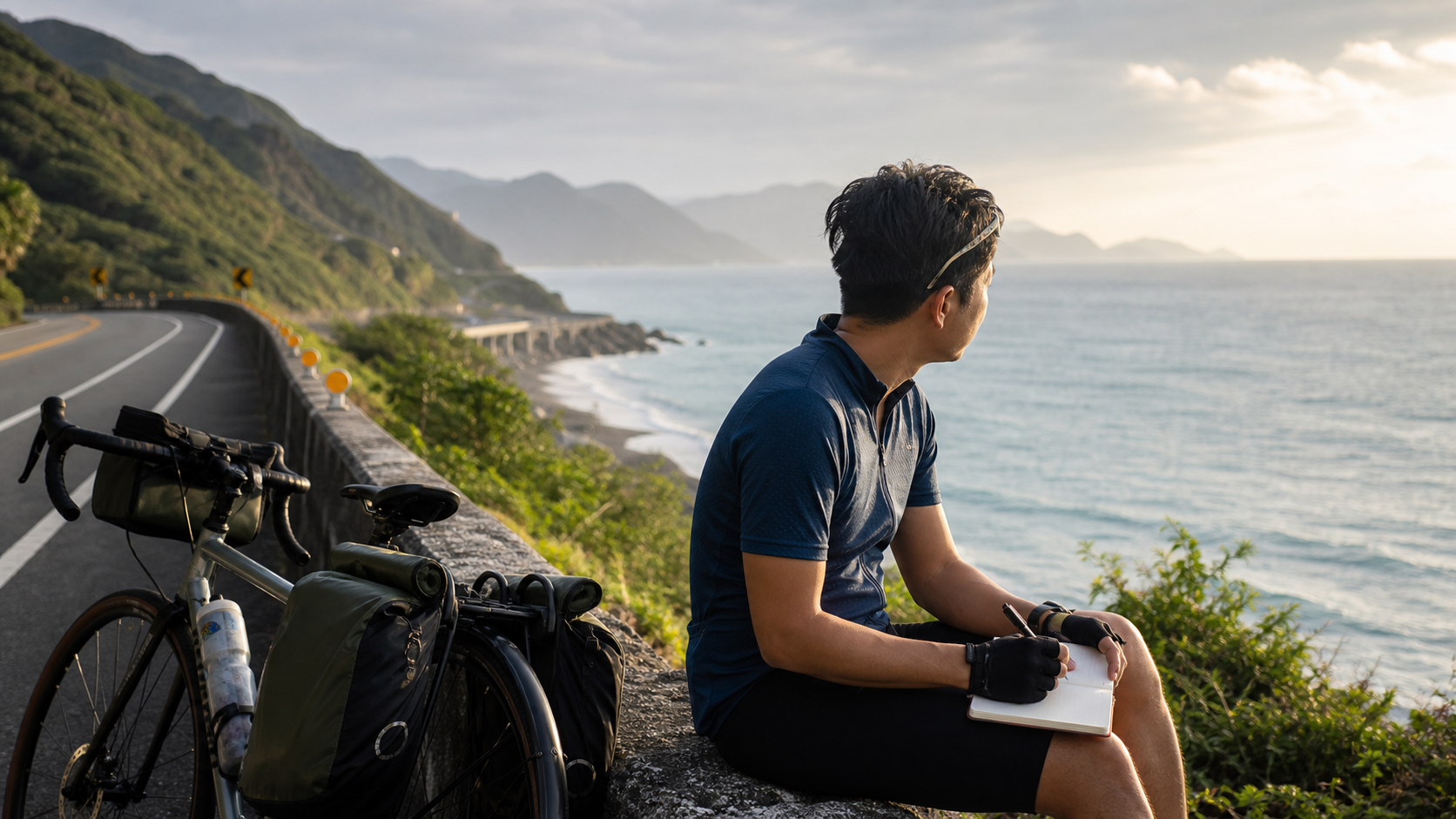
Carry a physical notebook: Typing on a phone has its convenience, but many cyclists find that on nights when they are utterly exhausted, writing a few lines by hand carries more ritual significance than scrolling on a phone, and the quality of the record is also more honest.
Conclusion
The cycling writing tradition of Taiwan’s round-island trips is one of this island’s cultural assets. Every cycling travelogue is a deep perception of this land, a personal response to the eternal questions of “Who am I, where am I, and where am I going?” Cycling around the island is a journey of the body; writing it down gives that journey a chance at a second life.
Related Reading
- Taiwan Charity Bike Rides: Combining Philanthropic Cycling with Social Responsibility
- Round Taiwan Cycling Challenge: A Daily Record of Completing the Island in 9 Days
- A Life on Two Wheels: How Cycling Transforms Worldviews, Friendships, and the Meaning of Life
- Bicycle Photography Techniques: Shooting Tips, Gear Selection, and Post-Processing While Riding
高雄綠園道鐵路自行車道 / 外地人能輕鬆駕馭 還是整路崩潰? / 2025 全線開通 春節實地探索一次!(附GPS連結)/ 公路車 / CT Yeh
1 年前
2023自行車展!與環台賽選手一同表演賽 / 全自動AI Fitting?/ TIME新車發表/神秘充電桌等 精華分享 VLOG | CT Yeh | 公路車
3 年前
虎豹潭!日本老師來台一日約騎 台灣車友熱情招待私房路線 / CT Yeh
21 天前
浪漫 #臺三線 #單車 員工旅遊 桃園到台中 老少咸宜 環台賽 路線探索
6 年前
金門 ! 我騎過最棒的離島了 / 最後可以騎車上金門大橋的機會!?/ 公路車 / CT Yeh
1 年前
台北大雁西飛 約騎挑戰 feat. Doris | 公路車 | CT Yeh
3 年前
小野田真的存在!日本赤城山爬坡公路賽 台灣首發團完全實錄 | 頭文字D真實賽道! | 看完東奧自行車賽後好想再去騎一次啊! | 公路車 | CT Yeh
4 年前
2024 如來神掌 百人約騎挑戰!feat. 秘境單車社團 / 神人們太可怕 / 全程錄影 x 完整坡度解析 / 公路車 / CT Yeh
2 年前