Introduction
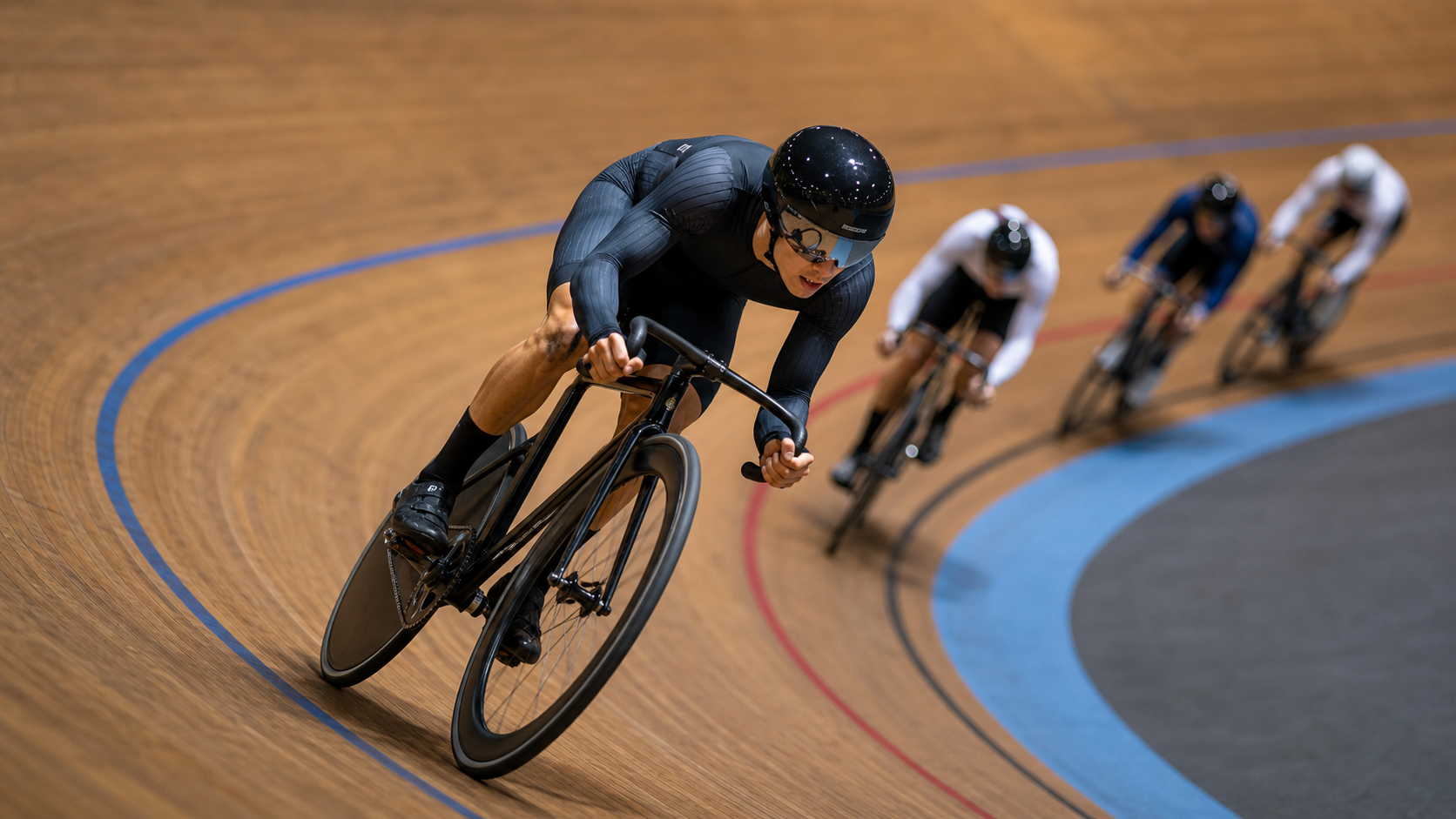
Track cycling, held on indoor wooden oval tracks (Velodromes), is one of the most visually striking disciplines in competitive cycling. The steeply banked curves, riders in streamlined skinsuits, and brakeless fixed-gear bikes—every detail of track racing is designed to push the limits of speed. On the Olympic stage, track cycling has always been a medal hotspot and a fiercely contested event among Asian nations, including Japan, South Korea, and Hong Kong.
Overview of Track Cycling Events
Olympic Events
Olympic track cycling is divided into the following main events:
| Event | Gender | Distance/Laps | Highlights |
|---|---|---|---|
| Keirin | Men/Women | Approx. 2km | Riders sprint freely after a motorized pace-setter leads |
| Sprint | Men/Women | 250m final sprint | Tactical drafting with top speeds reaching 75km/h |
| Individual Pursuit | Men/Women | 4km/3km | Time trial racing against an opponent from opposite sides |
| Omnium | Men/Women | Multiple events with points | The arena for all-round riders |
| Madison | Men/Women | Approx. 30–50km | Two-rider team relay with points |
| Team Pursuit | Men/Women | 4km (4 riders) / 4km (4 riders) | One of the fastest disciplines in cycling |
Keirin
The Keirin (originating in Japan in 1948) is the most dramatic event in track racing:
- Riders line up behind a motorized pace bike (Derny), starting at 30km/h
- The pace bike gradually accelerates to 50km/h before pulling off with 2.5 laps remaining
- Riders begin racing freely, launching into a short-distance sprint
- Tactical positioning, feints, and a final explosive surge are the essence of the Keirin
The Science of Speed in Track Cycling
The Pinnacle of Aerodynamics
Inside a closed Velodrome, air resistance is the only major source of drag (excluding friction). Aerodynamic optimization in track racing is a highly refined blend of science and engineering:
Frame Design:
- Fixed gear (no freewheel): eliminates airflow disturbance from the freewheel
- One-piece carbon fiber construction: minimizes frame cross-section
- Ultra-narrow seat post and bottom bracket design
Wheel Selection:
- Rear wheel: full disc wheel is the standard configuration
- Front wheel: deep-section rims (60–80mm) or a disc wheel, depending on track width regulations
Riding Position:
- Elbows and knees tucked in to create the smallest possible cross-section
- Back kept as horizontal as possible
- Streamlined helmet design
Utilization of Energy Systems
Different track events rely on different energy metabolism systems:
| Event | Primary Energy System | Ratio (Estimated) |
|---|---|---|
| 200m Flying Sprint Time Trial | ATP-PCr (Anaerobic) | 95%+ |
| Keirin | ATP-PCr + Lactic Acid | 70/30 |
| Individual Pursuit (4km) | Lactic Acid + Aerobic | 50/50 |
| Omnium | Aerobic (with intermittent sprints) | 70% Aerobic |
| Madison | Primarily Aerobic, Anaerobic during sprints | 80/20 |
The Physics of Track Banking
The banking of a Velodrome typically ranges between 28–45 degrees, and this incline serves a physical necessity:
- Provides centripetal force, allowing high-speed riders to take corners without slowing down
- Different speeds correspond to different optimal banking angles
- Wooden tracks (usually maple) offer the best coefficient of friction
The Development of Track Cycling in Asia
Asia boasts strong competitiveness in track cycling:
- Japan: Keirin is a traditional Japanese sport, and Japanese riders have consistently been internationally competitive in the event
- Hong Kong: Sarah Lee has won multiple World Championship Keirin medals, including a bronze at the 2020 Tokyo Olympics
- South Korea: Has development programs in sprint and time trial events
- China: Track cycling has grown rapidly in recent years, with significant resources invested in Olympic cycles
- Taiwan: Has a history of Asian Championship medals in track events, with room for further development
Key Training Focuses for Track Cycling
Track riders train differently from road cyclists:
- Higher proportion of explosive power training: Strength training (squats, deadlifts, explosive movements) is standard equipment
- Short-duration interval training: 10–30 second all-out sprints with 2–3 minute recovery
- Fixed-gear riding habits: Adapting to riding without a freewheel to improve pedaling efficiency
Practical Advice
For Taiwanese cyclists looking to get into track cycling:
- Fixie training: Riding a fixie in urban settings helps develop smooth pedaling habits
- Follow the UCI Track World Championships: Held annually in February–March, it’s the best time to watch thrilling track racing
- Track facilities in Taiwan: There are outdoor practice tracks near Taipei Arena, and some counties and cities have plans to promote track cycling
Conclusion
Track cycling is an extreme sport that represents a high-level fusion of engineering design, human physiology, and competitive strategy. That oval wooden track has witnessed generation after generation of riders challenging the boundaries of speed. For Taiwanese cyclists, understanding track racing not only enriches the viewing experience but also inspires a fresh perspective on one’s own pedaling efficiency.
Related Reading
- Track Cycling: A Technical Analysis of the Fastest Racing at the Olympics
- The Hall of Speed in Track Cycling: The Science of Wooden Track Banking and Speed Limits
- Fixed-Gear Track Cycling Explained: Rules and Tactics of the Six Olympic Events
- Taiwan Track Cycling: How to Ride at High Speed on the Racing Track
2023自行車展!與環台賽選手一同表演賽 / 全自動AI Fitting?/ TIME新車發表/神秘充電桌等 精華分享 VLOG | CT Yeh | 公路車
3 年前
2024 春季KOM 賽事精華版 / 太魯閣 / 貓捉老鼠精彩追擊 / 錄影剪輯版 / 東進武嶺 / 公路車 (請開啟字幕)
2 年前
2024 如來神掌 百人約騎挑戰!feat. 秘境單車社團 / 神人們太可怕 / 全程錄影 x 完整坡度解析 / 公路車 / CT Yeh
2 年前
3D 列印車褲墊 / 舒適改善? / 無痕 x 分區壓縮 / ATK & Decider系列 / JE22黑科技 / #公路車 #CTYEH
11 個月前
2025 海鷗團體繞圈賽 / 前八強賽事精華!/ 環台賽等級拍攝 / 國手菁英隊伍較勁 / CT Yeh #公路車
8 個月前
2025 乘鞍 KOM 登山賽挑戰實錄 / 日本公路最高 ! 賽前探路篇 / 比富士山厲害,無敵絕景!/ 40週年 / 中文YT首發 / 公路車 / CT Yeh #乘鞍ヒルクライム
10 個月前
2023桃園團體繞圈賽 / 海鷗繞圈賽 | 全程空拍數據版 | 公路車 | CT Yeh
2 年前
2025 紫南宮99.9K環縣自行車挑戰賽 直播 / 第一集團跟了20K / CT動態數據直播系統 / 公路車 / CT Yeh
1 年前