Team Car Strategy in Professional Cycling: A Complete Guide to Food Supply and Mechanical Support
Introduction
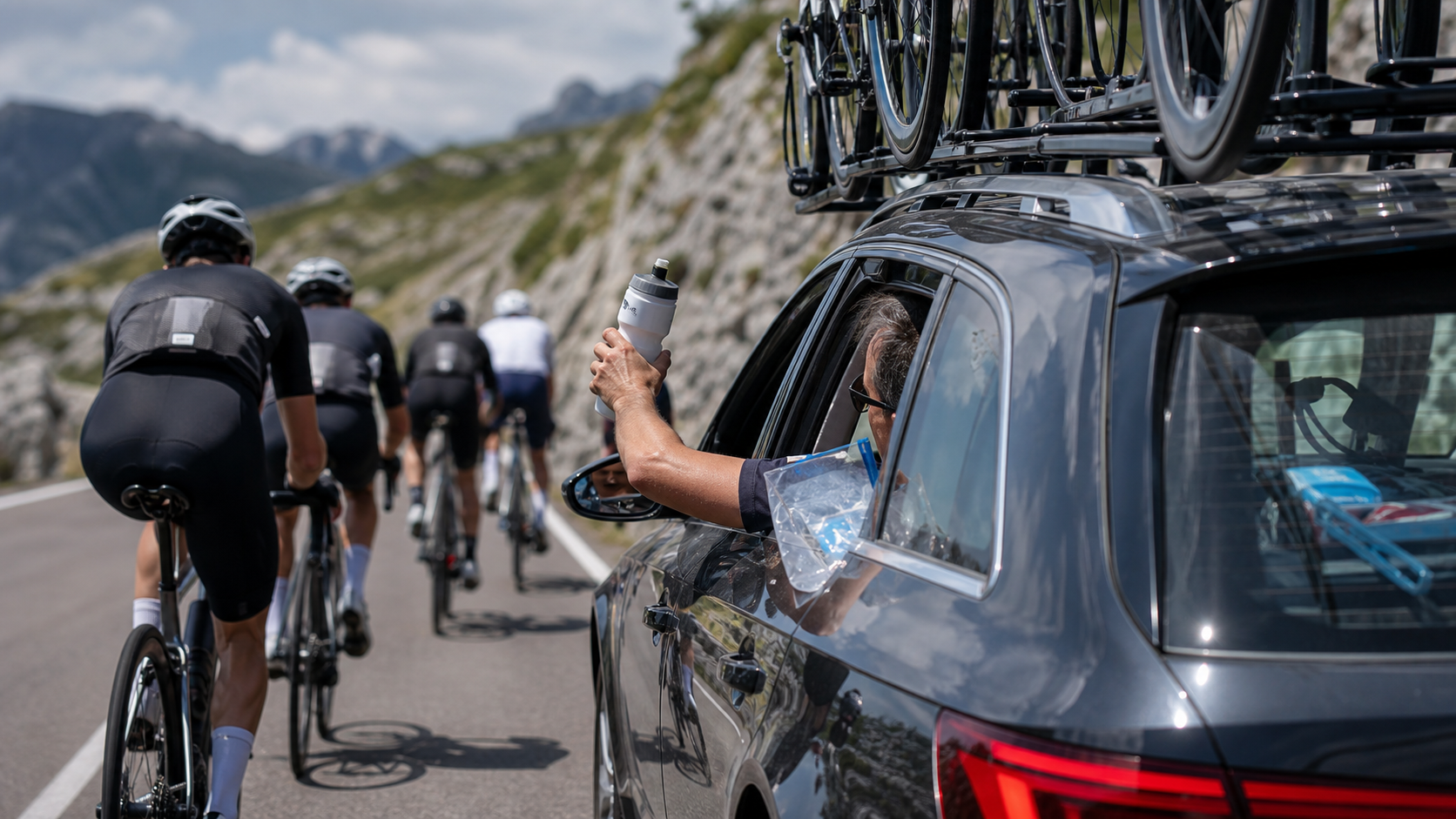
Beyond the thrilling sprints and mountain attacks of professional cycling, there is a role that rarely receives media attention yet is absolutely crucial—the Team Car and the entire logistical support system behind it. Behind a 9-rider professional team, there are typically 12–15 support staff operating, including the Directeur Sportif, mechanics, doctors, physiotherapists (Soigneurs), and chefs. A three-week Grand Tour is a complex logistical war, and team car strategy often determines the outcome of the entire race at critical moments.
Basic Configuration of the Team Car
The Role of the Team Car
Each participating team has 2 team cars on the road (a Neutral Service Car can provide additional emergency support):
Car 1 (Directeur Sportif’s Car):
- The Directeur Sportif (DS) sits inside
- Communicates with all riders in real time via radio
- Carries spare frames and spare wheels on the roof
- The trunk is stocked with various foods, drinks, rain jackets, etc.
Car 2 (Support Car):
- Usually follows behind the DS car
- Carries more spare equipment and toolboxes
- Provides support in long-distance feed zones
Roof Equipment List
| Equipment | Quantity (per car) | Purpose |
|---|---|---|
| Spare Bikes | 2–4 | Immediate replacement in case of a flat tire or serious mechanical failure |
| Spare Wheels | 6–10 sets | Quick wheel changes |
| Spare Helmets | 2–3 | Immediate replacement if a helmet is damaged after a crash |
| Rain Jackets/Vests | One set per rider | Quick distribution when weather changes suddenly |
Food Supply Strategy
How the Feed Zone Works
In professional races, there are designated feed zone sections where feed staff (usually 1–2 people standing at the roadside) wait for riders to pass. Riders grab a “Musette Bag” without stopping, then stuff the food into the back pockets of their jerseys.
Standard Contents of a Musette Bag:
| Food/Drink | Purpose | Calories (estimated) |
|---|---|---|
| Energy Bar | Steady release of carbohydrates | 200–250 kcal/bar |
| Energy Gel | Fast-absorbing carbohydrates | 100–120 kcal/packet |
| Rice Cake | Team-made, easy to digest | 150–200 kcal/piece |
| Choco Bar | Quick energy | 200–250 kcal |
| Fruit (bananas, etc.) | Natural sugars + potassium | 90–150 kcal |
| Electrolyte Drink Bottle | Replenishes fluids and salts | 100–200 kcal |
Nutrition Strategy for a Three-Week Grand Tour
Professional riders need to consume 5,000–9,000 kcal per day during a 21-day race, which is 2.5–4 times that of an average person:
- Race Day: Carbohydrate-focused, consuming 60–120 grams of carbohydrates per hour
- Breakfast: A high-carbohydrate meal of white rice, pasta, cereal, scrambled eggs, etc., 3 hours before the race
- Dinner: A recovery meal high in protein + carbohydrates, usually prepared on-site by the team chef
- Post-Race Refueling: A recovery shake within 30 minutes after finishing
Modern Teams’ Traveling Chefs
Top WorldTeams now all have a traveling Team Chef who follows the team throughout the entire season:
- Ensures food safety (avoiding gastrointestinal issues from contaminated food)
- Designs personalized meals based on each day’s stage profile
- Accommodates the dietary preferences and cultural needs of riders from different countries
Emergency Mechanical Support
Tactical Timing of Wheel Changes
When a rider gets a flat tire, the time it takes to change the wheel directly affects the race result:
- Rear wheel change: A well-trained mechanic can complete it in 15–25 seconds
- Front wheel change: Approximately 10–20 seconds
- Full bike change: A well-trained bike swap can be completed in 30–45 seconds
Tactical Considerations for Wheel Change Timing:
- If a flat occurs in the peloton: The driver immediately pulls over, the mechanic gets out to change the wheel, and the DS coordinates teammates to wait and shelter the rider
- If a flat occurs at a critical mountain section: It may be decided to swap the bike outright rather than wait for a wheel change (faster)
- The team leader can borrow a teammate’s wheel/bike to ensure the leader keeps riding as a priority
Neutral Service Car
UCI regulations require that a Neutral Service Car organized by the race organizers be provided at every event to offer emergency support to any team in specific situations. The Neutral Service Car is typically sponsored by wheel manufacturers (such as Shimano, SRAM) and is equipped with wheels of various sizes.
Logistical Challenges of a Grand Tour
The scale of logistics for a three-week Grand Tour is staggering:
- Daily Transfers: Team cars and all supplies must be transported to the new location after each stage ends and before the next stage begins
- Hotel Management: 21 days, 21 different cities—accommodation for 9 riders plus support staff must be coordinated every night
- Bike Wash and Maintenance: Upon arriving at the hotel, mechanics immediately wash and service all bikes
- Preparing for the Next Day: Bikes are set up with the appropriate equipment based on the next day’s stage profile (flat/mountain/time trial)
Practical Advice
Lessons Taiwanese cyclists can learn from team car strategy for everyday riding:
- Plan feed points in advance: Plan refueling stops every 30–45 minutes before a long ride
- Diversify your spare food: Combine gels + energy bars + real food (bananas, salt tablets)
- Don’t wait until you’re hungry to eat: Pro riders proactively refuel every 30 minutes rather than waiting for hunger to set in
- Carry spare wheels/tubes: Bringing a spare inner tube + CO2 inflator on long rides is the most basic emergency preparation
Conclusion
The team car and the support crew are the most low-profile yet indispensable presence in professional cycling. While people cheer for sprint finishes and hold their breath during mountain attacks, mechanics behind the scenes are frantically changing wheels, chefs are preparing recovery meals, and Soigneurs are massaging riders’ legs—these invisible efforts collectively underpin every race that captivates our hearts.
Related Reading
- Behind the Scenes of a Pro Team: The Complete Support System from Team Doctors to Mechanics
- Team Support Strategy: Timing and Positioning of Musette Bag Deliveries
- The Unsung Heroes of the Tour de Taiwan: Stories of Team Mechanics, Car Drivers, and Feed Zone Staff
- Ultramarathon Support Logistics: The Coordination Plan Between Runners and Aid Station Volunteers
新屋團體繞圈賽 | 眾多菁英好手賽道奔馳 | 千瓦女子軍團 | 無敵交管狂獲好評 明年你一定不能錯過 | #公路車
5 年前
2023桃園團體繞圈賽/環台賽等級拍攝/賽事精華/ 10人一隊缺一不可!50隊廝殺大場面 / 第三屆 海鷗繞圈賽 /公路車/CT Yeh
2 年前
2025 海鷗團體繞圈賽 / 前八強賽事精華!/ 環台賽等級拍攝 / 國手菁英隊伍較勁 / CT Yeh #公路車
8 個月前
2025 一日北高 護送女總一 全紀錄 / feat. 卡卡歡樂補給團隊! / 公路車 / CT Yeh
1 年前
2020 新屋團體繞圈賽 三分鐘爽快版 無敵交管衝到腳抽筋 居然有全女子軍團!| 公路車
5 年前
公路車 | DanCup 繞圈賽 | 馮俊凱 151 林彥君 等大咖同場交流 | 卡丁車場也可以繞!| 4K超高畫質
5 年前
2024桃園團體自由車邀請賽!4K環台賽等級拍攝 全賽事精華!/ 集團大摔車 / 60隊菁英好手衝線 / 公路車 CT Yeh
1 年前
第二屆 海鷗繞圈賽 / 桃園團體城市繞圈賽!多視角實況精華版 | | 訪問才是最好笑的 | 公路車 | CT Yeh
3 年前