Introduction
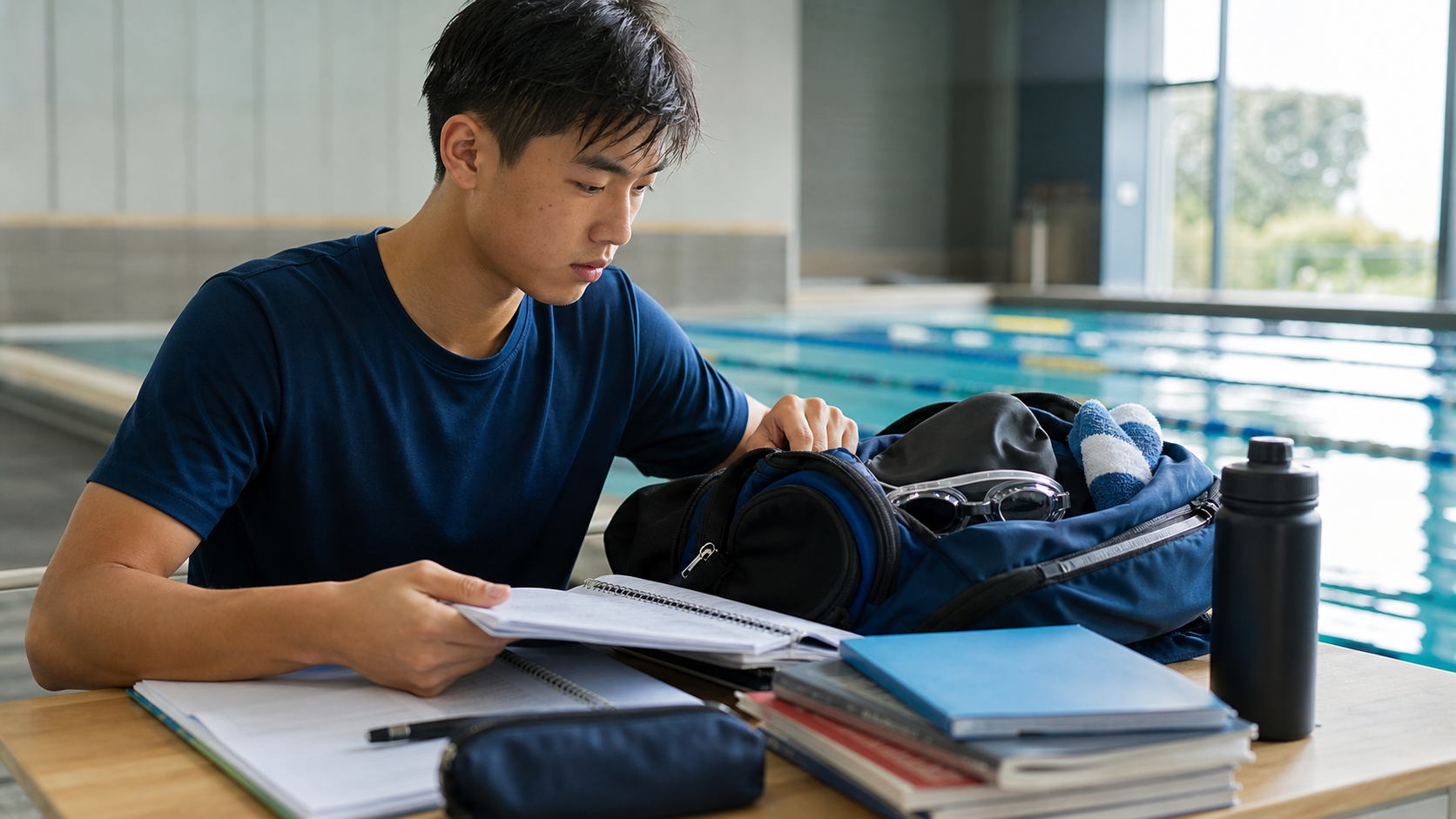
Waking up at 5:30 AM for swim practice, attending school in the morning, returning to the pool from 4 PM to 6 PM, and then coming home to do homework—this is the daily routine for many teenage swimmers in Taiwan. How can one maintain academic performance, preserve physical and mental health, and continue improving competitively within such a demanding schedule? This is not merely a matter of personal willpower; it is a time management skill that requires systematic learning.
Know Your Time: Allocating the 168 Hours in a Week
Everyone has 168 hours in a week. Taking a high school swimmer who trains 15 hours per week as an example, the time allocation looks roughly like this:
| Activity | Hours per Week |
|---|---|
| Sleep (8–9 hours per day) | 56–63 hours |
| School attendance | 35–40 hours |
| Swim training (including travel) | 18–22 hours |
| Meals | 7–10 hours |
| Remaining discretionary time | Approximately 35–50 hours |
This 35–50 hours of discretionary time must cover homework, self-study, socializing, leisure, exam preparation, and necessary physical recovery. A precise calculation of your time makes it clear: there is enough time—the key lies in how you allocate it.
The Key Factor in Academic Performance: Quality Over Quantity
Research shows that the relationship between study efficiency and study hours is not linear—inefficient studying while fatigued is often less effective than short, highly focused sessions. This is especially important for swimmers:
Most effective study windows (in order of priority):
- The 30–60 minutes after morning practice and before school (the brain is activated by exercise, and cognitive performance improves)
- 20–30 minutes during lunch break (light review to reinforce memory consolidation)
- The 1 hour before afternoon practice (during school study hall or the waiting period after classes)
- After evening practice (when fatigued, suitable for light reading or review, not for learning new concepts)
A Practical Time Management System
Weekly Planner: Do It Every Sunday Evening
It is recommended to spend 15 minutes every Sunday evening planning the upcoming week, including:
- Listing all exams and assignment deadlines for the week
- Estimating the preparation hours needed for each subject
- Filling specific study blocks into the schedule (rather than just “study when you have time”)
- Ensuring at least one “protected block” per day (no additional tasks accepted)
Making Use of Fragmented Time
Swimmers have large amounts of “waiting time” every day—waiting for practice to start, commuting, waiting to compete. These scattered moments add up considerably:
- Reviewing vocabulary and formulas: Use mobile apps (such as Anki flashcards) to review while waiting
- Listening to recorded lectures: Record difficult classroom content and listen again during commutes
- Brief meditation: 5 minutes of breathing exercises can help quickly refocus attention between classes
The Swimmer’s Version of the Pomodoro Technique
The traditional Pomodoro Technique (25 minutes of focus + 5 minutes of rest) is particularly effective for swimmers’ evening homework sessions:
- Eat a meal after practice ends (20–30 minutes)
- Start with the most difficult subject (the brain has just been refueled and is relatively alert)
- Give yourself a small reward after each completed Pomodoro session (not involving social media on your phone)
- Set a firm lights-out time at 10:30 PM to protect your sleep
Bridging Communication Between Coaches and School
Many Taiwanese swimmers face a dilemma during exam preparation periods—coaches want to maintain training intensity, while school teachers expect increased academic focus before major exams. Without communication, this dual pressure often leaves athletes performing poorly on both fronts.
Recommended three-way communication practices:
- Notify in advance: Two weeks before midterms or finals, proactively inform your coach of the exam schedule and negotiate a reduced training plan for that period.
- Homeroom teacher’s understanding: Help your homeroom teacher understand your training schedule and seek flexibility on assignment deadlines (within reasonable limits).
- Written records: Maintain a dual-track log of “training diary + study progress sheet” so that if a problem arises in either area, the root cause can be clearly identified.
Sleep: The Most Overlooked Management Variable
For teenage swimmers, insufficient sleep is the single most common cause of decline in both academic and athletic performance. Research shows that sleep deprivation (<7 hours) affects cognitive performance in adolescents similarly to a state of moderate alcohol intoxication.
Practical rules for protecting sleep:
- Maintain a consistent bedtime and wake-up time every day (even on weekends, try to stay consistent)
- Avoid blue-light screens for 1 hour before bed (use night mode or switch to paper materials)
- If you must sacrifice something, sacrifice entertainment rather than sleep
- Allow yourself up to 1 extra hour of sleep on weekends (no more than 2 hours past your weekday wake-up time)
Practical Advice
Weekly action checklist:
- Complete next week’s planner on Sunday evening (15 minutes)
- Confirm the top three priority tasks each morning
- Use a 5-minute mental transition before practice: switch from student mode to athlete mode
- Evaluate academic progress every Friday and adjust next week’s plan
- Review the overall “academics + training” situation with your coach/parents once a month
Mindset reminders:
- Perfectionism is a swimmer’s worst enemy—you don’t need 90+ in every subject; meeting your learning goals is enough.
- Swim training doesn’t require giving 100% in every session—reduced volume and recovery are part of training.
- Fatigue is normal, but if you feel like you “can’t keep going” for two consecutive weeks, that’s a warning sign that adjustments are needed.
Conclusion
Balancing academics and training is a unique challenge for Taiwanese swimmers, and it is also the most important life-skills training ground beyond competition. The core of time management is not “doing more,” but “doing the right things at the right time.” From building a weekly planner, to protecting sleep, to proactively communicating with coaches and school—these habits will have a far more lasting impact on a teenage swimmer’s overall development than any single race result.
Related Reading
- Youth Swimming Competitions: The Impact of Team Training Volume on Academics and Balance Strategies
- Weekly Swimming Fitness Plan: Maximizing the Benefits of Three Sessions for Office Workers
- Backpacks and Sneakers: How Teenagers Balance Academics and Athletic Training
- Swimming Weight Management Program: Calorie Burn and Diet Pairing for 4 Weekly Sessions
live) 超越北高 之一日北高12小時 策略
7 年前
西進武嶺 免費訓練分析服務 Intervals | 練不夠還是練過頭?你哪一種類型選手?AI模型告訴你! | 備戰神器 | 公路車 訓練 | CT Yeh
4 年前
一日北高前的高裝檢 | 北高 360 | 挑戰11小時的裝備 | 一日雙塔 | 補給
6 年前
一日北高 11小時 賽後心得分享篇 | TWB北高360 | 一日雙城 | 單車 | 公路車
6 年前
Live) 備戰2019彰化經典百K 賽前攻略 (已完賽請看新影片
7 年前
一日北高常見問題大集合 | 攻略 | 路線 | 訓練 | 補給 | 自行車 單車 | 一日雙城 | 雙塔 | TWB北高360 | 屁股痛
6 年前
一日北高前的西濱集訓 | 跟著11小時軍團 | 300W踩不動的大逆風 | 輪車破風差幾瓦?
6 年前
2019 夏季KOM 5小 完賽心得 準備攻略 東進武嶺 夏季登山王之路 Taiwan KOM Challenge
7 年前