Introduction
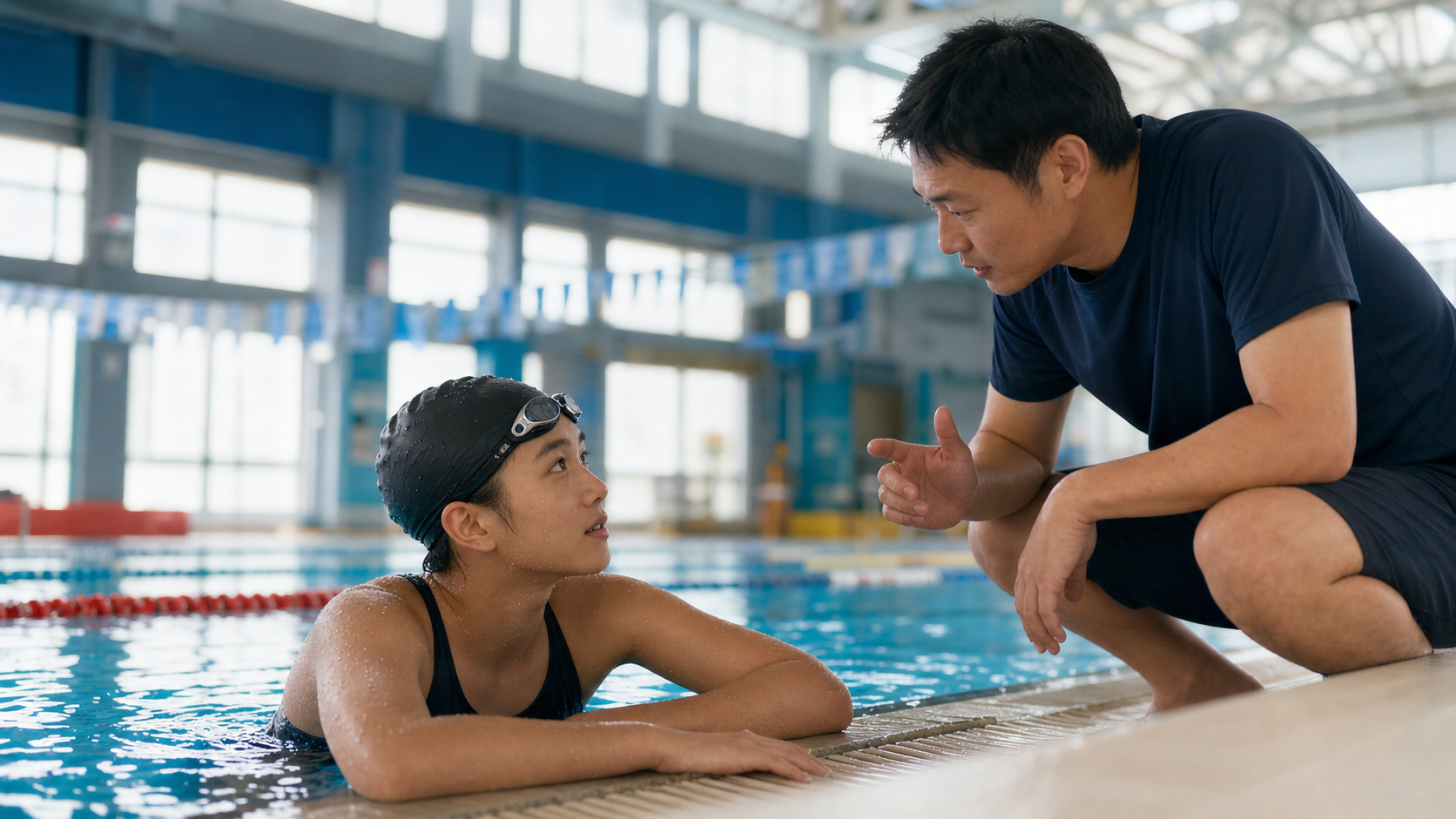
In Taiwan’s swimming community, there is a saying passed among coaches: “Teaching technique is easy; teaching people is hard.” Indeed, with the popularization of sports science, swimming technique instruction has become increasingly systematic, but the coach’s role extends far beyond that. For adolescents, a coach may be one of the most important non-family adult relationships in their lives—a good coach can change a child’s belief in their own abilities, while a wrong coach may cause a promising athlete to leave the sport prematurely.
The Evolving Role of the Modern Youth Swimming Coach
The traditional swimming coach model centers on “technical authority”: the coach shouts commands from the pool deck, athletes execute in the water, and performance is the sole evaluation criterion. However, 21st-century sports science and child development research have shown that this one-way, authoritarian teaching model has significant limitations in adolescent training.
The Multiple Roles of a Modern Youth Swimming Coach:
| Role | Core Function |
|---|---|
| Technical Mentor | Analyzing movements, correcting technical flaws, designing training programs |
| Psychological Supporter | Emotional support, stress management, confidence building |
| Long-term Development Planner | Mapping multi-year training pathways, balancing growth-period needs |
| Parent Communication Liaison | Managing expectations, conveying training goals and progress |
| Role Model | Demonstrating work ethic, resilience, and good character |
Core Competencies of the Technical Mentor
Observation and Diagnostic Ability
An excellent technical coach can quickly identify the root cause of movement issues while an athlete swims, rather than merely seeing surface symptoms. For example:
- Surface symptom: “Ankle eversion during freestyle kick”
- Possible root causes: insufficient ankle joint flexibility / tight hip flexors / kick tempo too fast
Different root causes require different corrective interventions. If a coach only addresses the symptom with a directive (“relax your ankle”) without resolving the root cause, the correction is often short-lived.
Designing Effective Instructional Cues
Research shows that external focus of attention cues are more effective at promoting motor learning than internal focus of attention cues:
- ❌ Internal focus: “Rotate your shoulders” (focusing on the body part itself)
- ✅ External focus: “Let your palm push the water toward your feet” (focusing on the effect on the environment)
This is especially important for adolescent athletes—their ability to comprehend verbal instructions is still developing, so cues should be simple, vivid, and limited to one correction point at a time.
The Science of Training Program Design
A good coach possesses the ability to plan periodized training, enabling them to:
- Adjust the ratio of training volume to intensity across different training phases (foundation, development, competition, recovery)
- Allocate time appropriately between technical and physical training within each session
- Adjust the plan dynamically based on athlete responses, rather than blindly executing a preset schedule
Core Competencies of the Psychological Supporter
Building Psychological Safety
“Psychological safety” refers to the mental state in which athletes feel they can make mistakes, ask questions, and express vulnerability without being judged in the training environment. This is a prerequisite for adolescent athletes to learn fully.
Coach behaviors that build psychological safety:
- The first response to a mistake is analyzing the cause, not emotional criticism
- Encouraging athletes to ask questions (“Where do you think the problem lies?”)
- A supportive attitude during difficult periods (“I believe you are working hard to solve this problem”)
- Modeling a culture in the group where “failure is part of learning”
Recognizing and Responding to Adolescent Emotions
Coaches interact with athletes daily and often observe signs of psychological distress earlier than parents do. The following are common signals of emotional distress in adolescent athletes:
Behavioral changes that warrant attention:
- A sudden, significant drop in training motivation (lasting more than one week)
- Frequent unexplained absences or tardiness
- Loss of enthusiasm for things previously enjoyed
- Significant deterioration in social relationships with teammates
- Noticeable changes in appetite or sleep (as reported by the athlete)
When coaches observe these signals, a recommended response process:
- Create an opportunity for a private conversation (before or after training)
- Ask open-ended questions (“How have you been feeling lately?”) rather than presupposing answers
- Listen rather than immediately offering solutions
- If the issue exceeds the coach’s capacity, communicate with parents and recommend seeking psychological counseling
Challenges and Growth Pathways for Swimming Coaches in Taiwan
Taiwan’s current swimming coach training system is primarily provided through coaching certification courses offered by the Chinese Taipei Swimming Association. However, the existing curriculum focuses mainly on technical instruction, with insufficient emphasis on psychology, child development, and communication skills.
Recommended areas for coaches’ self-directed professional development:
- Adolescent sports psychology (recommended reading: Developing the Young Athlete)
- Positive coaching techniques (Positive Coaching Alliance’s free online resources)
- Communication skills (nonviolent communication, active listening)
- The Long-Term Athlete Development (LTAD) model
Practical Recommendations
Coach self-assessment questions (once per quarter):
- How many athletes dropped out of training mid-season due to burnout or injury in the past quarter?
- How frequently do athletes proactively ask questions during training?
- Are my technical cues primarily external focus or internal focus?
- In the past month, have I had an individual, non-technical conversation with each athlete?
Observation indicators for swimming parents:
- Does your child still talk energetically about what they practiced after training?
- Does your child have a basic sense of trust in the coach (willing to proactively ask the coach questions)?
- Is the coach’s first reaction to your child’s mistakes instructional guidance or emotional criticism?
Conclusion
The improvement of youth swimming standards in Taiwan depends largely on the overall development of the coaching community. Technical ability is certainly important, but the most profound impact of an adolescent swimming coach often comes not from how fast they teach athletes to swim 100m, but from the support and belief they demonstrate during an athlete’s most difficult moments. Only when a coach possesses both technical depth and humanistic care can they truly nurture young athletes who shine both in and out of the pool.
Related Reading
- How Parents Can Effectively Accompany Children Learning to Swim: The Art of Support Without Interference
- Taiwan’s Youth Swimming Training System: Differences Between School Swim Teams and Clubs
- The Development Pathway for Junior High School Swimmers: A Systematic Training Blueprint from Amateur to Elite
- Psychological Development in Adolescent Swimming: Competitive Pressure and Confidence Building
單車AI教練!全新 ChatGPT4o 幫你分析訓練成果!排武嶺課表,分析騎車姿勢! 太神了! / 公路車 / CT Yeh / feat. 緯緯
2 年前
西進武嶺 免費訓練分析服務 Intervals | 練不夠還是練過頭?你哪一種類型選手?AI模型告訴你! | 備戰神器 | 公路車 訓練 | CT Yeh
4 年前
一日北高/長距離團騎 常見問題補充篇 / 組團或跟團的眉角 / 壯車友容易被瘦車友慢性拉爆 / 原來屁股痛可能是這個原因...? / 風場配速法 / 公路車 / CT Yeh
2 年前
CT 喇低賽) 武嶺牽車 才是王道 西進牽車四小時內秘訣 攝手位置 如何判斷 防抽筋小秘訣
7 年前
一日北高常見問題大集合 | 攻略 | 路線 | 訓練 | 補給 | 自行車 單車 | 一日雙城 | 雙塔 | TWB北高360 | 屁股痛
6 年前
滑雪新手們慘摔學習全紀錄(請開字幕),滑雪好好玩 | Snowboard + Ski | 岩原 スキー場 | 滑雪APP使用 | GoPro Max
6 年前
一個測試有沒有認真練車的方法😂 #公路車
10 個月前
單車元宇宙新霸主?TrainingPeaks Virtual 實測 / Zwift 完美平替? 還是超越?/ 有台灣國旗!前身 indieVelo / 公路車 / CT Yeh
1 年前